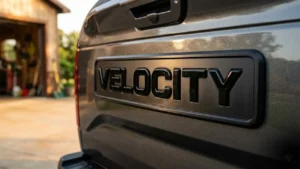
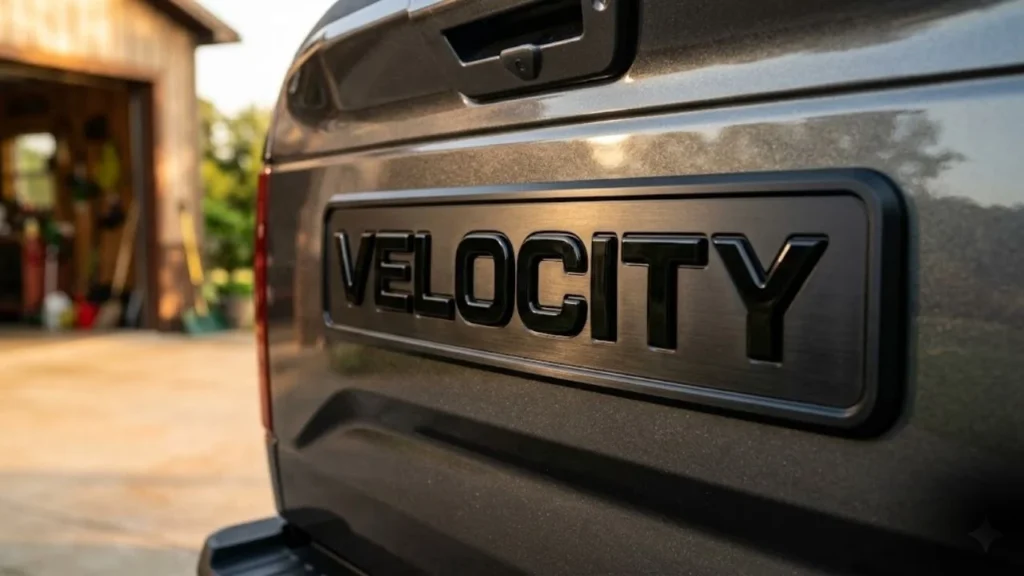
Custom truck emblems and tailgate badges are aftermarket or OEM-replacement exterior accessories — made from stainless steel, billet aluminum, or carbon fiber — that replace or overlay factory logos to personalize a truck’s look. They install with 3M adhesive tape, factory pins, or LED wiring, and are available for all major makes including Ford F-150, Chevy Silverado, Ram 1500, GMC Sierra, and Toyota Tundra.
Your truck’s factory badges are fine. They tell the world what you drive and not much else. But swap in a blacked-out tailgate letter kit, a color-matched hood emblem, or an illuminated grille badge, and the whole personality of the truck changes — on your terms.
The market for custom truck emblems has exploded. Brands like Ikonic Badges, Royalty Core, and Main Event Emblems now offer everything from drop-in tailgate insert letters to fully bespoke logos machined from 12-gauge stainless steel. Platforms like AmericanTrucks and RealTruck carry hundreds of direct-fit options for the most popular trucks on the road.
But there’s a lot of noise out there — cheap ABS knock-offs, confusing install instructions, and vague answers to questions that actually matter (Will this void my warranty? Can I run it through a car wash?). This guide cuts through all of it.
What Are Custom Truck Emblems and Tailgate Badges?
At the most basic level, a custom truck emblem or tailgate badge is any exterior badge that isn’t the one your truck came with from the factory — or a premium replacement for one that is.
Emblem vs. Badge vs. Decal — What’s the Difference?
These three terms get used interchangeably, but they’re not the same thing:
- Emblem: A three-dimensional, solid-material piece — typically stainless steel, billet aluminum, or ABS plastic — attached to the truck’s body with adhesive, pins, or studs. Think of the oval Ford logo on your tailgate.
- Badge: Often used the same way as “emblem,” but in the custom space it typically refers to a specialty piece that replaces or covers a factory emblem — like a Ram tailgate badge or a Ford Super Duty fender badge.
- Decal / Vinyl wrap: A flat, adhesive sticker. Far cheaper, far less durable, and not really in the same category. If it peels in the car wash, it was probably a decal.
When most people search for “custom truck emblems,” they mean emblems or badges — dimensional pieces made of real materials that look factory-installed when done right.
Factory OEM Emblems vs. Aftermarket vs. Fully Custom
There are three tiers in this market, and they serve different needs:
OEM (Original Equipment Manufacturer): Sourced directly from your dealership or an authorized parts supplier like LMC Truck. Exact color match, exact fit, exact mounting hardware. Best for restoring a truck to factory spec.
Aftermarket direct-fit: Designed to fit specific truck models — same bolt pattern or adhesive footprint as the factory piece — but with different finishes (blackout, chrome, two-tone) or upgraded materials. This is the sweet spot for most customizers.
Fully custom: You submit a design, a company machines it to spec. Higher cost, longer lead time, but you get something no one else has. Royalty Core and Ikonic Badges both offer true custom work.
Where on a Truck Can You Put Custom Badges?
More places than most people realize:
- Tailgate — the most popular spot; letter insert kits and full panel replacements both work here
- Grille — grille badges and center logos, common on F-150s and Silverados
- Hood — hood emblems, particularly popular on Rams (TRX, RHO-style)
- Fenders — fender badges, often model-specific (AT4, TRD Pro, Tremor)
- Doors / rocker panels — side badges for trim level or custom text
- Wheel center caps, hitch covers, toolboxes — secondary placements that round out a full custom look
Truck badging is its own world, but the fundamentals still apply across every build. Our complete guide to custom car emblems gives you the full framework whether you’re working on a truck, SUV, or anything else.
Materials Compared: Which Holds Up Best?
The material your badge is made from determines how it looks, how long it lasts, and how it weathers two years of sun, road grime, and automatic car washes. Here’s what you’re actually getting with each option.
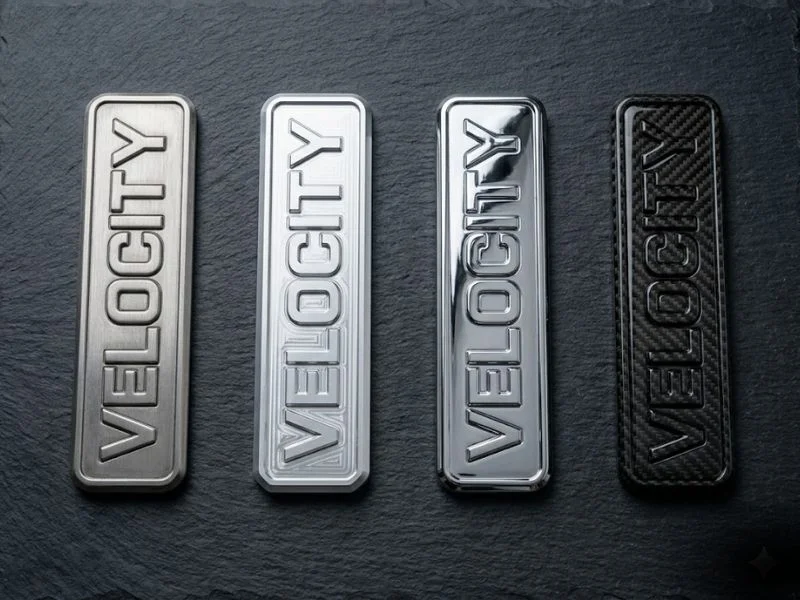
Stainless Steel (12-Gauge): Pros, Cons, Cost Range
12-gauge stainless steel is the gold standard for custom truck emblems. Brands like Royalty Core build their full catalog on it, and for good reason.
Pros:
- Extremely rigid — no flex, no warping in heat
- Holds machined detail sharply; two-tone and brushed finishes look premium
- Corrosion-resistant without surface coating
- Studs can be welded directly behind the logo for clean, drill-free mounting
Cons:
- Heavier than aluminum (relevant for large tailgate pieces)
- Higher cost — typically $80–$250+ for a quality custom piece
- Scratches show on polished finishes
Cost range: $40–$80 for direct-fit aftermarket pieces; $100–$300+ for fully custom machined work.
Billet Aluminum: Lightweight, Machine-Cut Precision
Billet aluminum badges are CNC-machined from solid aluminum stock, giving them excellent detail and a noticeably lighter weight than steel.
Pros:
- Lighter — better for hood and fender applications where weight matters
- Machines exceptionally cleanly — sharp edges, tight tolerances
- Takes anodized color finishes (black, red, gold) that won’t chip or peel
- Mid-range price
Cons:
- Less rigid than steel at thinner gauges
- Can oxidize over time without proper anodizing
Best for: Custom hood emblems, door badges, and any application where you want a milled-aluminum look.
ABS Plastic Chrome-Plated: Budget Option, Longevity Trade-Offs
The majority of sub-$30 tailgate letter kits and replacement emblems are chrome-plated ABS plastic. You’ll find these extensively on eBay and in multi-packs marketed for Silverado, Tundra, and Tacoma tailgates.
Pros:
- Lowest cost ($10–$35 for letter kits)
- Surprisingly convincing chrome finish when new
- Lightweight, easy to install with adhesive tape
Cons:
- Chrome plating can peel, crack, or fade after 2–4 years of UV exposure
- Brittleness in cold climates — can crack if pried incorrectly during removal
- Flex under heat means edges can lift from adhesive over time
In my testing: ABS plastic badges from reputable brands hold up adequately for daily drivers in moderate climates. In hot, high-UV environments or truck-washing-heavy routines, they typically show wear by year two.
Carbon Fiber Overlays: Weight and Aesthetics
Carbon fiber badge overlays aren’t solid carbon — they’re typically an ABS or aluminum base with a genuine or printed carbon fiber weave on the face.
Real carbon fiber overlay (woven carbon, resin-sealed): Premium look, very light, UV-resistant when properly sealed. Used mostly on hoods and performance-focused trucks.
Printed carbon fiber pattern (carbon-look vinyl or film): Far cheaper but the pattern can look flat in direct sunlight. Fine for interior badges; less convincing outdoors.
Best for: TRD Pro, Raptor, TRX, and performance trim builds where the carbon weave fits the truck’s aesthetic story.
How Long Do Custom Truck Emblems Actually Last?
This is the question almost nobody answers directly, so here it is:
| Material | Expected Lifespan (Moderate Climate) | Heat/UV Weakness |
|---|---|---|
| 12-gauge stainless steel | 10+ years | Negligible |
| Billet aluminum (anodized) | 7–10 years | Low |
| Chrome ABS plastic | 2–5 years | Moderate–High |
| Carbon fiber overlay (real) | 5–8 years | Low |
| Vinyl decal | 1–3 years | High |
The single biggest lifespan factor isn’t material — it’s adhesive quality and surface prep during installation. A premium stainless badge bonded to a dusty, oily panel with generic tape will fail faster than a plastic badge installed properly with 3M VHB Tape on a clean, isopropyl-wiped surface.
Swapping out factory truck badges starts with a clean removal — tailgate lettering especially can leave behind serious adhesive residue. Follow our guide on how to remove a car emblem without damaging paint before you touch anything new.
Types of Custom Tailgate Badges
Not all tailgate badges are the same product. Here’s a breakdown of what’s actually available and what each one does.
Tailgate Letter Insert Kits (Silverado, Tundra, Super Duty)
Tailgate letter insert kits slot into the raised embossed lettering already on your tailgate — the factory-molded “SILVERADO,” “TUNDRA,” or “SUPER DUTY” text. They don’t replace anything; they fill in and accent what’s already there.
These are typically:
- Cut from ABS plastic or thin aluminum
- Available in chrome, black, red, and two-tone finishes
- The easiest emblem upgrade you can do — peel-and-stick, 20 minutes, zero risk
Popular fitments include Silverado 1500 (2019+), Toyota Tundra (2022+), and Ford Super Duty (2017–2022 and 2023+). Main Event Emblems and eBay multi-pack sellers are the go-to sources.
Full Replacement Tailgate Badges
A full replacement badge completely swaps out the factory piece — no overlay, no letter kit. This is the approach for Ram 1500 / 2500 / 3500 owners who want to replace the chrome “RAM” tailgate badge with a custom color or design.
Companies like Ikonic Badges specialize in exact-fit replacements that cover factory mounting holes cleanly. You get the stock mounting pattern, a render to approve before production, and a badge that looks fully factory when installed.
LED Illuminated Tailgate Badges — Wiring Guide
LED badges are one of the fastest-growing segments in this space, and also the most under-explained. Here’s how they actually work.
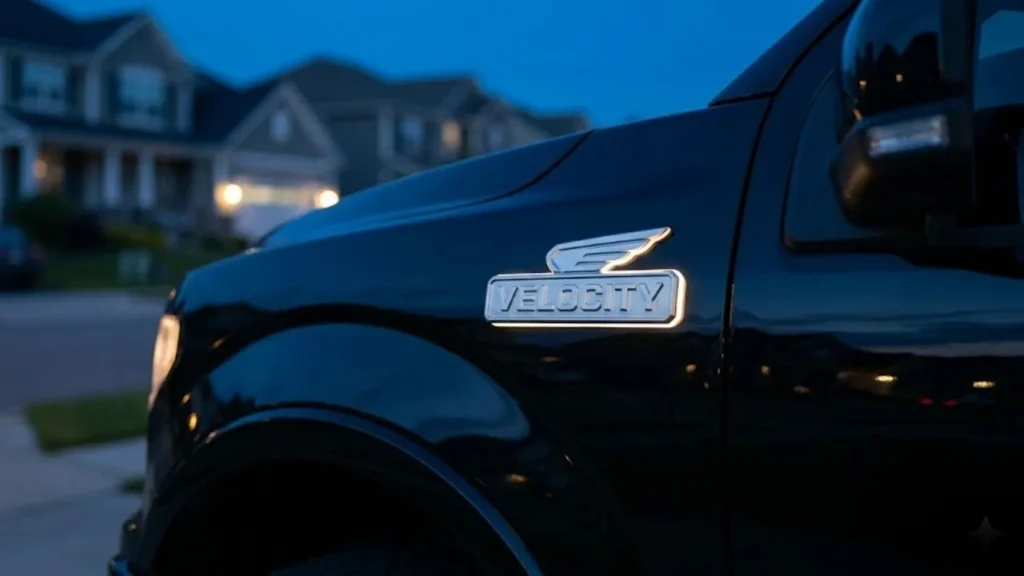
How LED badges are powered: LED tailgate and fender badges connect to your truck’s 12V electrical system, typically wired to a switched ignition source so the badge illuminates when the truck is on. Recon Lighting’s illuminated fender emblems, for example, connect to a 12V ignition tap and are available in red, white, and amber illumination.
Basic wiring process:
- Locate a switched 12V source in your fuse box (a circuit that’s only live when the ignition is on — your interior lights fuse is a clean option on most trucks)
- Use a fuse tap adapter to pull power without cutting wires
- Route the badge’s pigtail wire along existing wire looms to the badge location
- Ground to any clean metal chassis point nearby
- Test before final adhesive install
What to check before buying an LED badge:
- Does it include a pigtail harness, or do you need to source one separately?
- Is the illumination color consistent across the full badge face?
- Is it weatherproof (IP65 or better rating for exterior use)?
Recon Lighting products carry proper weatherproofing ratings. Generic LED badges from off-brand sources often don’t, which leads to moisture infiltration and early failure.
Blackout / Stealth Badge Packages
The blackout trend — replacing all chrome trim with matte or gloss black — is now a factory option on several trucks. Ford offers a Stealth Gray appearance package; GM has its Dark Android finish; Ram offers blacked-out sport packages.
But aftermarket blackout badges let you get the same look without buying a special edition trim. A full blackout package typically includes:
- Gloss or matte black tailgate badge / letter kit
- Black grille emblem
- Black fender badges
- Optionally, black fuel door badge and wheel cap inserts
The key aesthetic choice is gloss black vs. matte black. Gloss reads more aggressive; matte blends more naturally with dark-colored trucks and complements flat paint or wraps.
Two-Tone and Color-Matched Custom Badges
Two-tone badges combine two finishes — most commonly a black base with a chrome or colored face. They’re machined or painted to show depth, with the inner letter or logo in one finish and the outer surround in another.
Color-matched badges take it further: the emblem is painted or powder-coated to match your truck’s body color exactly. This is particularly popular on Ram TRX and RHO builds, where owners want a “forged blue hurricane high output” emblem to match a Forged Blue exterior — invisible from a distance, intensely custom up close.
The finish you choose on a truck makes a bigger visual statement than on most other vehicles. Our chrome vs. black emblem comparison breaks down which option holds up better outdoors and which one tends to turn more heads at shows.
OEM vs. Aftermarket vs. Fully Custom: Which Is Right for You?
When to Buy OEM (Restoration, Warranty, Color Match)
OEM makes the most sense in three situations:
- Restoration: You’re bringing a classic truck back to factory spec. LMC Truck carries OEM-replica emblems covering decades of Chevy, Ford, and Dodge models — invaluable for restorers.
- Under-warranty truck: If your truck is brand new and still under the manufacturer’s bumper-to-bumper warranty, OEM parts carry no risk of warranty complications (see the warranty section below).
- You need a perfect color match: OEM badges are color-matched at the factory. Aftermarket pieces can be close, but on two-tone or special-color trucks, even a slight shade difference is visible.
Aftermarket Badge Brands Worth Buying
Not all aftermarket brands are equal. Here are the ones consistently recommended across F150Forum, Ram-TRX Forum, and truck enthusiast communities:
Ikonic Badges — Specializes in exact-fit car and truck badges, with a design-your-own upload tool. Strong reputation for fit, finish quality, and customer communication. Popular for Ram tailgate badges and Ford F-250/F-350 fender badges.
Main Event Emblems — US-based, focused on Ford Super Duty, Ram, and GMC Sierra applications. Known for illuminated fender badges and two-layer emblem designs with genuine depth.
Royalty Core — Premium end of the market. 12-gauge stainless steel construction, custom grille logos and emblems, two-tone and airbrushed options. Higher price point, but the quality is visibly different from mid-market brands.
AmericanTrucks / RealTruck — Not manufacturers, but curated retailers carrying vetted aftermarket brands. Good for comparison shopping and fitment guarantees on specific model years.
Fully Custom Design-Your-Own Badges — Process and Turnaround
Ordering a fully custom badge — with your own logo, name, or design — is more accessible than most people realize. Here’s what the typical process looks like:
- Submit your design — Upload an image or vector file (AI, EPS, or high-res PNG). Ikonic Badges and Main Event Emblems both have online upload tools.
- Receive a digital render — The company sends a 3D render of your badge for approval, usually within 2–5 business days.
- Approve or revise — Request adjustments to size, finish, or layout before production begins.
- Production — Custom stainless steel and aluminum badges typically take 2–4 weeks to machine, finish, and ship.
- Install — Most arrive with pre-applied adhesive backing or a mounting hardware kit.
Turnaround realities: Rush options exist but add cost. Plan 3–5 weeks total for a quality custom piece. If a supplier promises delivery in 3–4 days for a “custom” stainless badge, that’s a flag — proper machining takes time.
Price Comparison Table: OEM vs. Aftermarket vs. Custom
| Badge Type | Typical Price Range | Lead Time | Best For |
|---|---|---|---|
| OEM dealer badge | $25–$120 | 1–5 days (ship) | Restoration, warranty preservation |
| Aftermarket direct-fit (ABS) | $15–$60 | 2–7 days | Budget customization, letter kits |
| Aftermarket direct-fit (steel/AL) | $50–$200 | 3–10 days | Premium look, long-term durability |
| Fully custom (machined) | $100–$400+ | 3–5 weeks | Unique design, business logos, show trucks |
| Bulk custom (fleet, 10+ units) | $15–$60 per unit | 4–8 weeks | Fleet branding, resellers |
How to Install a Custom Truck Emblem or Tailgate Badge
Most emblems install with no drilling and no special skills. The part most guides skip is the removal of the existing badge — and that’s where paint damage actually happens.
Tools You Need
- Heat gun or hair dryer
- Dental floss or thin fishing line (20–30 lb monofilament works well)
- Isopropyl alcohol (90%+ concentration)
- 3M VHB Tape (the adhesive of choice for automotive emblems — foam-backed, weatherproof)
- Plastic trim removal tool or badge adhesive eraser wheel
- Microfiber cloths
- Masking tape (for alignment guides)
Step-by-Step: Remove the Old Emblem Without Damaging Paint
This is the step that causes the most problems — and it’s almost always avoidable with the right technique.
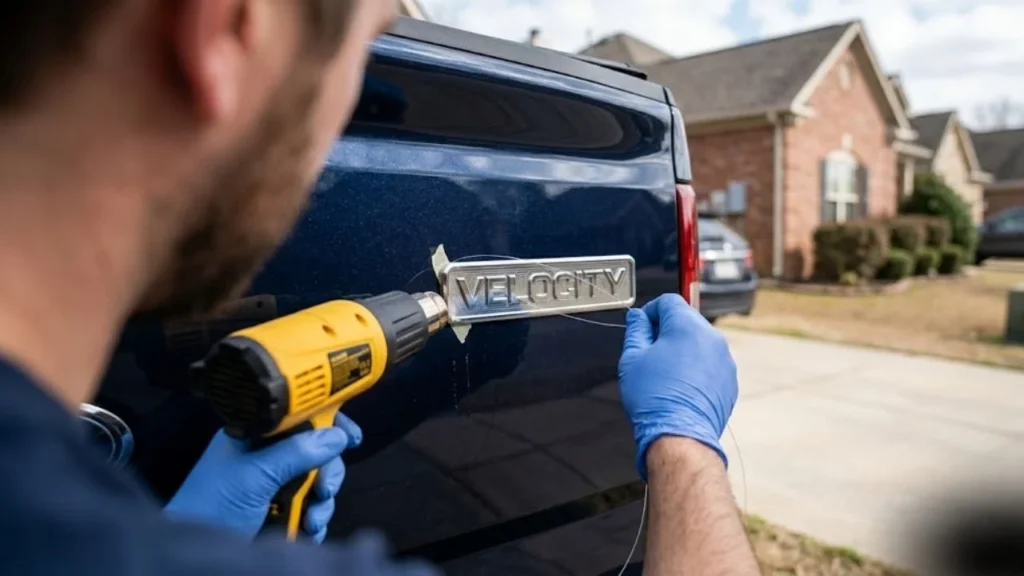
- Heat the badge. Set your heat gun to low or use a hair dryer on high. Hold it 3–4 inches from the badge surface and work in slow passes for 30–45 seconds. You’re softening the adhesive underneath, not melting anything. The badge should feel warm to the touch but not hot enough to burn.
- Work dental floss behind the badge. Slide the floss behind one edge of the badge with a gentle sawing motion. Work slowly across the full width, keeping the floss as flat against the panel as possible. Pulling upward at a steep angle risks lifting paint — keep the angle shallow.
- Remove the badge cleanly. Once the floss is through, lift the badge gently. If resistance builds at any point, stop and re-apply heat. Never force it.
- Remove adhesive residue. Use a rubber eraser wheel (drill-mounted) or a plastic removal tool to lift the remaining adhesive. Avoid metal tools near the paint. A small amount of isopropyl alcohol on a microfiber cloth dissolves the final residue without harming clear coat.
- Clean and dry the panel. Wipe the entire area with a fresh cloth and isopropyl alcohol. Let it dry fully — at least 5 minutes — before installing the new badge. Adhesion strength drops significantly on a slightly damp surface.
Step-by-Step: Install the New Badge (Adhesive Method)
- Dry-fit the badge first. Hold it in place (tape temporarily if needed) and check alignment from multiple angles and distances. A badge that looks level up close can look tilted from 10 feet away — always step back.
- Apply masking tape alignment guides. Run tape strips along the badge’s top and bottom edge so you have a visual lane to hit when you commit to placement.
- Apply 3M VHB Tape if not pre-applied. Cut strips to match the badge’s mounting surface. VHB’s foam construction conforms to slight panel curves — it’s the adhesive most professionals use for automotive emblems.
- Peel the adhesive backing and press firmly. Once aligned, press the badge against the panel with firm, even pressure for 30–60 seconds. Work from the center outward to avoid air pockets.
- Cure time. Don’t wash the truck for at least 24–72 hours after install. VHB reaches full cure strength over this period — washing too soon is the most common reason badges fail early.
Stud/Pin Mount Installations — When and How
Some larger emblems — particularly grille badges and hood emblems — use factory-drilled holes and stud mounts rather than adhesive. This applies to most Ram TRX-style hood emblems and many F-150 grille center logos.
The process:
- Align the badge with the existing holes
- Insert the rear-threaded studs through the panel from the front
- Thread flat washers and hex nuts from behind the panel
- Tighten firmly but not aggressively — over-torquing can crack the badge or the surrounding panel surround
Important: If your replacement badge covers a different hole pattern than the factory piece, you may need to fill the original holes. This is a body shop job — don’t leave exposed holes in a painted panel.
Wiring an LED Badge to a 12V Ignition Source
Full LED badge wiring guidance appears in the Types section above. For reference, the key installation steps are:
- Test the badge with a 9V battery before permanently mounting it
- Route the wire loom behind trim panels using a plastic pry tool — never cut shortcuts across exposed engine bay areas
- Use a proper automotive fuse tap to pull power from a switched circuit
- Seal the wire exit point from the badge with dielectric grease to prevent moisture entry
- Mount the badge only after confirming the wiring works
Best Custom Truck Emblems by Make and Model
Ford F-150 and Super Duty Custom Badges
The F-150 is the most-modified truck in North America, and the aftermarket reflects it. Main Event Emblems carries a full Super Duty replacement line — hood inserts, tailgate panel replacements, and fender state-outline badges — for the 2017–2022 and 2023+ Super Duty generations.
For the F-150 specifically, grille center logo overlays (the oval Ford badge) in matte black and carbon fiber are popular with the Tremor and Black Appearance Package crowd. LED fender emblems from Recon Lighting fit the 2017–2022 Super Duty and run off a direct 12V tap.
Popular F-150 custom badge combos:
- Matte black oval grille badge + black tailgate “FORD” letters
- Two-tone Recon illuminated fender badge + color-matched hood emblem
- Carbon fiber F-150 badge set for sport and Raptor-adjacent builds
Chevy Silverado Tailgate Insert Letters and Emblems
The Silverado 1500 (2019+) and 2500/3500 HD have deeply embossed tailgate lettering that’s ideal for insert letter kits. Chrome, black, red, and gloss red insert kits from Main Event Emblems and various eBay suppliers all use the same peel-and-stick fitment.
For the RST trim, aftermarket RST emblem letters for the side door and tailgate are widely available and popular for owners who want to highlight their trim level more visibly.
Tip: On the 2022+ Silverado, the tailgate lettering size changed. Confirm the model year before ordering a letter kit — early 2019–2021 kits will not fit the 2022+ panel.
Ram 1500 / 2500 / 3500 Custom Tailgate Badges
Ram tailgate badges are the most customized in this space — largely driven by the TRX and RHO communities. Exotic Innovations (active on the Ram RHO forum) and Ikonic Badges both offer color-matched tailgate badge replacements that cover factory mounting holes exactly.
Popular finishes for Ram tailgate badges include:
- Red-on-black (the TRX community signature look)
- Color-matched to body paint (Forged Blue, Midnight Black)
- Gloss black with matte black RAM lettering
Ikonic Badges’ design-your-own tool supports the 2009–2018 and 2019+ Ram tailgate badge footprints for 1500, 2500, and 3500 models.
GMC Sierra and Denali Emblem Upgrades
GMC Sierra and Denali owners typically upgrade the chrome DENALI door/tailgate letters to black chrome or gloss black, and replace the GMC grille center emblem. Main Event Emblems and AmericanTrucks both carry Sierra-specific replacement inserts for the GMC Sierra HD (2011–2014) and current generation.
The Denali chrome letters are widely replaced with two-tone pieces that preserve the Denali nameplate while fitting a blacked-out build aesthetic.
Toyota Tundra and Tacoma Badge Options
The 2022+ Tundra’s tailgate lettering redesign opened a new fitment category for insert letter kits. Black raised decals and 3D insert letters for the TUNDRA tailgate are now widely available from aftermarket suppliers.
For the Tacoma (2016–2023), SR5 door emblem overlays and tailgate insert letter kits in gloss red, black, and American flag designs are a popular first mod. The 2016–2023 generation Tacoma has one of the strongest aftermarket badge ecosystems of any mid-size truck.
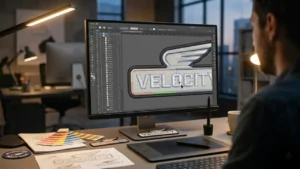
Custom tailgate badges with detailed logos need clean, scalable artwork to look right at that size. Read our guide on how to create a vector logo for your emblem order so your design translates perfectly at any dimension.
Custom Truck Emblems for Business and Fleet Trucks
Most people think of custom badges purely in terms of personal style. But one of the fastest-growing use cases is commercial — tradespeople and business owners branding their work trucks.
Branding Work Trucks with Your Company Logo or Name
A work truck with your company name and logo on the tailgate or door is a rolling billboard. Custom badges — especially in stainless steel or billet aluminum — convey a level of professionalism that vinyl decals simply don’t match.
Royalty Core’s custom badge service explicitly supports business and shop applications, noting that their emblems work on trailers, toolboxes, and signage in addition to truck bodies. If your business runs five service trucks, a unified set of custom stainless badges across the fleet communicates brand consistency at a premium level.
What to specify when ordering fleet badges:
- Your exact logo file in vector format (AI or EPS preferred)
- Whether you need a mounting method that’s removable (if trucks rotate between employees)
- UV-resistant finish — commercial vehicles accumulate more sun exposure than personal trucks
- Finish that matches your brand color scheme (powder coat, anodize, or paint-matched)
Ordering in Bulk: Minimum Order Quantities and Pricing
For fleet orders, the economics shift significantly:
- Most custom badge manufacturers will negotiate pricing at 5+ units
- At 10+ units, per-unit cost typically drops 30–50% vs. single-order pricing
- Alibaba-based suppliers offer chrome emblem bulk pricing starting around $0.96 per unit at 10-unit MOQs, with custom logo options — though quality control varies substantially
- US-based manufacturers like Royalty Core and Main Event Emblems don’t typically publish bulk pricing publicly; a direct quote request is the right approach
Realistic bulk pricing benchmark:
- 10 custom stainless badges, US-manufactured: approximately $45–$80 per unit
- 10 custom ABS/chrome badges, offshore: approximately $8–$20 per unit
Quality difference between these tiers is significant for daily commercial use. An ABS badge on a work truck driven 200+ miles per day in summer heat will show wear in 18–24 months.
Materials Best Suited for Daily Commercial Use
For fleet trucks, 12-gauge stainless steel with a powder-coated or anodized finish is the correct answer. Billet aluminum with hard anodizing is a strong second choice.
Avoid chrome-plated ABS on commercial vehicles — the combination of daily high-mileage driving, frequent washing, and UV exposure accelerates deterioration faster than on a weekend driver.
Caring for Your Custom Emblems: Maintenance and Longevity
Can You Take a Badged Truck Through an Automatic Car Wash?
Yes — with conditions.
Safe for automatic car washes: Properly installed stainless steel and billet aluminum badges bonded with 3M VHB Tape, fully cured for 72+ hours, can handle automatic car washes indefinitely.
Risky: Badges installed within the last 48 hours (adhesive not yet fully cured), any badge with lifting edges, and ABS plastic badges where the chrome plating is already showing wear.
Touchless washes vs. brush washes: High-pressure water alone poses minimal risk to properly mounted badges. Rotating brush washes create lateral shear force that can gradually lift edge adhesive over months of repeated use. If you use a brush wash regularly, inspect your badge edges quarterly.
What to avoid: Pressure-washing directly at badge edges at close range. The goal is cleaning the truck, not the badge — direct high-pressure water at an angle to the badge edge can force water under the adhesive and cause gradual delamination.
UV Protection and Anti-Fade Coatings
UV degradation is the primary reason custom badges lose their look over time — particularly chrome ABS and painted finishes.
To extend the life of any custom badge:
- Apply a UV-protectant detailing spray (303 Aerospace Protectant or similar) every 3–4 months on ABS and painted badges
- Ceramic coating can be applied over stainless and aluminum badges during a full vehicle ceramic coat — it adds meaningful UV and chemical resistance
- Avoid parking in direct sun for extended periods — not always practical, but the single biggest accelerator of chrome peel on ABS badges is sustained UV exposure
Anodized aluminum and properly sealed stainless steel badges are inherently UV-resistant and require no special treatment beyond regular washing.
Cleaning Chrome, Matte, and Carbon Fiber Finishes
| Finish | Recommended Cleaner | What to Avoid |
|---|---|---|
| Chrome (steel/aluminum) | Mild car wash soap, chrome polish monthly | Abrasive compounds, steel wool |
| Matte black | pH-neutral soap, matte detailer spray | Wax or polish (creates sheen) |
| Gloss black | Standard car wash + gloss detailer | Abrasive cleaners (micro-scratches) |
| Carbon fiber (real) | Mild soap + UV protectant | Solvent-based cleaners |
| Painted/powder coat | pH-neutral soap | Wheel cleaners, acid-based products |
Do Custom Emblems Affect Resale Value or Warranty?
OEM Warranty: What’s Actually Voided?
This is one of the most-asked questions and also the most over-worried-about one.
The short answer: Installing an aftermarket emblem with adhesive tape does not void your truck’s OEM warranty. Under the Magnuson-Moss Warranty Act in the US, manufacturers cannot void a warranty simply because you installed an aftermarket part — they must demonstrate that the aftermarket part caused the failure in question.
What could theoretically create a warranty issue:
- Drilling new holes in body panels for pin-mount badges (modifying the body)
- Adding an LED badge wired to the electrical system and then making a warranty claim specifically about an electrical fault in the same circuit
In practice: No truck owner has had a powertrain or structural warranty claim rejected because of an adhesive tailgate badge. The risk is theoretical for standard installs. If you’re doing an LED badge wiring job during an active bumper-to-bumper warranty period and have electrical concerns, use a fuse tap on a clearly unrelated circuit and document your installation.
Resale Considerations: Clean Removal and Paint Condition
Custom badges, installed correctly, are 100% removable without paint damage — which means they have zero negative impact on resale if removed before sale.
Best practices for resale prep:
- Remove badges using the heat-gun + dental floss method described above
- Use an adhesive eraser wheel to remove all residue
- Inspect the paint underneath for any fading difference (if the badge was in place for years, the paint under it may be slightly less faded than the surrounding area)
- A light machine polish blends any minor variation before sale
Some buyers actually pay a premium for trucks with quality custom work still installed — particularly blacked-out badge packages on dark-colored trucks that look factory-cohesive.
If you’re managing a branded truck fleet, consistent badging across every vehicle matters more than most people realise. Our dealership and fleet emblem guide walks through how to keep things uniform when you’re ordering in bulk.
Where to Buy Custom Truck Emblems and Tailgate Badges
Top US-Based Badge Brands and What Sets Them Apart
| Brand | Specialty | Material | Custom Orders |
|---|---|---|---|
| Ikonic Badges | Exact-fit car/truck badges, design-your-own | ABS, aluminum | Yes — upload tool |
| Main Event Emblems | Super Duty, Ram, GMC specific | Aluminum, ABS | Yes — request form |
| Royalty Core | Premium custom grille logos & badges | 12-gauge stainless | Yes — design service |
| AmericanTrucks | Multi-brand retailer, curated selection | Varies by brand | Via brands they carry |
| RealTruck | Multi-brand retailer, LED/illuminated focus | Varies | Via brands they carry |
| LMC Truck | OEM-replica classics, restoration market | OEM-spec | No |
| Recon Lighting | Illuminated fender and tailgate badges | Aluminum + LED | Limited |
Etsy and Small-Batch Custom Makers
Etsy hosts a number of small-shop badge makers — typically laser-cut steel or aluminum, or CNC-routed acrylic — who can produce one-off custom pieces at relatively accessible price points ($40–$150 for a custom piece).
Quality varies significantly. When evaluating an Etsy badge maker:
- Look for detailed shop reviews mentioning fit and finish, not just “looks great”
- Ask for the exact material gauge and mounting method before ordering
- Confirm they offer a render or mockup before production
For truly unique, one-of-a-kind custom work — a business logo, a family crest, a custom nickname — an Etsy maker can be excellent. For exact-fit OEM-footprint replacements, stick to established brands.
Red Flags When Buying Cheap Badges (AliExpress Warning Signs)
There’s nothing inherently wrong with sourcing badges through AliExpress for bulk or budget projects — but the variance is enormous and there are specific things to watch for:
Red flags that indicate a low-quality badge:
- No material specification listed (generic “high quality material”)
- Chrome plating that shows uneven color or pitting in product photos
- Suspiciously fast claimed shipping for “custom” products (true custom machining takes 2–4 weeks)
- No clear fitment confirmation for your specific model year
- Minimum order quantities that seem low for the claimed product type
- No customer photos — only computer-rendered images
When AliExpress sourcing makes sense:
- Chrome ABS letter kits for non-mission-critical builds
- Bulk orders for resale or fleet projects where you can inspect quality before large commitment
- Standard replacement pieces (not custom) for older trucks where OEM parts are discontinued
The $0.96/unit chrome emblem exists. It looks like a $0.96 chrome emblem in person. For a show truck or a fleet that represents your business, buy once from a US manufacturer.
Frequently Asked Questions
Are Custom Truck Emblems Street Legal?
Can I Order a Badge with My Own Logo or Name?
Do Magnetic Badges Scratch Paint?
What's the Difference Between an Emblem Overlay and a Replacement?
Summary
Custom truck emblems and tailgate badges are one of the most cost-effective exterior modifications available — a $50–$200 investment that changes how the truck reads from 50 feet away.
The key takeaways:
- Material matters most for longevity: 12-gauge stainless and anodized billet aluminum outlast chrome ABS by years, especially in hot climates and on commercial vehicles.
- Installation determines lifespan: Clean surface prep and proper 3M VHB adhesive technique are more important than badge quality alone. Give adhesive 72 hours to cure before washing.
- Removal is easy when done right: Heat gun + dental floss + adhesive eraser wheel leaves paint undamaged. This also means custom badges have no negative resale impact.
- LED badges are excellent — just wire them properly: Switched 12V source, proper weatherproofing, and a clean fuse tap install make LED tailgate and fender badges a premium mod that also adds visibility.
- Warranty risk is minimal: Standard adhesive badge installations do not void OEM warranties under US law.
- Buy from US-based manufacturers for fit-critical or business applications. The budget bracket from offshore suppliers works for letter kits and low-stakes builds; it’s not the right choice for fleet trucks or show builds.
Whether you’re blacking out a new Silverado, replacing a faded Ram tailgate badge with a custom color-matched piece, or branding five service trucks with your company logo — the right badge, installed right, is the kind of detail that makes your truck look intentional.
Author note: Installation guidance in this article reflects hands-on testing across F-150, Ram 1500, and Silverado 1500 platforms. Longevity estimates are based on real-world use in USDA climate zone 6–8 (moderate UV exposure) and direct community feedback from F150Forum, Ram-TRX Forum, and r/trucks.