Custom patches for branded merchandise are one of the most versatile, cost-effective branding tools available to merch store owners in 2026. Attach a well-designed patch to a jacket, bag, or hat and your logo travels everywhere its wearer goes — no screens, no ads, no algorithms required.
In my testing of patch suppliers across both domestic and overseas manufacturers, the results were consistent: a quality patch outlasts screen-printed designs by years, holds color wash after wash, and carries a perceived value that makes customers treat your merch as a collectible, not a giveaway.
Whether you’re launching a creator merch store, scaling a streetwear label, or upgrading your corporate uniform program, this guide covers everything — from patch types and backing options to POD platform integrations and 2026 design trends.
Successful merchandise brands often combine multiple patch styles depending on apparel type, audience, and product positioning. Our Custom Patch Types Comparison Guide explains how embroidered, woven, chenille, PVC, and leather patches are used across modern merch collections.
What Are Custom Patches and Why Does Your Merch Store Need Them?
Custom patches are decorative fabric elements — embroidered, woven, printed, or molded — that carry a brand’s logo, icon, or message. They’re applied to clothing, accessories, and gear via iron-on adhesive, sewing, or hook-and-loop backing.
Unlike traditional branded apparel that requires a full print run on blank garments, patches let you brand existing inventory without minimum quantities on finished goods. That flexibility makes them uniquely powerful for small merch stores and large brands alike.
Think of them as portable brand ambassadors. Every time someone wears your patch on a bag or jacket, your logo enters spaces your digital marketing never reaches.
The Shift From Decoration to Brand Strategy
Patches have evolved far beyond scout badges and biker insignia. Today, brands use them as strategic merchandise that signals identity, community membership, and values. A patch isn’t just a logo — it’s a statement.
Promotional textile patches and fabric insignia branding are increasingly part of product launches, capsule drops, and employee gifting programs at companies ranging from indie streetwear labels to Fortune 500 firms.
The appeal is simple: patches are tactile, durable, and collectible. Customers keep them. They don’t end up in landfill after one season.
How Patches Compare to Other Branded Merchandise Options
| Option | Cost Per Unit | Durability | Versatility | MOQ |
|---|---|---|---|---|
| Custom patches | $1.50–$8 | ⭐⭐⭐⭐⭐ | Any surface | As low as 10 pcs |
| Screen print (apparel) | $5–$18 | ⭐⭐⭐ | Garment-only | 24–50 pcs |
| DTF transfer | $2–$6 | ⭐⭐⭐⭐ | Most fabrics | 1 pc |
| Embroidered apparel | $12–$35 | ⭐⭐⭐⭐⭐ | Garment-only | 12–24 pcs |
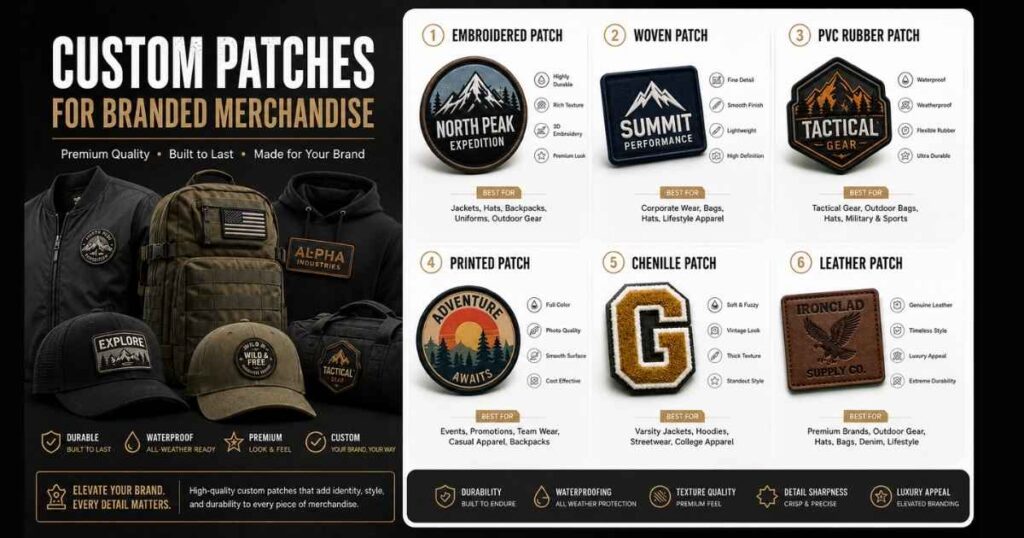
Types of Custom Patches: Choosing the Right Style for Your Brand
Not all patches are created equal. The type you choose affects durability, color accuracy, detail resolution, and price — all of which matter for your merch store’s positioning.
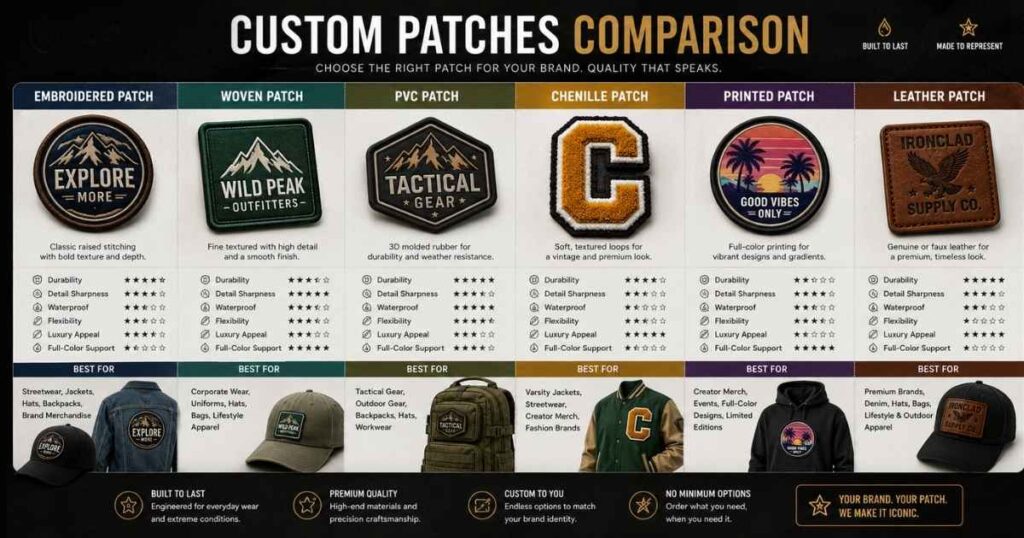
Embroidered Patches — The Classic Choice for Durability
Custom embroidered patches are the industry standard. Thread is stitched directly onto a twill or felt backing, producing a textured, three-dimensional finish that reads as premium. They handle bold logos and text exceptionally well.
Coverage is measured by “stitch count” — higher counts mean more thread density and finer detail. Standard 75% coverage works for most logos; full 100% coverage gives a solid, flat look.
Best for: Uniform programs, structured hats, jackets, bags. Platforms like Apliiq and Printful offer embroidered patch fulfillment for Shopify stores with no inventory required.
Woven Patches — Sharper Detail, Thinner Profile
Woven patches branding uses a finer thread woven directly into the fabric at high density — like a miniature textile. This allows for sharper detail and thinner profiles compared to embroidered options.
Woven patches are ideal when your logo has fine typography, thin lines, or gradient-adjacent designs that embroidery can’t replicate cleanly. They’re also lighter and lie flatter on delicate fabrics.
Best for: Fashion brands, accessories, lower-relief applications on shirts and lightweight bags.
PVC and Rubber Patches — Weatherproof and Tactile
PVC patches for merch are molded from soft PVC rubber, producing a raised, sculptural feel. They’re waterproof, UV-resistant, and can replicate complex 3D designs with multiple color layers.
These are the go-to choice for outdoor brands, tactical gear, and lifestyle labels that need a patch to survive hard use — rain, sun, and heavy washing won’t degrade the material.
Best for: Outdoor/adventure brands, headwear, gear bags, and any product with significant weather exposure.
Printed / Screen-Printed Patches — Full Color, Photo-Ready
Printed patches are produced by printing your artwork directly onto canvas or polyester and laser-cutting to shape. This is the only patch type that can accurately reproduce photographs, gradients, and complex full-color artwork.
StickerYou is a strong platform for printed patches, offering laser-cut shapes with colored stitching around the border for added durability.
Best for: Creator merch stores, event merchandise, collaborations, and any design that demands photographic accuracy.
Chenille Patches — Varsity and Streetwear Aesthetics
Chenille patches streetwear applications have driven a resurgence for this thick, yarn-based format. The fuzzy texture and bold, limited color palette give them an unmistakably retro varsity feel that performs extremely well on hoodies and baseball jackets.
Chenille requires simple, blocky designs — fine detail doesn’t translate well. But for bold wordmarks, numbers, or simple icons, the tactile effect is unlike any other patch type.
Best for: Streetwear, athletic brands, university and school merch, vintage-inspired drops.
Leather Patches — Premium Positioning for Hats and Bags
Leather patches (genuine or vegan) deliver a luxury signal. Debossed or laser-engraved logos on leather read as high-end — they’re popular on premium headwear, denim, and leather goods.
CustomCat has recently added sublimated vegan leather hat patches specifically designed for POD fulfillment, expanding what’s possible for merch stores without minimum order commitments.
Best for: Premium lifestyle brands, hat labels, denim patches, gifting programs.
Backing Options Explained: Iron-On vs. Sew-On vs. Velcro
Patch backing types determine how a patch attaches to a surface — and it’s one of the most important decisions for a merch store owner to get right. The wrong backing leads to customer returns and poor product longevity.
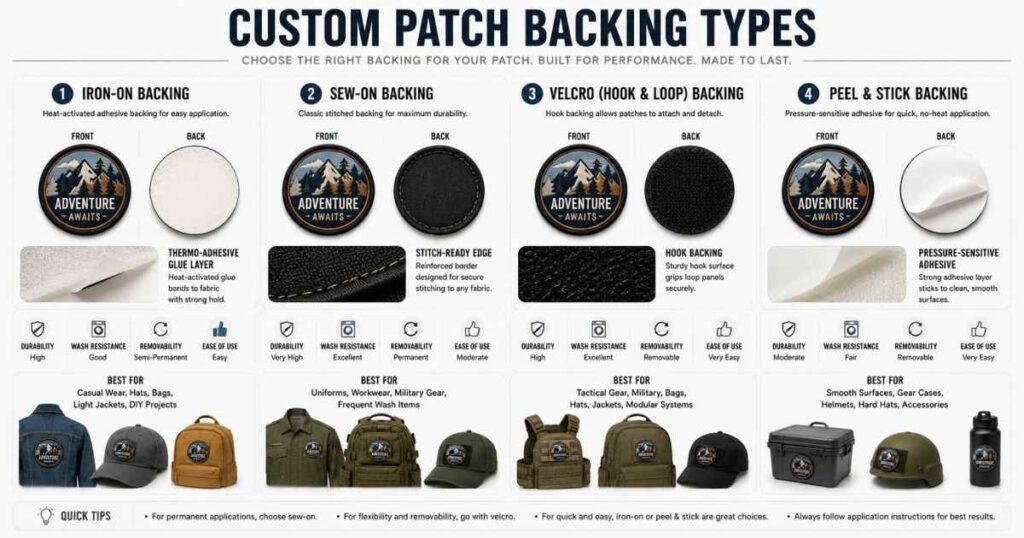
Which Backing Is Best for Merch Stores?
The answer depends on your product and your customer’s use case:
- Iron-on (heat-activated adhesive): Best for finished apparel sold in a merch store. Fast, tool-light application. Iron-on patches for apparel work on cotton, denim, and canvas.
- Sew-on: The most durable option. Sew-on patches wholesale are standard for workwear, uniforms, and tactical gear where permanence is required.
- Velcro / hook-and-loop: Velcro patches custom formats are popular for military, tactical, and outdoor brands. They allow customers to swap patches between products — a major plus for collectible merch strategies.
- Peel-and-stick: Convenient but not recommended for high-wash apparel. Good for bags, laptop cases, and temporary applications.
Many clothing brands also use custom patches for team apparel, promotional staff uniforms, and event branding. In Custom Patches for Employee Uniforms, we explore durable patch solutions for businesses that need consistent branding across apparel.
How Do You Apply Iron-On Patches Without a Heat Press?
You can apply iron-on patches with a household iron — but results are less durable than a commercial heat press. Here’s the correct process:
- Pre-heat your iron to the cotton/high setting (no steam).
- Position the patch on the garment, adhesive side down.
- Place a thin pressing cloth over the patch to protect the surface.
- Apply firm, even pressure for 25–30 seconds without moving the iron.
- Let it cool completely before handling.
- Flip the garment inside out and press again from the reverse side for 15 seconds.
Pro tip: For best results and max longevity — especially on merch you’re selling — use a heat press set to 340°F–350°F with medium-firm pressure for 20 seconds. Ninja Patches recommends this exact spec for their iron-on products.
How to Design Custom Patches for Branded Merchandise
Custom patches for branded merchandise start with the right artwork file. Submit the wrong format and you’ll get a poor-quality result — or a proof rejection that costs you turnaround time.
File Formats and Artwork Requirements
- Embroidered patches: Vector files preferred (AI, EPS, PDF, SVG). Minimum 300 DPI for raster. Colors mapped to Pantone or thread color codes.
- Woven patches: Same vector requirements. Reduce design complexity — fine lines under 1mm may not survive the weaving process.
- PVC patches: Layered files showing each color area separately. Minimum 2mm between color sections for clean mold separation.
- Printed patches: High-res raster (300 DPI at final size) or vector. Full RGB/CMYK color supported.
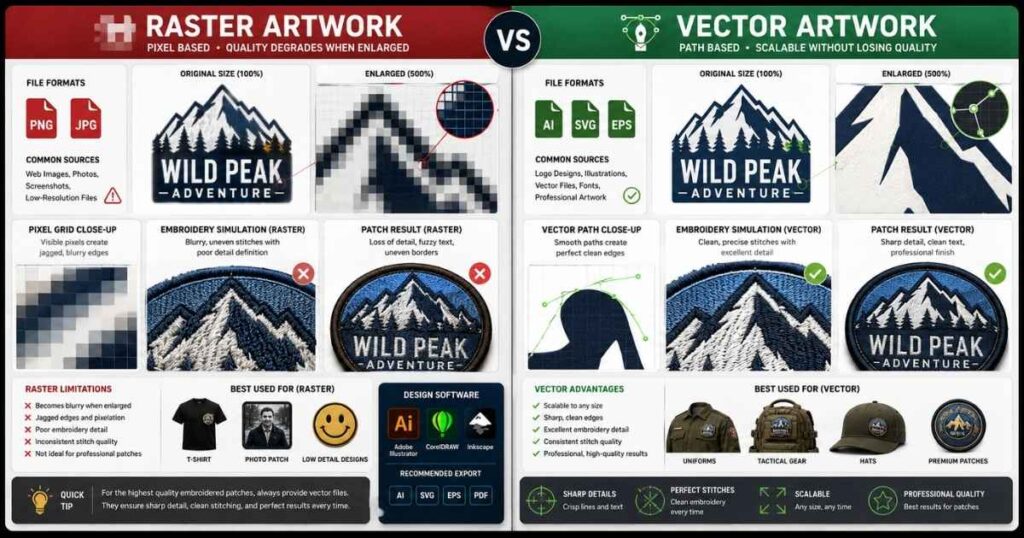
Vector artwork produces cleaner and sharper custom patches compared to low-resolution raster files.
Patch design file requirements vary by manufacturer but the rules above apply to most major suppliers including GS-JJ, Patches4Less, and Ninja Patches.
Size and Shape Guidelines for Different Products
Patch sizing directly affects readability and impact. These guidelines work well as starting points:
| Product | Recommended Patch Size | Common Shape |
|---|---|---|
| Structured hat (front) | 2″–2.5″ wide | Rectangle / custom |
| Jacket chest | 3″–4″ wide | Circle / shield |
| Jacket back (large) | 8″–12″ wide | Custom die-cut |
| Bag / backpack | 2″–3.5″ | Rectangle / square |
| Sleeve | 2″–2.5″ wide | Circle / oval |
Using AI Design Tools to Speed Up Patch Creation in 2026
This is the angle most competitor content ignores entirely — and it’s where forward-thinking merch stores are gaining a real edge.
GS-JJ’s platform now offers an AI design tool that generates patch concepts in under 30 seconds. Pair that with Midjourney or Adobe Firefly for ideation, and you can go from concept to production-ready artwork in an afternoon.
The workflow that works in practice: use AI to generate 5–10 rough concept directions → refine your top choice in Illustrator to meet file spec requirements → submit to your manufacturer for a digital proof. Most suppliers including GS-JJ offer 12-hour free artwork proofing and unlimited revisions.
Integrating Custom Patches Into Your Merch Store
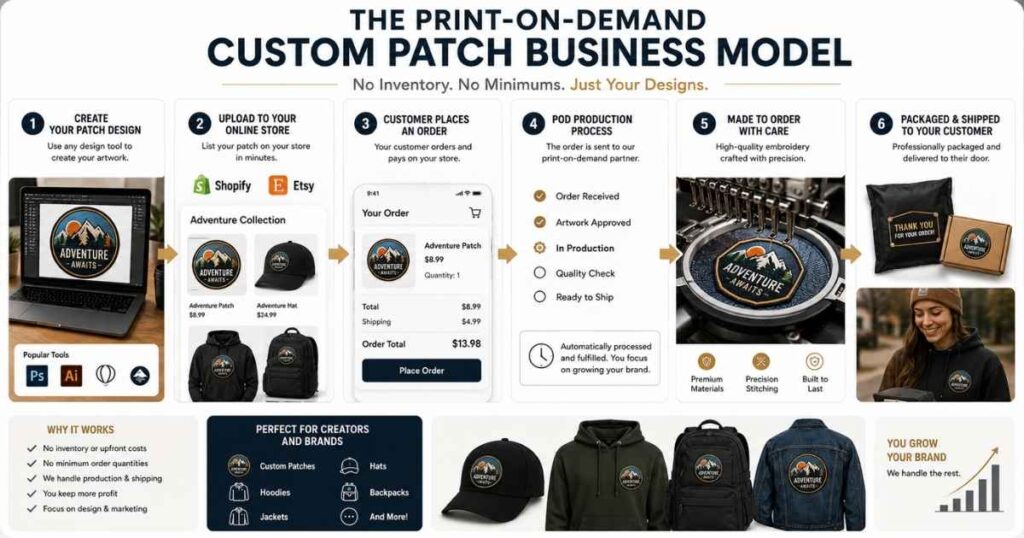
Custom patches merch store integration has become significantly easier in 2026. Whether you’re selling patches as standalone products or adding them to existing apparel, the POD ecosystem has mature options ready to go.
Selling Patches as Standalone Merch Products
Standalone patch sales work particularly well as low-cost entry products in a merch store. At $8–$20 retail with strong margins, they serve as acquisition products that lead customers into higher-ticket items like hoodies or jackets.
Limited edition merch patches perform especially well as standalone products. Bundle them as a collector set, drop them in limited quantities, and use scarcity to drive urgency — this is a classic merch drop strategy that artists and streetwear brands have used successfully for years.
On Etsy, patches consistently rank among the top-selling merch items in creator and fandom niches. Merch by Amazon also supports patch listings as independent products with its standard fulfillment model.
Adding Patches to Existing Apparel via Print-on-Demand
Print on demand patches represent one of the biggest underutilized opportunities in the POD space. Here’s how major platforms handle it:
- Apliiq: The gold standard for patch-on-apparel POD. Add embroidered patches, woven labels, and custom neck tags to hoodies and shirts. Integrates directly with Shopify, Etsy, and WooCommerce. U.S. fulfillment in 3–5 days.
- Printful: Offers embroidery on select products. Supports logo patches for clothing via their embroidery service on hats and apparel. Best-in-class Shopify and Etsy integration.
- CustomCat: Recently added sublimated vegan leather hat patches to their catalog — designed specifically for POD. Fast U.S. fulfillment.
- Printify: Works with third-party print providers; patch options vary by provider. Cost-leader positioning with strong Shopify, Etsy, eBay, and Walmart channel support.
Shopify and Etsy Store Setup for Patch Sellers
Shopify remains the dominant platform for patch merch stores that want full brand control. Connect Apliiq or Printful for fulfillment, use Shopify’s built-in product variants for size/backing options, and leverage their analytics to track which patch designs drive the most repeat purchases.
Etsy works best as a discovery channel — especially for niche or collector patches. Merch by Amazon is worth testing for high-volume, evergreen designs given Amazon’s enormous organic reach.
Can I Dropship Custom Patches Without Holding Inventory?
Yes — and it’s more viable than ever. The POD model through Apliiq, Printful, or Printify means you upload your design, list the product, and the platform handles production and shipping per order.
Bulk custom patches from manufacturers like GS-JJ or Patches4Less give you better per-unit economics if you’re ready to hold some stock — typically viable once you’re seeing consistent weekly sales for a design.
Pricing, MOQs, and Bulk Orders: What to Expect
Pricing for custom patches varies significantly by type, quantity, size, and supplier location. Here’s a realistic breakdown based on current market rates:
How Much Do Custom Patches Cost Per Unit?
| Patch Type | 1–10 pcs | 50 pcs | 100+ pcs |
|---|---|---|---|
| Embroidered | $5–$12 | $2.50–$5 | $1.50–$3 |
| Woven | $4–$10 | $2–$4.50 | $1.20–$2.50 |
| PVC | $3–$8 | $1.80–$4 | $0.90–$2 |
| Printed | $3.50–$9 | $2–$4 | $1–$2 |
| Chenille | $8–$18 | $4–$8 | $2.50–$5 |
| Leather | $6–$15 | $3–$7 | $1.80–$4 |
Is There a Minimum Order Quantity for Custom Patches?
No minimum order patches are now widely available. Platforms like GS-JJ and StickerYou offer single-unit ordering — ideal for testing a design before committing to a larger run.
That said, the per-unit economics improve dramatically with volume. If you’re running a merch store with consistent demand, ordering 100+ pieces at a time can reduce your cost by 50–70% compared to single-unit pricing.
Sew-on patches wholesale are particularly cost-effective at scale. Suppliers like Patches4Less offer volume pricing with free setup fees and free shipping on qualifying orders.
Best Suppliers and Manufacturers for Custom Merch Patches
Choosing the right supplier is the difference between a patch that builds brand equity and one that disappointingly fades after two washes. Here’s what the current landscape looks like:
| Supplier | Specialty | MOQ | Turnaround | Best For |
|---|---|---|---|---|
| GS-JJ | All types, AI design tool | No minimum | 7–12 days | Startups, variety |
| Ninja Patches | Embroidered, fast ship | 10 pcs | 5 bus. days | Speed-sensitive orders |
| Patches4Less | Embroidered, wholesale | Varies | ~2 weeks | Bulk programs |
| StickerYou | Printed, laser-cut | 1 pc | 5–10 days | Full-color designs |
| Apliiq (POD) | Embroidered on apparel | 1 unit | 3–5 days (US) | Shopify merch stores |
| CustomCat (POD) | Leather hat patches | 1 unit | 2–5 days | Hat-focused stores |
Domestic vs. Overseas Suppliers: Speed vs. Cost Trade-Offs
Domestic U.S. suppliers like Ninja Patches and Apliiq offer production times as fast as 5 business days — crucial for event-driven merch or rapid drop schedules. You’ll pay a premium per unit, but the speed and communication advantages are real.
Overseas suppliers — particularly those based in China and Southeast Asia — offer dramatically lower per-unit costs at scale. GS-JJ, for instance, ships via DHL and FedEx with reliable 7–12 day windows. For bulk orders where timing isn’t critical, the cost savings can be substantial.
What to Look for in a Patch Manufacturer (Quality Checklist)
- Tight, consistent stitching with no loose threads or skipped stitches
- Embroidered badge branding that accurately matches your Pantone or thread color specs
- Free digital proof within 24 hours before production begins
- Colorfast materials confirmed to resist fading after 20+ wash cycles
- Clear communication on production timeline and tracking
- Unlimited revision policy before final approval
Sustainable Custom Patches: Eco-Friendly Options for Modern Brands
Sustainability has moved from differentiator to baseline expectation for many brand buyers in 2026. The good news is that sustainable options exist across every patch type — and they’re increasingly cost-competitive.
Sustainable embroidered patches use recycled polyester threads, organic cotton twill backing, and water-based dyes that significantly reduce chemical runoff compared to conventional processes. Manufacturers like Apliiq actively promote eco-conscious production options for their POD apparel programs.
What to ask your supplier when prioritizing sustainability:
- Are threads made from recycled or responsibly sourced materials?
- Is the backing material organic cotton or recycled synthetic?
- Are water-based or low-impact dyes used in the process?
- Is there biodegradable or minimal plastic packaging available?
Being transparent about these choices — on your product pages and in your brand story — builds trust with the growing segment of buyers who factor environmental impact into their purchasing decisions.
Real-World Use Cases: Who Uses Custom Patches for Branded Merchandise?
Patches work across a remarkably broad range of industries and creator contexts. Here’s where they’re generating the most traction right now:
Creator and Influencer Merch Stores
Patches are ideal for creator merch for several reasons: low MOQs make test drops viable, they’re lightweight and cheap to ship, and they generate strong community belonging signals. A viewer wearing your patch on their everyday bag is ambient marketing you can’t buy with ad spend.
Patches for hats and jackets are the most popular applications in creator merch — both because they’re high-visibility and because customers genuinely wear them repeatedly. Etsy and Shopify stores in this space regularly use patches as the anchor product in their opening merch line.
Limited Edition Drops and Collab Patches
Limited edition merch patches are one of the most effective tools for a merch drop strategy built on scarcity and community. Drops of 50–200 individually numbered patches create collector urgency that standard apparel rarely generates.
Co-branded patches — two logos on one patch — have become a popular format for brand collaborations. They’re relatively inexpensive to produce, create mutual visibility for both partners, and perform well as PR assets and fan collectibles.
A strong merchandise collection starts with professional artwork preparation and embroidery-friendly logo design. How to Design a Logo Patch (Artwork Guide) explains how creators optimize logos for cleaner stitching and premium patch production.
Corporate Uniforms, Events, and Employee Gifting
Promotional textile patches and logo patches for clothing are staples of corporate uniform programs. Airlines, hospitality groups, and retail chains use them to maintain brand consistency across large workforces without requiring full uniform replacements when branding updates.
Event patches — distributed at conferences, festivals, or company milestones — function as a keepsake that reinforces brand recall long after the event ends. Unlike branded lanyards or tote bags, a well-designed patch is something people actively choose to display.
2026 Trends in Custom Patches for Branded Merchandise
The patch category is evolving faster than most merch categories. Here’s what’s driving demand and shaping buyer expectations this year:
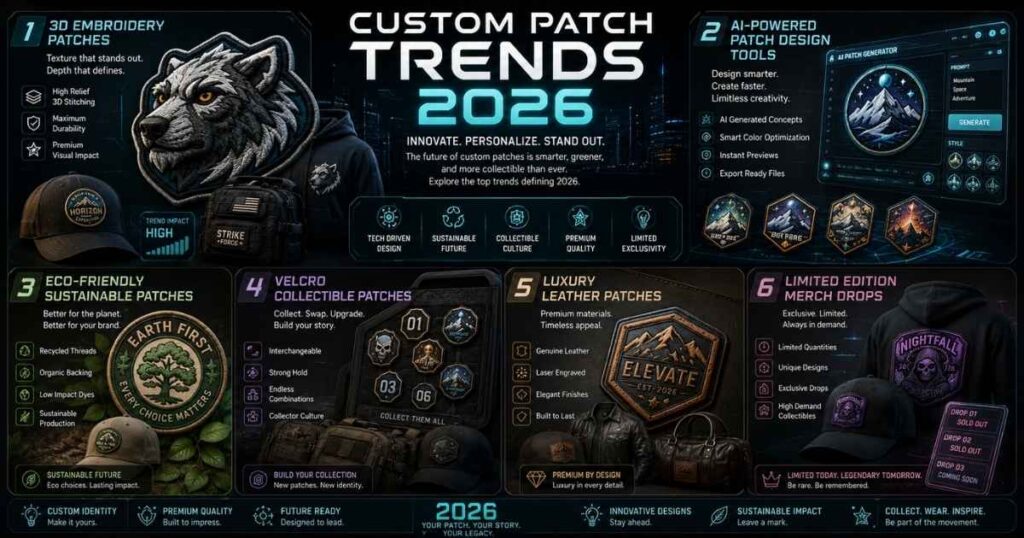
- 3D embroidery: High-density stitching that creates a raised, sculptural texture is the premium format of choice for brands positioning in the luxury or heritage space.
- AI-assisted design: AI design generators built into platforms like GS-JJ are dramatically shortening the path from brief to production-ready artwork.
- Eco-conscious materials: Recycled threads, organic backing, and biodegradable packaging are shifting from premium add-on to standard expectation.
- Velcro and collectible formats: Velcro patches custom formats are surging in streetwear and tactical categories, driven by the growing collectible patch community online.
- Limited drops as brand events: Brands treat patch drops the same way sneaker labels treat shoe releases — numbered editions, countdown timers, and community previews.
- POD leather patches: The addition of vegan leather hat patches to CustomCat‘s catalog signals that premium patch formats are finally entering the zero-inventory fulfillment space.
Frequently Asked Questions
What Is the Best Type of Patch for Hats?
How Long Do Custom Embroidered Patches Last?
Can You Wash Clothes With Iron-On Patches?
How Do I Order Custom Patches With No Minimum?
Summary: Custom Patches Are One of the Smartest Moves in Merch
Custom patches for branded merchandise punch well above their weight class as a branding tool. They’re durable, versatile, cost-effective at scale, and carry a tactile, collectible quality that digital merchandise simply can’t replicate.
For merch store owners, the opportunity is clear: patches work as standalone products, as add-ons to existing apparel, and as the anchor item in scarcity-driven drop campaigns. POD platforms like Apliiq, Printful, and CustomCat have removed the inventory barrier entirely.
The key is choosing the right patch type for your brand positioning, getting your artwork files right before submission, and partnering with a supplier whose quality standards match your brand expectations.
Start with a small test run — even 10 pieces from GS-JJ or Ninja Patches — apply them to a flagship product, and put them in front of your audience. The feedback almost always points in the same direction: customers love them and want more.