You’ve got a logo, a deadline, and a supplier asking which patch type you want. Sound familiar? Most buyers freeze here — not because the decision is hard, but because no one has ever explained it properly.
From NASA mission emblems to Boy Scouts of America achievement badges to Carhartt’s signature leather label patches, the right patch type has always said something about the wearer before they open their mouth. The wrong one? It shows.
In my experience ordering samples across multiple patch types for branding projects, the biggest mistakes buyers make are choosing based on appearance alone — ignoring durability, backing compatibility, and design limitations that only become obvious when the patches arrive. This guide fixes that.
Here’s everything you need to pick the right custom patch type for your project — the first time.
What Are the Main Types of Custom Patches?
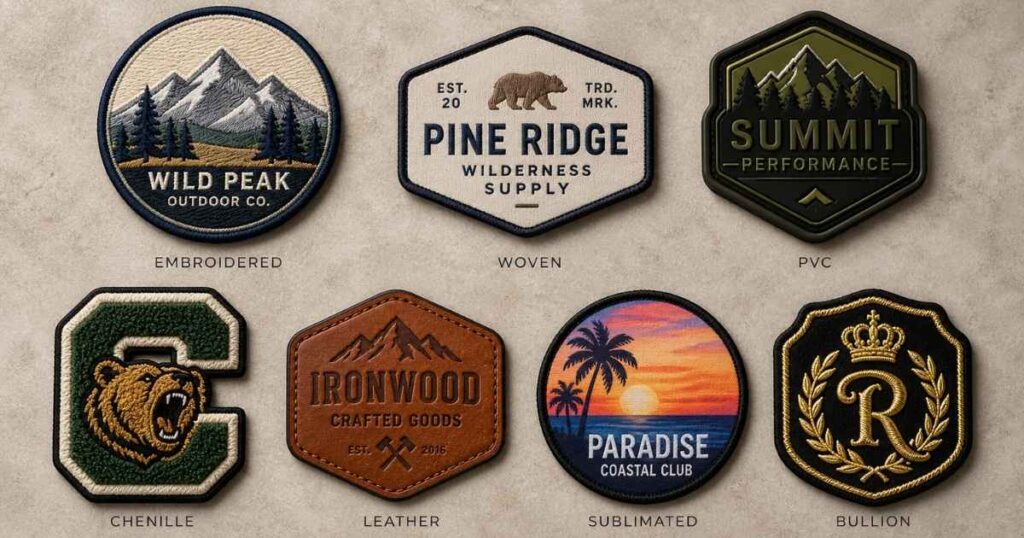
Five patch types account for the vast majority of custom patch orders: embroidered, woven, PVC, leather, and sublimated. Add chenille and bullion and you cover virtually every use case from tactical gear to varsity jackets to ceremonial dress uniforms.
Here’s the master comparison at a glance:
| Type | Texture | Detail Level | Waterproof | Best For | Price Range |
|---|---|---|---|---|---|
| Embroidered | Raised, stitched | Medium | No | Uniforms, fashion, clubs | $0.80–$3.00 |
| Woven | Flat, smooth | Very High | No | Small text, fashion, hats | $1.50–$3.00 |
| PVC | Flexible, 3D | High | Yes | Tactical, outdoor, gear | $2.00–$12.00 |
| Chenille | Thick, fuzzy | Low | No | Varsity jackets, streetwear | $3.00–$6.00 |
| Leather | Firm, supple | Low–Medium | Partial | Premium apparel, headwear | $3.00–$7.00 |
| Sublimated | Flat, printed | Unlimited | No | Full-color, photographic | $1.50–$3.00 |
| Bullion | Metallic, 3D | Medium | No | Ceremonial, formal dress | $8.00–$25.00 |
Embroidered Patches — The Classic Choice
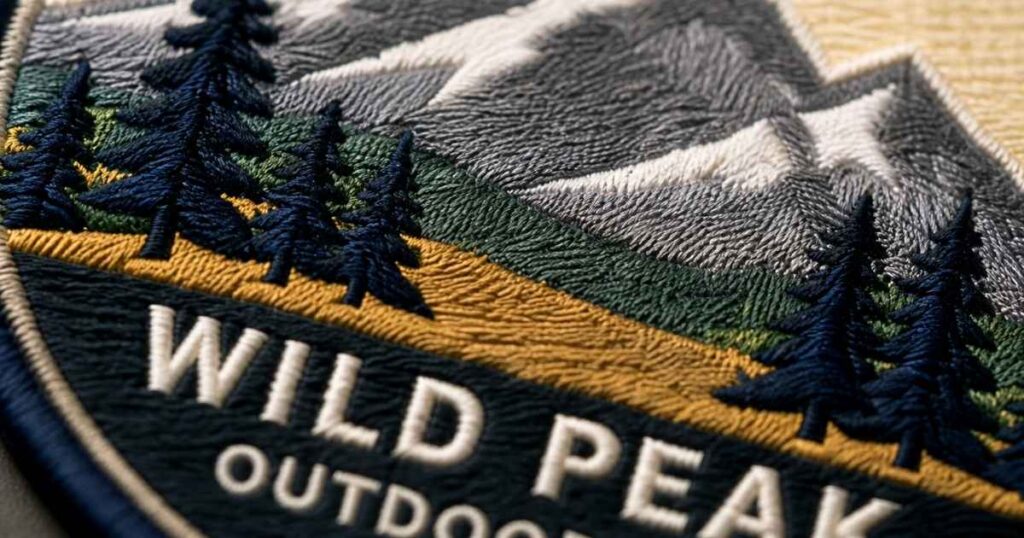
Embroidered patches are what most people picture when they hear “custom patch.” Thread is stitched onto a twill backing using computerized embroidery machines — the same basic method used for Boy Scouts of America merit badges and military uniform insignia for decades.
How they’re made: Thread is layered at varying stitch densities onto a stabilized twill backing. Embroidery coverage — the percentage of the patch surface covered by thread — typically ranges from 50% to 100%. Higher coverage means more richness and detail, but also higher cost. Pantone color matching is available from most custom patch makers, ensuring your logo colors are exact.
Best for:
- Corporate and uniform patches for staff workwear
- Military patches, police patches, and fire department patches
- Club, biker, and organization emblems
- Fashion jackets and denim
- Promotional patches and event merchandise
Limitations: Fine text under ¼ inch tall tends to blur. Threads can fray or fade under extreme conditions — repeated industrial washing especially. Not ideal for gradients or photographic designs.
When ordering embroidered patches in bulk, most patch suppliers set a minimum order quantity (MOQ) of 50 pieces. At that scale, the per-unit cost drops dramatically — it’s where embroidery really earns its reputation as the most cost-effective patch type.
3D Puff Embroidery — When You Want Extra Dimension
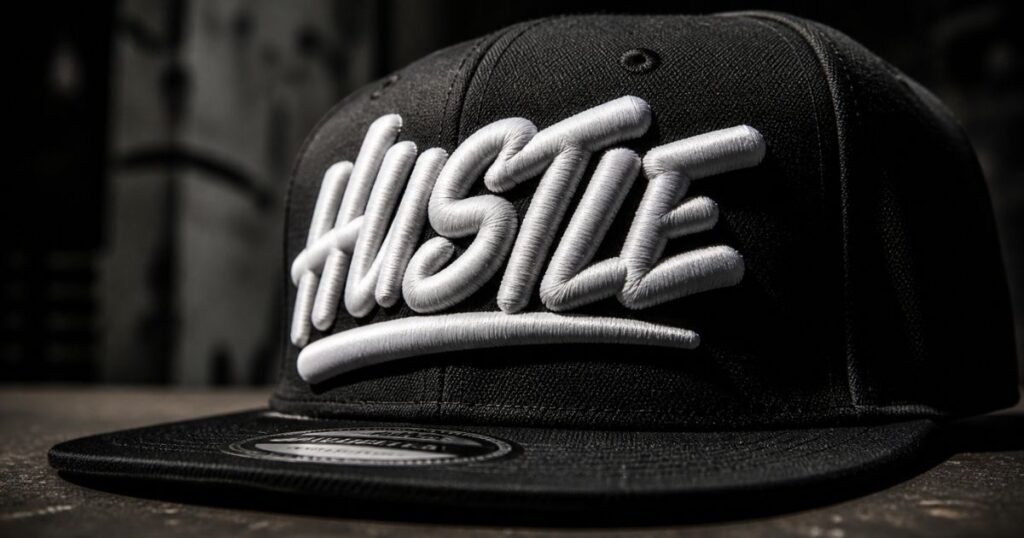
A foam insert is placed under specific areas before stitching, causing those elements to rise dramatically from the surface. Widely used on snapback hats, 3D puff embroidery creates a bold, sculptural effect that’s particularly effective for logos, numerals, and name patches. It’s not a separate patch — it’s a finishing technique applied on top of standard embroidery.
Woven Patches — The Detail-First Option
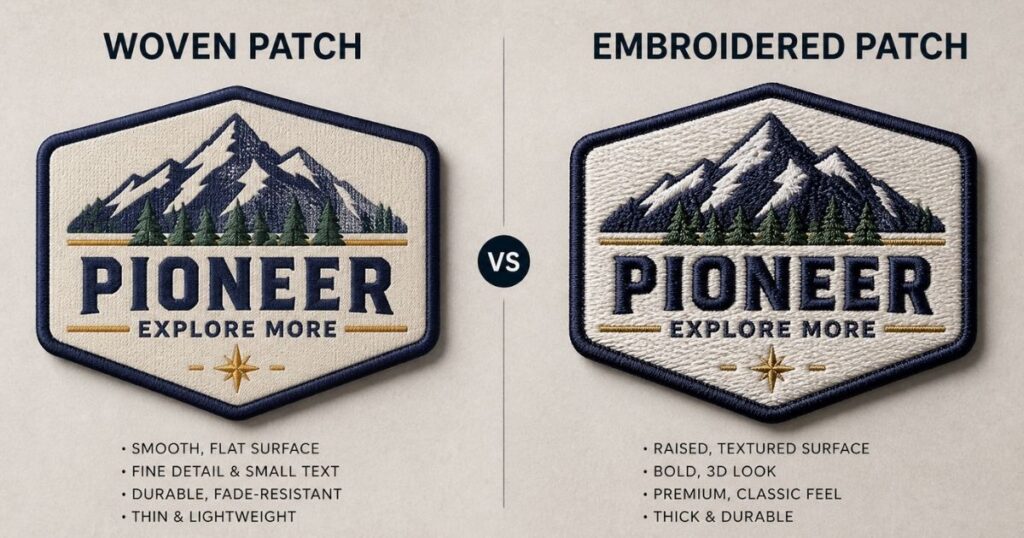
Woven patches look similar to embroidered patches from a distance, but up close they’re a fundamentally different product. Instead of thick thread stacked on top of a backing, woven patches use fine interlaced threads woven directly into the fabric — more like a label than a stitched badge.
When I hold both up to the light, woven patches look almost like a printed label, while embroidered ones have visible thread stacks you can run your finger across. That difference in construction is why woven patches capture finer detail — small text, intricate logos, multi-layered graphic elements — that embroidery simply can’t replicate cleanly.
Best for:
- Small logo patches with text under ¼ inch tall
- Fashion brands that want a sleek, label-like look
- Hat patches and lightweight polo shirts where embroidery would feel stiff
- Employee uniforms and rank insignia requiring fine lettering
- Corporate patches where a clean, modern finish matters
Limitations: Less tactile than embroidery — if you want texture, woven won’t deliver it. Also, woven patches can wear out faster than embroidered ones under heavy abrasion. Most suppliers cap color options at around 10 per patch.
Suppliers like American Patch offer both merrowed edge and laser-cut edge borders for woven patches, giving you clean or raw finishing options depending on your aesthetic.
PVC Patches — Built for the Outdoors
PVC stands for polyvinyl chloride — a soft, flexible plastic molded into precise shapes rather than stitched. The result is a patch that’s fundamentally different from anything made with thread: waterproof, UV-resistant, wipe-clean, and extraordinarily durable.
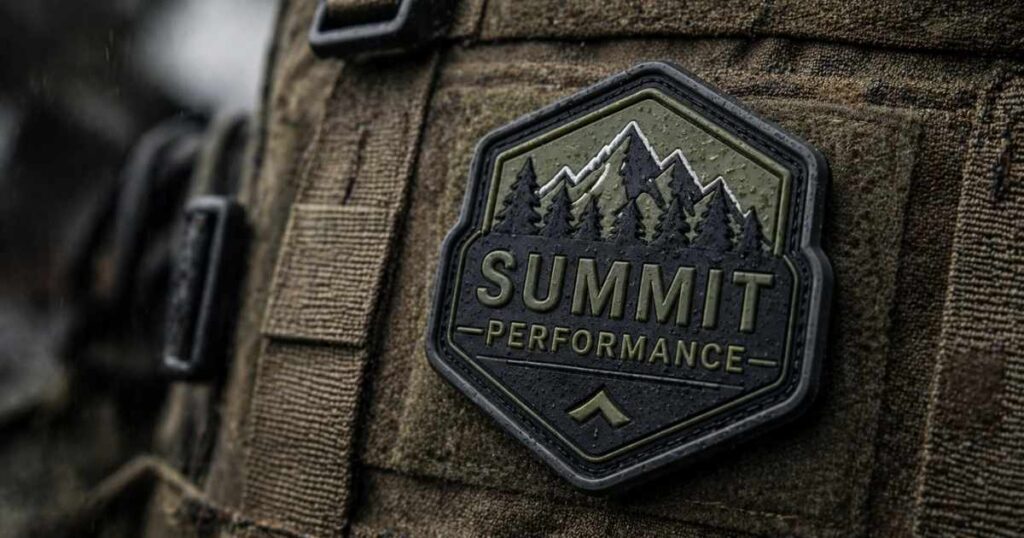
Law enforcement agencies, fire departments, military units, and outdoor brands gravitate toward PVC patches for one simple reason: they survive conditions that would ruin fabric-based patches. Rain, mud, salt water, extreme heat — PVC doesn’t fray, fade, or crack.
How they’re made: Liquid PVC is poured into a CNC-machined mold, with colors added in layers. 2D PVC produces a flat surface with raised color borders. 3D PVC uses multiple height layers to create genuine depth — a foreground shape that literally sits above the background. The molding process supports up to about eight colors without extra cost.
Best for:
- Tactical patches and morale patches on military and tactical gear
- Outdoor brands, fishing hats, marine merchandise
- Backpacks, luggage, and equipment used in harsh conditions
- Biker clubs and sports teams needing weatherproof identification
- Flag patches and unit identifiers on combat uniforms
Glow-in-the-dark PVC and translucent PVC patches are gaining serious traction in streetwear and tactical markets. If you’re after an edgy, modern look, ask your custom patch maker about these specialty finishes.
2D vs. 3D PVC — What’s the Actual Difference?
2D PVC is your clean, flat-profile patch with sharp color zones separated by raised borders. 3D PVC adds genuine relief — parts of the design physically stand higher than others, creating a sculptural effect. 3D costs more due to mold complexity, but for logos with a strong foreground element (an animal, emblem, or shape that should visually “pop”), it’s worth the premium.
Are PVC Patches Safe to Machine Wash?
Yes. PVC patches are dishwasher-safe in some cases, and at minimum, they handle a gentle machine cycle without any degradation. For iron-on PVC patches, a gentle cycle is recommended to protect the heat seal backing — but the patch itself won’t suffer.
Chenille Patches — Varsity, Retro, and Bold
Chenille patches are the soft, fuzzy patches you grew up seeing on varsity jacket patches in high school hallways. They’re made by looping thick yarn through a base fabric, creating that distinctive plush, almost pillow-like texture. There’s nothing subtle about a chenille patch — and that’s exactly the point.
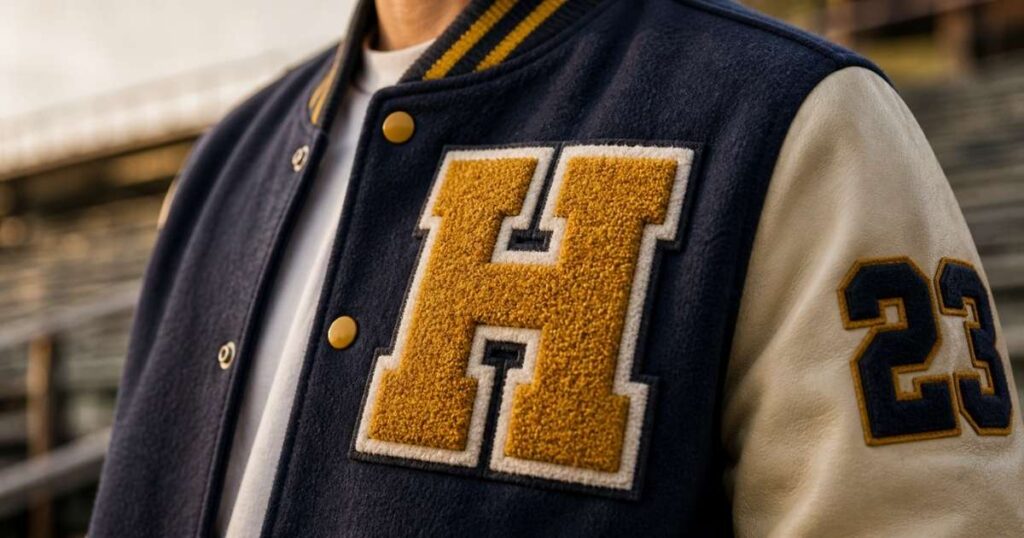
Chain-stitching (horizontal loop stitching) is the defining production method here, producing that signature raised, velvety surface.
Best for:
- Varsity jacket patches and letter jackets for schools and sports teams
- Streetwear and hip-hop fashion brands
- Sports achievement awards and club emblems
- Bold, simple logo patches and large lettering
Limitations: Chenille is not a detail medium. Fine lines, small text, and complex graphics are impossible — the thick yarn simply can’t replicate them. Keep designs bold and simple. Chenille patches also need gentle washing and should stay away from heavy rain or abrasive surfaces.
Chenille vs. Embroidered — Which Has More Texture?
Chenille wins on sheer plushness — it’s thicker, softer, and more dimensional than embroidery. But embroidery wins on detail and versatility. Think of it this way: chenille makes a statement, embroidery makes an impression.
Leather Patches — Premium and Timeless
Leather patches communicate something that no other patch type quite manages: quality that ages. Carhartt built part of its brand identity on the leather label patch. Patagonia uses it on premium outerwear. There’s a reason — leather patches gain character over time rather than losing it.
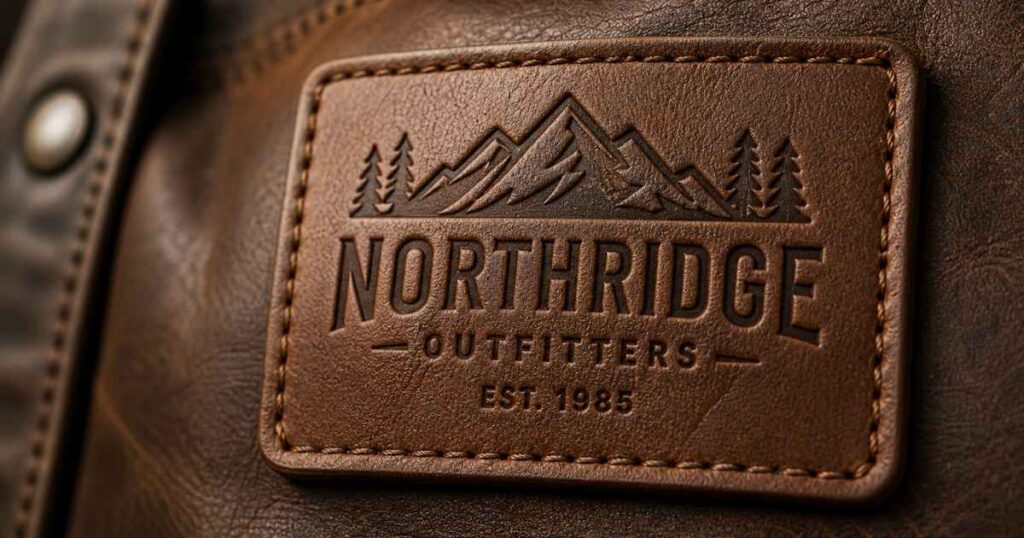
Types of leather used:
- Full-grain leather — the highest quality; ages beautifully, develops patina
- Top-grain leather — slightly processed, more consistent texture
- Faux/vegan leather — synthetic alternative; more affordable, consistent, cruelty-free
Application methods: Debossing presses the design into the leather surface (recessed). Embossing raises the design above the surface. Laser engraving uses CNC laser machines for sharp, precise burns into the leather. Screen printing applies color directly to the surface.
Best for:
- Premium headwear (beanies, rope-brim caps, trucker hats)
- Denim jackets, bags, and luxury accessories
- Workwear brands that want a heritage aesthetic
- Jeans labels and back-pocket patches
Limitations: Debossing blurs fine detail — if your logo has thin lines or small type, skip leather and consider woven or sublimated. Genuine leather requires spot-cleaning and occasional conditioning. Not suitable for gradient or full-color logo designs.
Debossed vs. Embossed Leather — Which Should You Choose?
Embossed patches have a raised design that catches light and creates shadow — visually bold, excellent for logos with strong silhouettes. Debossed patches press the design into the leather — subtler, more understated, often associated with luxury goods. When in doubt, debossed reads as more premium; embossed reads as more rugged.
Sublimated Patches — Full Color, No Limits
Dye sublimation patches are the patch world’s answer to one question: what if I need photographic detail, unlimited gradients, or a design that no thread count can replicate? The dye sublimation process uses heat to transfer ink directly into a twill or polyester base — not on top of it — creating a flat patch with colors that are technically part of the fabric itself.
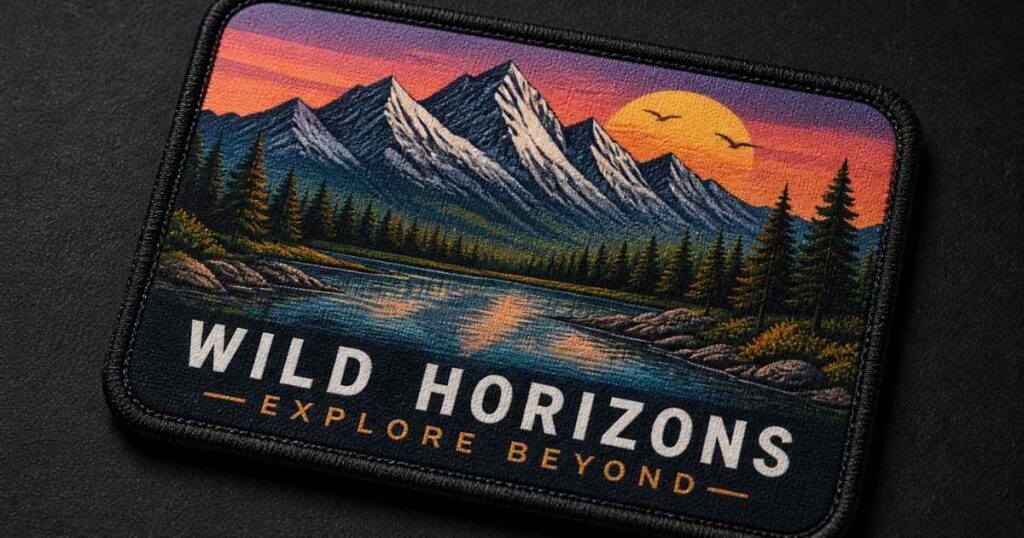
Suppliers like Eagle Patches and Panda Patches use this method for sports apparel, event merchandise, and corporate patches where brand color accuracy and design complexity are non-negotiable.
Best for:
- Photorealistic imagery and full-color photography on a patch
- Designs with gradients, shadows, or more than 12 distinct colors
- Sports team patches with complex artwork
- Corporate promotional patches with detailed brand graphics
- Event merchandise that needs fast turnaround
Limitations: Sublimated patches are flat — zero texture. If your customer expects to feel the patch, this isn’t the right choice. Colors can also fade faster than PVC or embroidery with repeated washing without care. Artwork must be at least 300 DPI for clean reproduction.
Combination Patches — The Best of Two Worlds
One of the most underused options in custom patch production is the combination patch: a sublimated background with embroidered elements on top. The result is a patch with full-color depth in the background and the tactile, raised quality of embroidery in the foreground. Suppliers like American Patch offer these as a specialty product — they cost more but solve the “my design is too complex for embroidery but I still want texture” problem elegantly.
Bullion Patches — When Only Luxury Will Do
Bullion patches sit at the highest end of the patch spectrum — in cost, craftsmanship, and formality. They’re made using gold and silver metallic wire wound around a fiber core, stitched onto a felt base to create rich, three-dimensional designs. You’ll see bullion patches on naval officer dress uniforms, masonic organization blazers, ceremonial military regalia, and prestige club insignia.
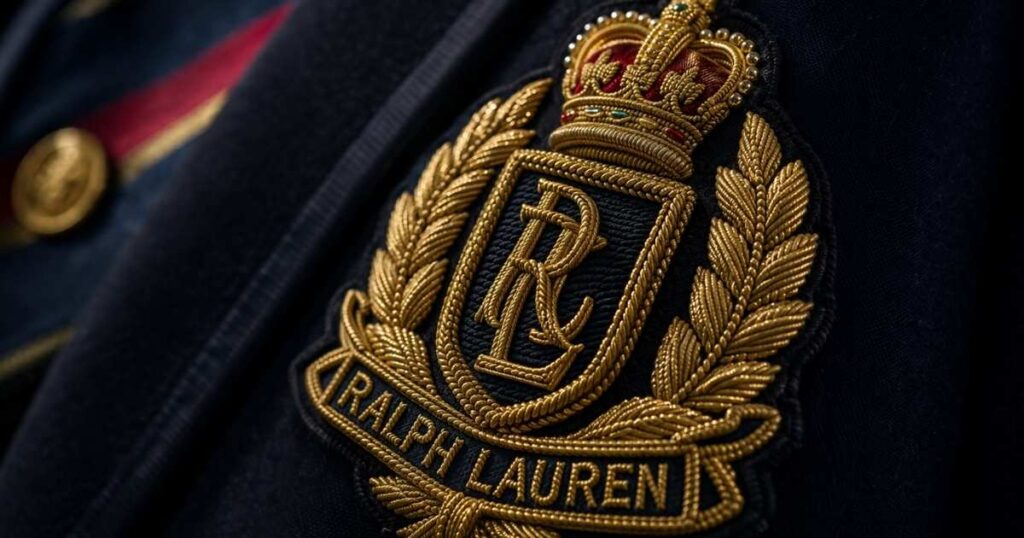
NASA’s early mission patches featured elements of bullion-style embroidery — a nod to the craftsmanship tradition these patches carry.
Best for:
- Military dress uniform insignia and rank patches
- Formal blazers and ceremonial garments
- Luxury limited-edition merchandise
- Award patches and commemorative emblems
Limitations: These are hand-wash-only patches — machine washing will damage the metallic wire. They’re the most expensive patch type by a significant margin and have an MOQ that reflects their production complexity. Not practical for everyday workwear or high-volume orders.
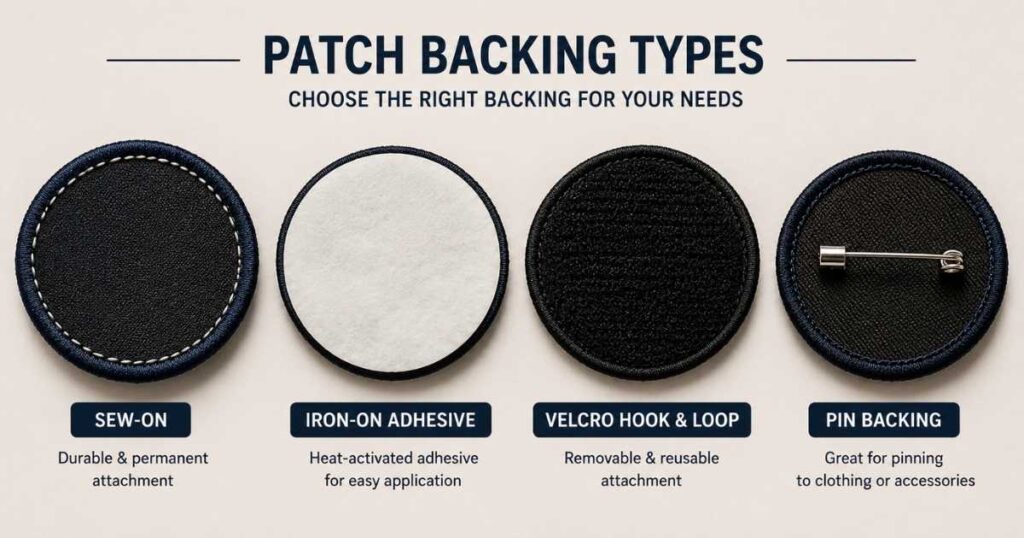
Patch Backing Types — The Decision Most People Overlook
Here’s what most comparison guides miss entirely: the patch backing is just as important as the patch type. The wrong backing can mean your $3 patch falls off after two washes, regardless of how well it was made.
| Backing Type | How It Works | Best For | Durability |
|---|---|---|---|
| Sew-on | Stitched through fabric | Jackets, uniforms, heavy fabrics | Highest |
| Iron-on / Heat press | Heat-activated adhesive | T-shirts, hats, light fabrics | Medium |
| Velcro / Hook-and-loop | Removable hook-and-loop | Military, tactical, corporate uniforms | High (reusable) |
| Adhesive / Peel-and-stick | Pressure-sensitive adhesive | Events, promotional, temporary | Low |
| Heat seal backing | Factory heat application | Mass production, branded apparel | Medium-High |
| Pin backing | Metal clasp through fabric | Collector patches, event badges | Medium |
Iron-On vs. Sew-On — Which Lasts Longer?
Sew-on wins every time for long-term durability. Iron-on patches are convenient, but the heat seal backing weakens with repeated machine washing — especially in hot water or a hot dryer. For patches on uniforms or gear that get washed weekly, always sew the edges after iron-on application, or go sew-on from the start. Many patch suppliers recommend this hybrid approach as standard practice.
How to Choose the Right Custom Patch Type
Ask yourself these four questions:
- Where will the patch live? Outdoor/rugged environments → PVC or leather. Indoor/formal → embroidered or woven.
- How complex is your design? Fine detail, small text, gradients → woven or sublimated. Bold logo or simple shape → embroidered or chenille.
- What’s your budget and order volume? Bulk affordable → embroidered or woven. Low MOQ premium run → leather or bullion.
- What aesthetic are you going for? Heritage/classic → embroidered or leather. Modern/bold → PVC. Retro/varsity → chenille. Luxury/ceremonial → bullion.
Which Patch Type Is Best for Uniforms?
Embroidered patches are the standard for most uniform patches — corporate patches, police patches, fire department patches — because they’re durable, cost-effective at scale, and carry the professional weight these contexts demand. For tactical or outdoor uniforms, PVC with Velcro hook-and-loop backing is the industry standard, allowing patches to be swapped between garments.
Which Patch Type Is Best for Hats?
Woven patches and PVC patches are the go-to options for hat patches. Woven patches sit flat and low-profile on structured caps without distorting the front panel. PVC works brilliantly on fishing hats, tactical caps, and outdoor headwear. Leather patches deliver a premium heritage look on rope-brim and trucker-style caps. Embroidered patches work too, but can be stiff on lightweight hat fabrics — test before committing to a large batch.
What Patch Type Do Military and Law Enforcement Use?
It depends on the application. Dress uniforms typically use embroidered patches with merrowed edges for rank insignia and flag patches. Combat and tactical gear increasingly uses PVC patches with Velcro hook-and-loop backing — they withstand field conditions, can be repositioned between garments, and don’t fray or absorb water. Morale patches (the unofficial, often humorous patches soldiers wear on non-regulation gear) are almost exclusively PVC.
What Do Custom Patches Actually Cost?
Most patch suppliers are intentionally vague about pricing online. Here are realistic per-unit ranges based on typical market rates — your actual costs will vary based on size, design complexity, and total quantity.
| Patch Type | Price Per Unit | Typical MOQ | Key Cost Driver |
|---|---|---|---|
| Embroidered | $0.80–$3.00 | 50 pcs | Embroidery coverage % |
| Woven | $1.50–$3.00 | 100 pcs | Color count, size |
| PVC (2D) | $2.00–$5.00 | 25–50 pcs | Mold complexity |
| PVC (3D) | $4.00–$12.00 | 25 pcs | Multi-layer mold |
| Chenille | $3.00–$6.00 | 25 pcs | Size, yarn volume |
| Leather | $3.00–$7.00 | 25 pcs | Leather grade, method |
| Sublimated | $1.50–$3.00 | 50 pcs | Setup/artwork fees |
| Bullion | $8.00–$25.00 | 10 pcs | Hand craftsmanship |
Patch turnaround time is also worth factoring in. Standard production is typically 2–4 weeks from artwork approval, with proof/mockup turnaround around 1–2 business days. PVC patches with new molds can add time. Factor in an extra week for first-time orders with any new patch manufacturer.
Care and Washing Instructions by Patch Type
- Embroidered: Machine wash cold, gentle cycle. Air dry. Avoid bleach and high heat.
- Woven: Cold water, gentle cycle. Air dry flat to prevent distortion.
- PVC: Wipe clean with a damp cloth. Can handle gentle machine cycles. Avoid high-heat drying.
- Chenille: Hand wash only. Lay flat to dry. Never machine wash.
- Leather: Spot clean with a damp cloth. Condition periodically with leather conditioner. Never submerge.
- Sublimated: Gentle cycle, cold water. Avoid high heat in dryer — colors can fade faster than embroidery.
- Bullion: Hand wash only, or dry clean. Machine washing will damage metallic wire.
Frequently Asked Questions
Which custom patch type lasts the longest?
Can I mix different patch types on the same garment?
What patch type is best for small text or intricate logos?
What file format do I need to order custom patches?
The Bottom Line
Every custom patch type exists for a reason. The key is matching the right one to your project — not defaulting to embroidery because it’s familiar, or to PVC because it looks impressive in product photos.
- Want affordable, versatile, and classic? Embroidered patches.
- Need fine detail or small text? Woven patches.
- Building for the outdoors? PVC patches.
- Going for a retro, varsity vibe? Chenille patches.
- Signaling premium quality? Leather patches.
- Reproducing a complex, full-color design? Sublimated patches.
- Dressing a formal or ceremonial occasion? Bullion patches.
And don’t forget: the patch type is only half the decision. The backing — sew-on, iron-on, Velcro hook-and-loop, or heat seal — determines how long it stays on. Get both right, and your patch will outlast the garment it’s attached to.