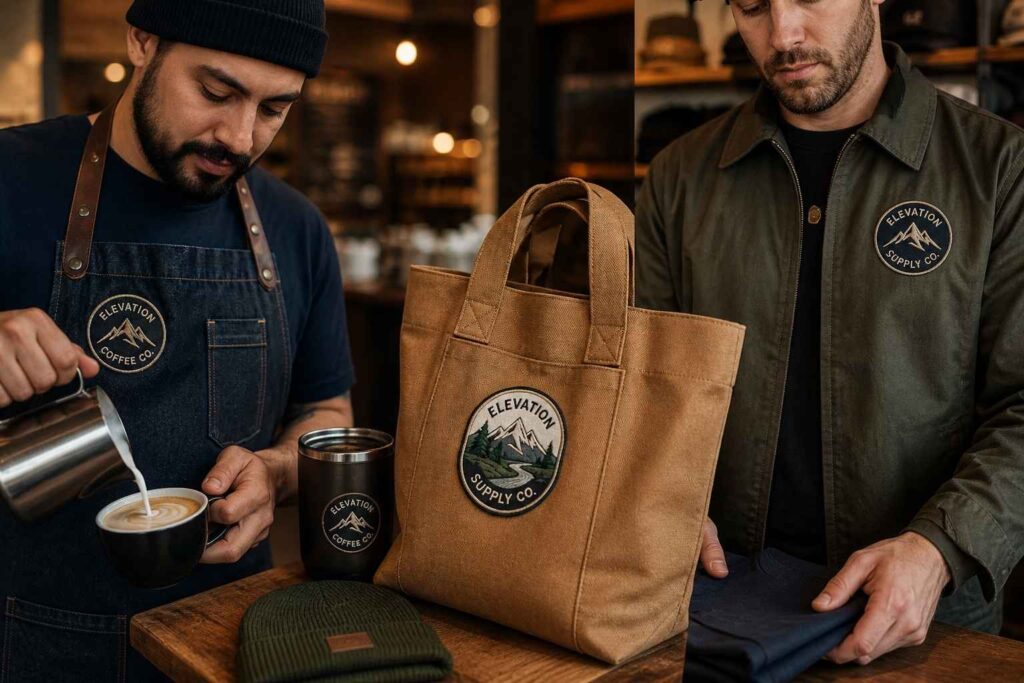
You’ve seen them on the barista’s apron at the corner café. On the jacket of a food truck crew. On a tote bag at a craft market. Small, stitched, and oddly compelling — custom patches have quietly become one of the most underrated branding tools available to small business owners.
They’re not new. But the way small businesses are using them has shifted considerably. What was once reserved for uniforms and military insignia is now a full-stack branding strategy — covering employee workwear, branded merchandise, promotional giveaways, and even limited-edition product launches that drive social media engagement.
This guide covers everything you need to make a confident decision: which patch type suits your brand, what backing holds up in the real world, how much you’ll actually spend, and how to avoid the supplier mistakes that cost businesses time and money. By the end, you’ll have enough to brief a supplier, design a patch, and measure whether it’s working.
Why Small Businesses Are Using Custom Patches (And Not Just for Uniforms)
The obvious use case is workwear. Your team looks more cohesive, customers can identify staff instantly, and there’s a professionalism signal that comes from a well-made patch on a polo or jacket that a printed logo simply doesn’t replicate.
But uniform patches are just the entry point.
How Custom Patches Improve Brand Recognition on a Small Budget
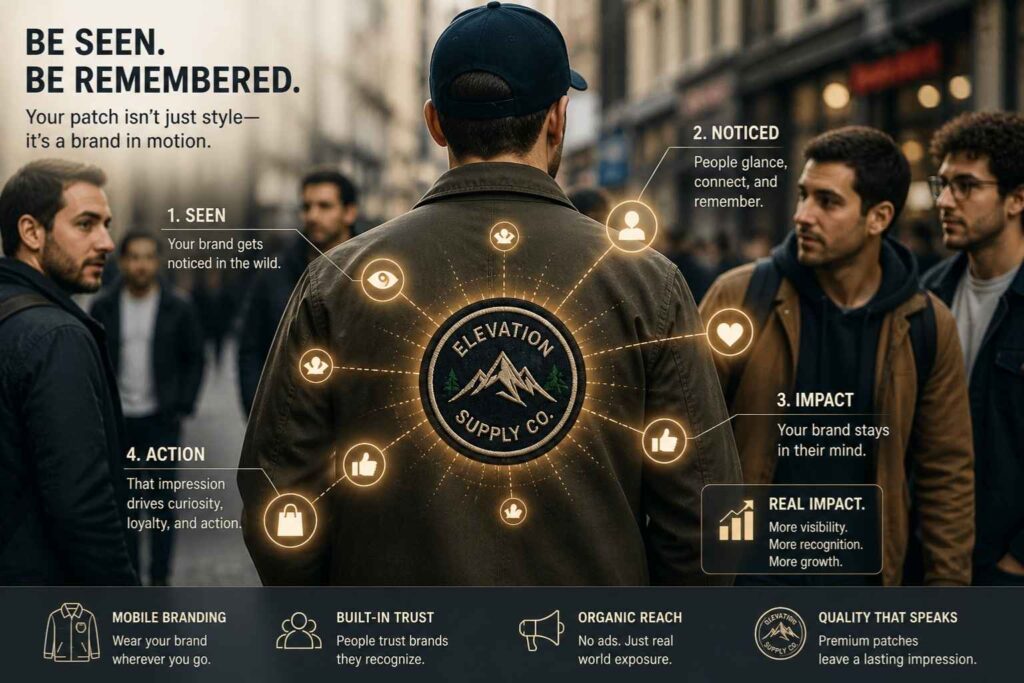
Brand recognition is built through repeated exposure. Every time a customer sees your logo, the mental association deepens. The challenge for small businesses is that most advertising channels charge you for each impression — pay-per-click, social ads, print placements. Patches don’t.
Once produced, a patch on an employee’s jacket or a customer’s tote bag keeps generating impressions for as long as it’s worn. There are no recurring costs. The cost-per-impression drops with every day the patch is in use — and we’ll run those numbers in the ROI section at the end of this guide.
Custom patches also convey permanence. A sticker peels. A printed iron-on cracks. An embroidered patch branding your logo onto quality twill backing communicates that your business is established, intentional, and worth noticing.
Patches vs. Direct Embroidery: Which Makes More Sense for a Small Business?
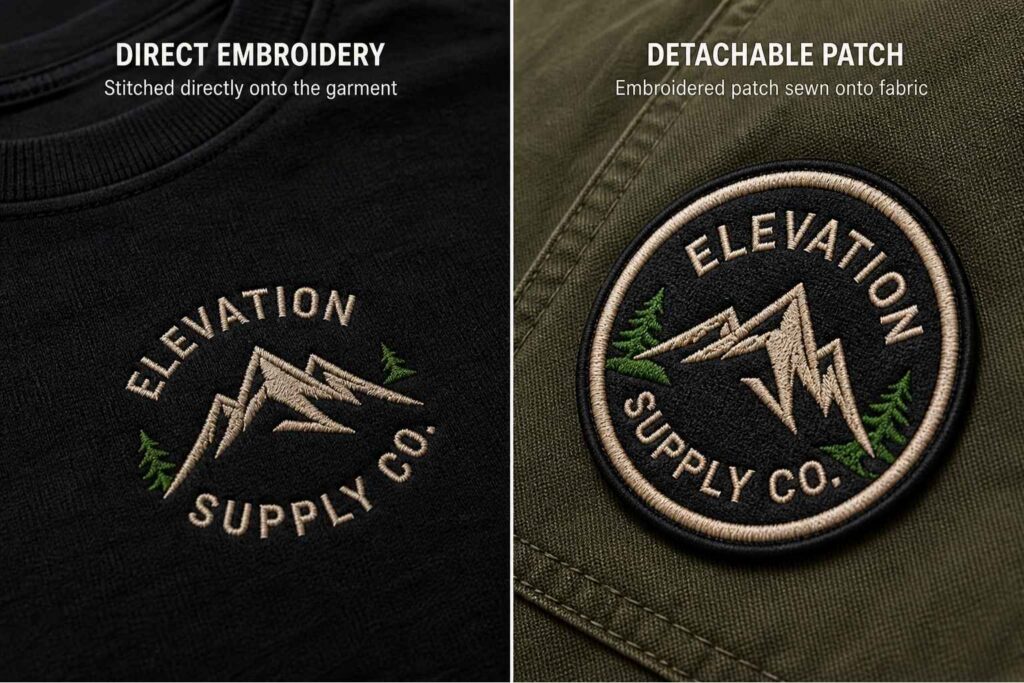
Direct embroidery — where thread is stitched directly onto a garment — sounds like the simpler option. And for a single item or a one-off uniform piece, it might be.
But for a small business managing a team, a product line, or a merchandise operation, custom patches win on practicality:
- Consistency. Patches are manufactured to exact specs in a single production run. Direct embroidery varies slightly by machine and operator, especially across multiple garment types.
- Flexibility. You can apply patches to new garments as your team grows, without re-running an embroidery order each time.
- Inventory efficiency. Order a batch of patches and apply them as needed. No minimum per garment type.
- Repairability. If a garment is damaged, the patch transfers to a replacement. With direct embroidery, you start over.
For businesses buying 50 or more pieces, patches almost always work out cheaper per unit and more consistent in quality.
Are Custom Patches Worth It for a Small Business?
Short answer: yes — with a caveat. They’re worth it when you have a clear use case (uniforms, merch, events) and a design that translates well to embroidery or another patch format. A patch with a highly detailed gradient logo is going to disappoint you. A bold, simplified version of the same logo will look sharp.
The return on investment argument is strong for businesses that already spend money on printed promotional materials or branded apparel. Patches outlast all of them.
Types of Custom Patches: Which One Fits Your Brand?
Small businesses often struggle to choose the right patch material for branding, uniforms, or merchandise. Our Custom Patch Types Comparison Guide explains the differences between embroidered, woven, PVC, leather, and chenille patches so you can choose the best option for your brand identity and budget.
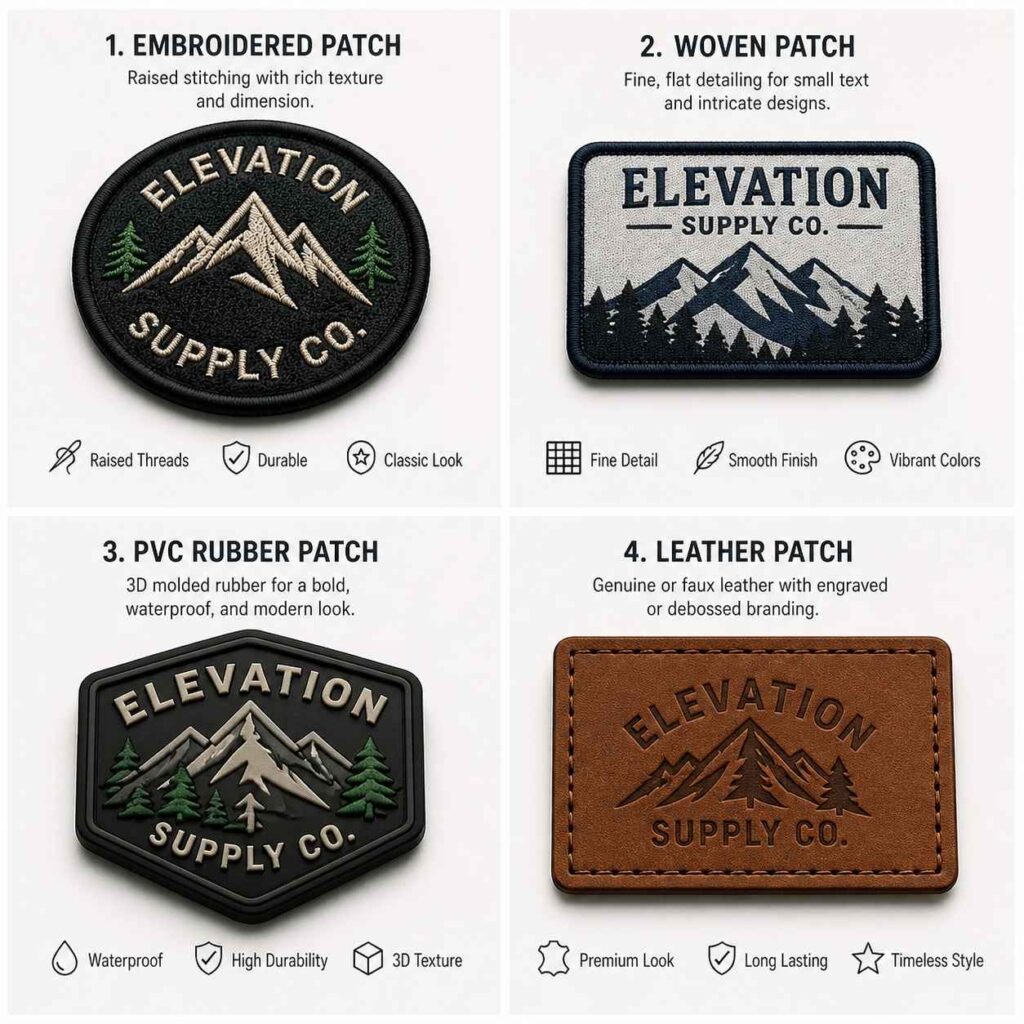
The patch market has expanded well beyond the classic embroidered badge. Each format has specific strengths, and choosing the wrong one for your application is one of the most common (and costly) ordering mistakes.
Embroidered Patches — The Go-To for Bold Logos and Workwear
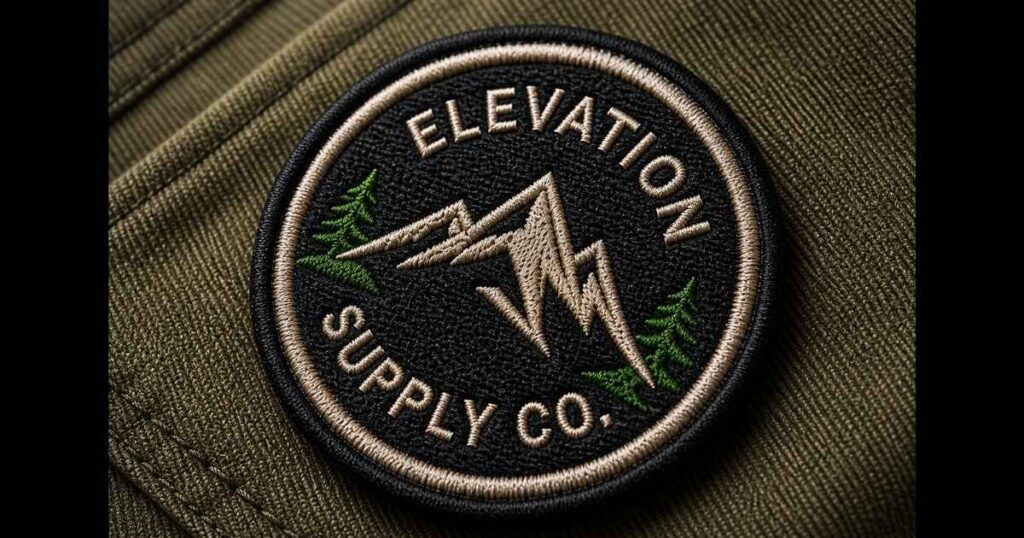
Embroidered patches are the industry standard for a reason. Thread is stitched onto a twill backing using computerized embroidery machinery, creating a raised, textured surface that photographs well, looks premium on workwear, and holds up across hundreds of wash cycles.
They work best for:
- Bold logos with strong lines and limited color transitions
- Employee uniforms and workwear where durability matters
- Anything where that classic, tactile quality signals credibility
The one limitation: fine details and small text blur. If your logo includes a tagline smaller than about 6 points in the finished size, the stitching will merge. Simplify the design, or switch to woven.
Woven Patches — When Your Design Has Fine Detail or Small Text
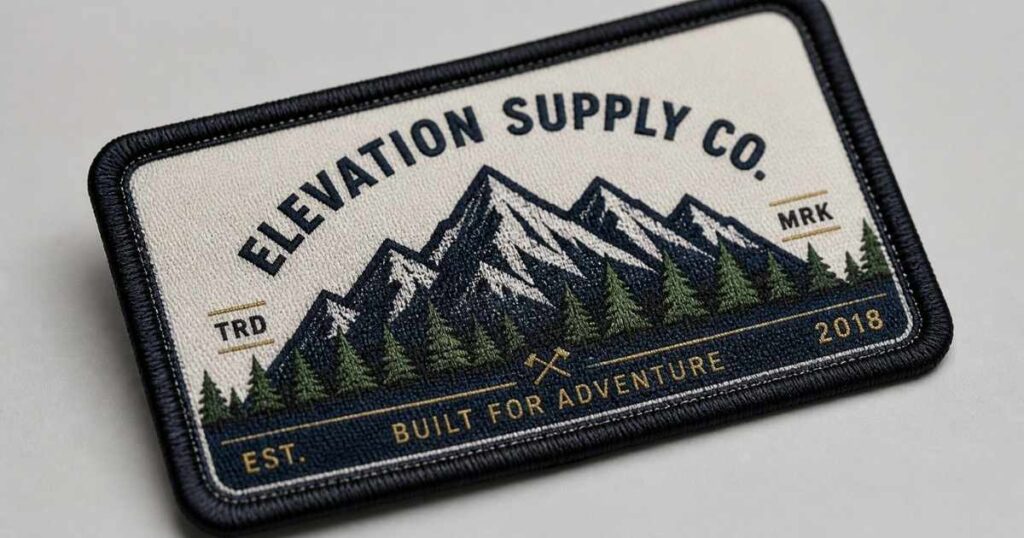
Woven patches are made on an industrial loom, integrating the design directly into the fabric rather than stitching thread on top of a base. The result is flatter, thinner, and capable of capturing fine details that embroidery can’t.
These are the right call when:
- Your logo has intricate linework, small typography, or multiple thin elements
- You want a lower-profile patch that sits flush on lightweight garments
- Your brand aesthetic leans minimal or refined rather than textured
No minimum Custom patches orders are often easier to fulfill in woven format too, because digital setup is less labor-intensive than embroidery machine programming.
PVC and Rubber Patches — Best for Outdoor and Tactical Applications
PVC patches are molded from soft rubber-like plastic, making them waterproof, fade-resistant, and virtually indestructible. They’re a different product category entirely — no fabric, no thread — and they suit a specific kind of business.
If you run an outdoor company, a gym, a landscaping crew, or any operation where gear takes a beating, PVC is worth serious consideration. Pantone matching is straightforward, and the ability to create true 3D relief details gives them a premium look on bags, vests, and tactical gear.
They’re not for everyone. The aesthetic is distinctly contemporary-utilitarian. A bakery or a boutique retailer probably wants something warmer.
Printed and Leather Patches — Retail-Ready Options for Product Branding
Printed (sublimated) patches use dye-sublimation to reproduce full-color, photographic designs on fabric. If your logo uses gradients, complex illustrations, or photographic elements, this is the only patch format that can handle them faithfully. The trade-off is a flatter, less dimensional look than embroidery.
Leather patches — genuine or faux — are the standard on trucker hats, beanies, and denim products. They carry a premium, artisanal signal that works well for craft brands, coffee companies, and any business whose identity leans toward quality craftsmanship. Designs are typically laser-etched or embossed, keeping detail sharp.
What Is the Difference Between Embroidered and Woven Patches?
The practical difference: embroidered patches build up raised thread on a fabric base, giving them texture and dimension. Woven patches integrate design into the fabric structure on a loom, producing a smooth, flat finish with sharper fine-detail resolution. Embroidered is the better choice for bold, icon-style logos; woven is better for complex or detailed designs where clarity at small sizes matters.
Backing Options Explained: Iron-On, Sew-On, Velcro, and Heat Press
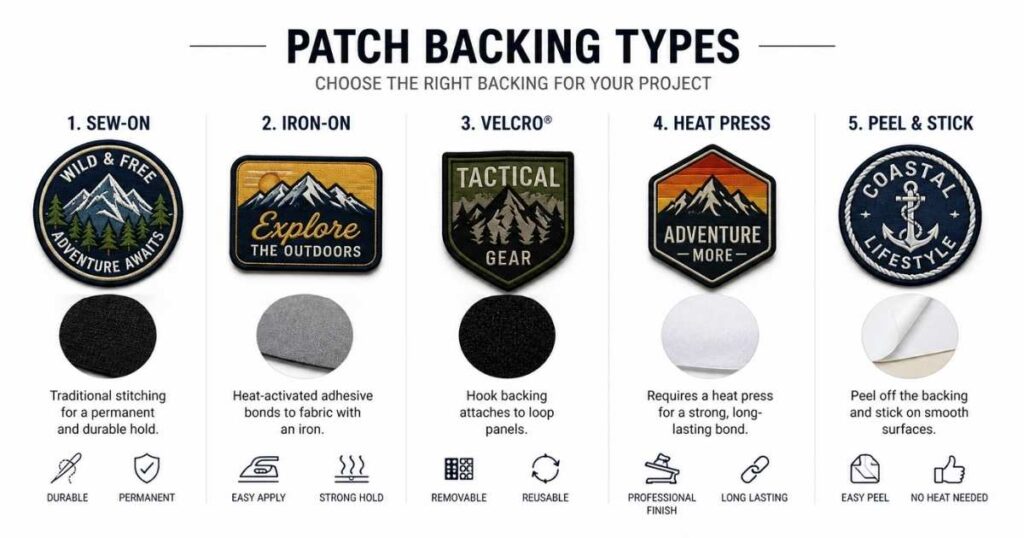
How a patch attaches to a garment matters as much as how it looks. The wrong backing for the application is a recurring complaint in patch reviews — peeling patches, detachment after a few washes, or patches that can’t be applied to the specific fabric involved.
Here’s a clear breakdown:
| Backing Type | Best For | Notes |
|---|---|---|
| Sew-on | Employee uniforms, permanent applications | Strongest long-term bond; requires a sewing machine or hand-stitching |
| Iron-on | Casual merch, promotional giveaways, DIY | Uses thermoplastic adhesive; convenient but weaker on its own for heavy-use items |
| Heat press | Commercial garment decoration | Industrial iron-on; much stronger bond than a household iron |
| Velcro / hook & loop | Tactical gear, rotating displays, staff ID patches | Allows repositioning; requires sewing the loop side onto the garment |
| Peel & stick | Temporary applications, samples, trade shows | Not wash-resistant; for display or trial use only |
How Durable Are Iron-On Patches After Washing?
Applied correctly to cotton or polyester with a proper household iron, iron-on patches using industrial-grade thermoplastic adhesive can handle 20–50 wash cycles before the edges begin to lift. The variables are fabric type (they bond weakly to nylon and polyester blends), application temperature, and whether adequate pressure was applied during bonding.
The practical recommendation: for anything that will be laundered regularly — uniforms especially — add a perimeter of sew-on stitching after the initial iron-on application. This takes a few minutes and extends patch life indefinitely.
Which Backing Type Lasts Longest on Employee Uniforms?
Sew-on is the industry standard for uniforms that go through regular commercial laundering. No adhesive can match mechanical stitching over hundreds of wash cycles. If your garments will go through industrial laundry processes, there’s no debate.
For garments that only require hand washing or light machine washing, a heat-press application (done professionally with calibrated temperature and pressure) plus perimeter stitching is a strong alternative that most commercial embroiderers offer.
Backing Comparison by Use Case
- Employee uniforms: Sew-on or heat press + perimeter stitch. Non-negotiable for longevity.
- Branded merchandise (hats, bags, jackets for retail): Iron-on with sew-on reinforcement, or sew-on only for premium items.
- Promotional giveaways / trade show patches: Iron-on is fine — recipients typically apply them once to a personal item. Velcro works well if you want recipients to be able to reposition.
- Limited-edition collectibles: Sew-on or Velcro — these are display and collect items; durability expectations are different, but perceived quality matters.
If you want your staff uniforms to look professional and consistent, Custom Patches for Employee Uniforms covers everything from durable backing options to bulk order consistency, helping businesses maintain a polished appearance across every team member.
How Much Do Custom Patches Cost? Pricing Breakdown for Small
Businesses
For startups and small brands testing new ideas, Custom Patches No Minimum Order explains when low-quantity patch orders are the smartest choice for sampling, limited editions, and cost-effective prototyping.
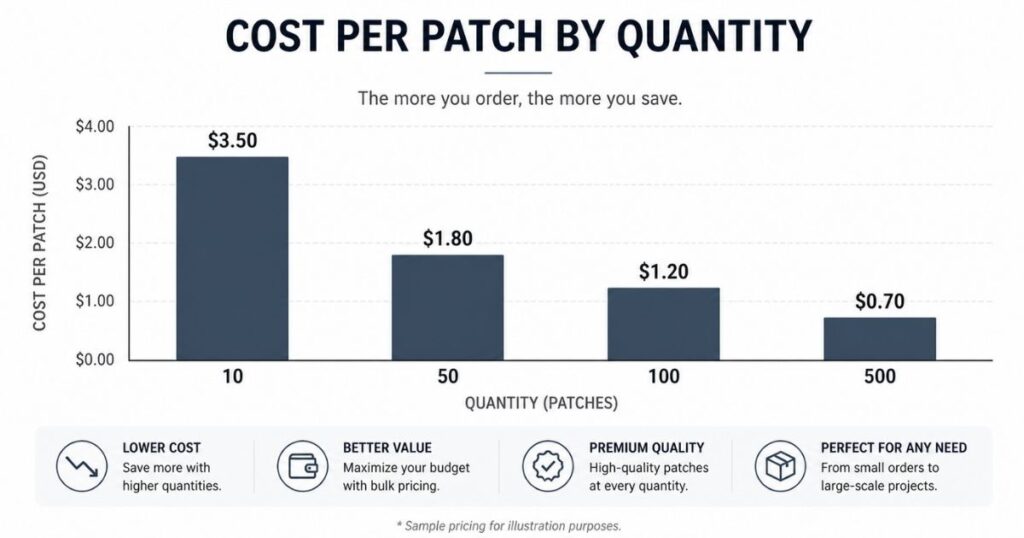
Patch pricing is driven by four variables: patch type, size, quantity, and design complexity (expressed as embroidery percentage — the proportion of the patch surface covered by stitching).
What Is the Minimum Order Quantity for Custom Patches?
This varies by supplier and patch format. As a general benchmark:
- Most standard embroidered patches: 50-piece minimum
- Chenille patches: typically 25-piece minimum
- Woven, PVC, and leather: varies; often 50–100 pieces
- No-minimum suppliers (GS-JJ, Ninja Patches, Patches.co): accept orders of 1–10 pieces at a significant per-unit premium
Cost Per Patch at Different Order Volumes
These are realistic ballpark ranges for a standard embroidered patch (2–3 inches, 75% embroidery coverage, iron-on backing):
| Order Quantity | Est. Price Per Patch |
|---|---|
| 10 pieces | $5.00 – $9.00 |
| 50 pieces | $2.50 – $4.00 |
| 100 pieces | $1.50 – $2.50 |
| 500 pieces | $0.75 – $1.25 |
PVC and leather patches run slightly higher at equivalent quantities. Woven patches are comparable to embroidered. Printed / sublimated patches can come in lower for large runs.
The per-unit cost drops sharply between 10 and 100 pieces. If you’re in the early planning stage and the math on 50+ pieces works for your use case, the bulk pricing breakeven is usually reached around the 100-piece mark.
No-Minimum-Order Suppliers: When the Premium Is Actually Worth It
Paying $6–$9 per patch on a 10-piece order sounds expensive. But for specific situations, it makes sense:
- Prototyping a new design before committing to a bulk run
- Testing a new colorway or badge style for a limited-edition product
- Replacing a single damaged uniform patch without reordering 50
- Event-specific runs where you genuinely only need a small number
Suppliers like GS-JJ, Patches4Less, and Ninja Patches all offer low or no-minimum options. The key question is whether the per-unit premium is smaller than the cost of ordering 50 pieces and having 30 go unused.
Do I Have to Pay for Artwork or Setup Fees?
Most reputable custom patch suppliers in 2025–2026 have eliminated setup and artwork fees as standard practice. Suppliers including PinMart, American Patch, The Monterey Co., and GS-JJ explicitly offer free digital proofs and free artwork conversion.
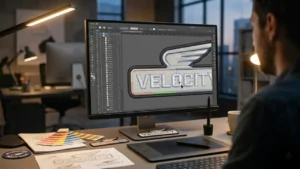
What this means for you: submitting a rough logo or a sketch is acceptable. The supplier’s design team will digitize it — converting your artwork into a stitch file — at no additional charge. Vector artwork (AI, EPS, PDF) gives the best results, but a high-resolution JPG or PNG works too.
Confirm this with any supplier before ordering. A few lower-tier suppliers still charge digitizing fees of $15–$40 per design, which can meaningfully change the economics of a small order.
A high-quality patch always starts with proper artwork preparation. In How to Design a Logo Patch (Artwork Guide), you’ll learn about vector file formats, embroidery-friendly logo adjustments, and the digitizing process that improves final patch quality.
Real-World Use Cases: How Small Businesses Deploy Custom Patches

Employee Uniforms and Workwear — Building Team Identity on a Budget
This is the most direct application and typically delivers the clearest return. A custom logo patch for hats and patch on a jacket, apron, polo, or work shirt does three things simultaneously:
- Identifies your staff to customers — reducing the “do you work here?” friction
- Signals professionalism — a stitched patch reads as more established than a printed logo
- Creates walking brand impressions — employees commuting to and from work extend your brand’s reach beyond the business premises
For businesses in hospitality, trades, retail, and food service, embroidered patches on uniforms are one of the highest-ROI branding investments available.
Branded Merchandise and Retail Add-Ons (Hats, Bags, Totes)
Custom logo patches for hats have become a standard component of small business merchandise programs. A custom patch hat — particularly a dad hat or trucker style with a leather or embroidered badge — is a product customers will actually wear, turning a sale into ongoing brand exposure.
The same logic applies to canvas tote bags, denim jackets, and canvas backpacks. Patches add a boutique, intentional quality to merchandise that heat-printed or screen-printed logos often lack. They also allow you to update your branding without retiring an entire inventory — remove the old patch, apply the new one.
Event Giveaways and Trade Show Swag
Patches have a significant advantage over other promotional giveaways: people keep them. Branded pens get lost. Tote bags pile up. A well-designed patch ends up on a jacket, laptop bag, or backpack, where it’s displayed voluntarily.
For trade shows and events, patches function as a low-cost, high-retention promotional item. When ordered in bulk at 500+ pieces, the per-unit cost can fall below $1.00, making them competitive with pens and notepads on a cost-per-item basis — but with substantially longer shelf life and more intentional placement.
Using Patches for Limited-Edition Product Drops and Collectible Runs
This angle is underused in small business marketing, but it’s well-established in streetwear and craft culture. The mechanic is straightforward: release a limited run of patches tied to a product launch, a season, or a milestone.
Why it works:
- Artificial scarcity drives urgency — “only 100 made” is a legitimate claim when you order 100
- Collectability extends engagement beyond the initial sale
- Brand storytelling — each patch can represent something meaningful (a founding year, a flagship product, a local landmark)
- Low production risk — a 50-piece run of woven patches costs a few hundred dollars
Several small coffee brands, independent bookshops, and craft breweries have built loyal communities around annual or seasonal patch releases. The barrier to entry is low; the ceiling for engagement is surprisingly high.
Social Media UGC Campaigns Built Around Patch Giveaways
A patch giveaway structured around user-generated content (UGC) is an underexplored growth tactic for small businesses. The framework:
- Order 50–100 patches (custom patches low MOQ is achievable for most budgets)
- Run a campaign — “tag us in a photo of your patch, win [prize]” or “first 50 customers this month get a free patch”
- Collect UGC showing your patch on real people’s clothing, bags, and gear
- Repurpose that content across your channels
The patch itself generates the incentive. The photos it generates become authentic social proof. And because patches end up on visible items, they continue working after the campaign ends. Suppliers like Ninja Patches and Patches4Less can turn around small promotional runs quickly when timing is tied to a campaign.
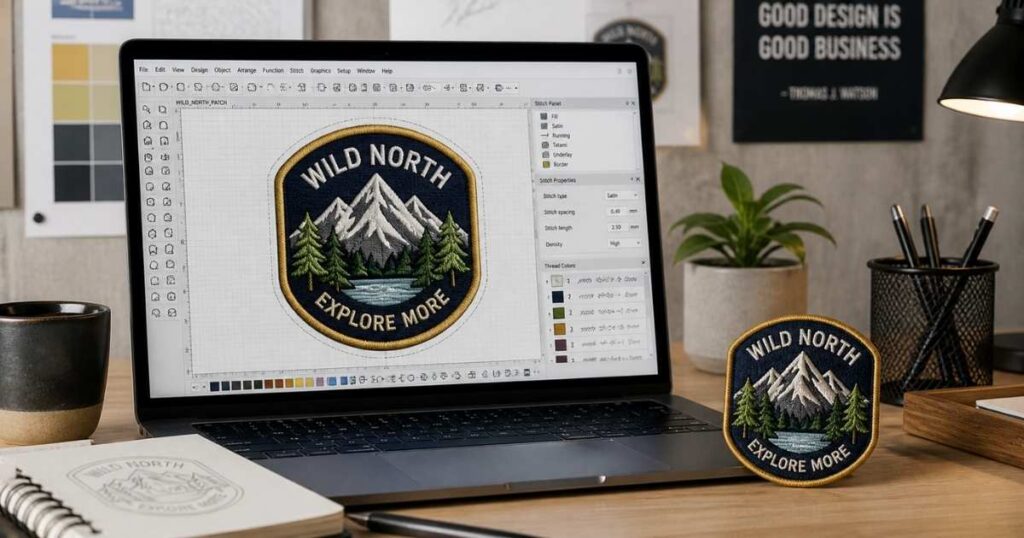
How to Design a Custom Patch: What You Need Before You Order
What File Format Do I Need to Submit for Custom Patches?
Vector files are ideal — AI, EPS, or PDF formats produced in Adobe Illustrator or similar software. Vector artwork scales without quality loss and transfers cleanly into the digitizing process.
If you only have a raster file (JPG, PNG, TIFF), high resolution is the priority — at least 300 DPI at the intended patch size. Most reputable suppliers will convert raster files to vector at no charge as part of the free proofing process.
What to avoid: low-resolution screenshots, files exported from presentation software, or logos pulled from a website (typically 72 DPI, too low for clean reproduction).
Logo Simplification Tips: What Works in Embroidery and What Doesn’t
The translation from screen to stitched fabric involves real constraints. Understanding them before you submit artwork saves revision rounds.
What embroidery handles well:
- Solid color fills with clear boundaries
- Bold text at 10+ point size in the finished patch size
- Simple geometric shapes and strong outlines
- High-contrast color combinations
What embroidery struggles with:
- Gradients and soft color transitions (use printed/sublimated patches instead)
- Text smaller than roughly 3–4mm in height
- Fine linework thinner than 2–3 thread widths
- Photographic detail or complex illustration
A practical test: squint at your logo until the detail blurs. What remains? That’s roughly what your embroidered patch will look like. If the essential brand elements survive that test, you’re in good shape.
Choosing Size: How Big Should a Patch Be?
Size matching to the application surface matters more than most first-time buyers expect.
- Hat (front panel): 2 – 2.5 inches wide is standard; larger reads as oversized on most hat styles
- Jacket breast / chest: 3 – 4 inches; enough to read clearly from a short distance
- Jacket back / full back: 8 – 12 inches; this is statement territory, appropriate for motorcycle clubs, sports teams, and heritage brand aesthetics
- Bag / tote: 3 – 5 inches depending on placement; centered on a canvas tote can go up to 4 inches comfortably
- Sleeve: 2 – 3 inches; should be legible but not dominate the garment
When in doubt, order a physical sample at your intended size before committing to a full run. Several suppliers — including The Monterey Co. — offer free sample packs.
Border Styles: Merrowed Edge vs. Heat-Cut — Pros and Cons
The border finish affects both aesthetics and durability:
Merrowed border (thread-wrapped edge): the classic patch look — a visible raised thread border that frames the patch and prevents fraying. Works best for standard shapes (circles, ovals, rectangles, shields). The border itself becomes part of the design; choose border thread color intentionally.
Heat-cut edge (laser or die-cut): the patch is cut to a custom shape with a heat-sealed perimeter rather than a thread border. Allows for complex silhouettes — your patch can match the exact outline of your logo or character. Cleaner look for modern branding; slightly less fraying protection over many years of use.
For workwear on a budget, merrowed is more durable and forgiving. For fashion-forward branded merchandise where the patch shape is part of the design, heat-cut is worth the slightly higher cost.
How to Choose a Custom Patch Supplier (Without Getting Burned)
Red Flags in Patch Supplier Quotes You Should Never Ignore
The custom patch market includes a wide range of supplier quality. These warning signs should give you pause:
- No free proof or digital sample offered — any legitimate supplier shows you exactly what you’re getting before production begins
- No physical address or phone number listed — overseas-only suppliers with no US contact point create problems if your order arrives wrong
- Digitizing or setup fees on standard designs — a fee structure that charges $25–$40 before you’ve even approved a proof is a red flag in 2025
- Turnaround times that seem impossibly fast — a 3-day turnaround from overseas is almost always achieved by cutting production quality corners
- No revision policy stated — you should be able to request changes at the proof stage without additional charges
- Reviews that mention consistent color inaccuracies — this signals poor Pantone matching processes; your brand colors will look different on the final product
Domestic vs. Overseas Production: Turnaround, Quality, and Cost Trade-Offs
Both options are legitimate; the right choice depends on your priorities.
Domestic suppliers (American Patch, PinMart, The Monterey Co., Patches4Less):
- Turnaround: typically 10–15 business days standard, 5–7 days rush
- Quality control: direct communication, easier resolution when issues arise
- Cost: 20–40% higher per unit than comparable overseas orders
- Best for: tight deadlines, first-time orders, complex designs needing close collaboration
Overseas suppliers (GS-JJ and similar):
- Turnaround: 15–25 business days including shipping; factor this into planning
- Quality: has improved significantly; reputable overseas suppliers produce excellent work
- Cost: meaningfully lower, especially at 500+ pieces
- Best for: established designs being reordered, large quantity runs where cost savings matter
How Long Does It Take to Get Custom Patches Made?
Standard timelines from order placement to delivery:
- Embroidered and sublimated: 2–3 weeks domestic; 3–5 weeks overseas
- Leather and PVC: 3–4 weeks domestic; 4–6 weeks overseas
- Rush orders: most domestic suppliers offer 5–7 business day production for a 20–30% premium
Build in buffer for proof approval rounds. A first-time order with design revisions can add 3–5 business days. If you’re ordering for a specific event, place your order at least 6 weeks out.
What Questions to Ask Before Placing Your First Bulk Order
Before committing to a large quantity, confirm the following with your supplier:
- What is included in the free proof, and how many revisions are allowed?
- Will the final product match the proof exactly in terms of color (and is Pantone matching available)?
- What is the defect policy, and how are replacements handled?
- What is the exact production and shipping timeline from proof approval to delivery?
- Can I order a pre-production sample before the full run?
- Are digitizing / setup fees included, or charged separately?
Suppliers who answer these clearly and without hesitation are the ones worth working with.
Custom Patch ROI: Measuring the Impact on Your Brand
Cost-Per-Impression Comparison: Patches vs. Print Ads vs. Branded Pens
The ROI case for custom patches becomes compelling when you run the numbers against alternatives.
Consider a staff member who wears a patch-branded jacket 5 days a week, 50 weeks a year, in a public-facing role (retail, hospitality, trade work). At a conservative 30 organic visual impressions per day — customers, commuters, passersby — that patch generates around 7,500 impressions per year.
| Marketing Item | Typical Cost | Est. Annual Impressions | Cost Per Impression |
|---|---|---|---|
| Embroidered patch (jacket, 100-piece run) | ~$2.00 | 7,500/year | ~$0.00027 |
| Branded pen | ~$0.75 | Lost in 2 weeks, ~100 | ~$0.0075 |
| Local print ad (quarter page) | ~$400 | ~5,000 per issue | ~$0.08 |
| Facebook ad (CPC model) | ~$1.00/click | 1 click = 1 visit | ~$1.00+ |
The patch wins decisively on cost-per-impression over any time horizon beyond a few weeks. The caveat is reach — patches don’t target specific demographics the way digital ads do. But for local brand recognition and community presence, the economics are hard to beat.
How to Track Brand Lift from Patch-Based Employee Uniform Programs
Most small businesses don’t measure this, which means they underestimate the return. A few practical approaches:
Customer survey question: “How did you first become aware of us?” Include “I saw a staff member / someone wearing your branding” as an option. Track this quarterly.
New customer intake: If you have any intake process (appointment booking, first purchase, membership sign-up), add a one-question origin survey. Even a rough percentage of “saw someone in your uniform” is useful data.
Social media monitoring: Set up a brand mention alert. If your patch has a unique enough design, customers who photograph it and tag you are giving you a direct signal.
Before-and-after comparison: If you roll out a uniform program, compare month-over-month foot traffic, social mentions, or referral volume against the same period the prior year. The patch isn’t the only variable, but a consistent upward shift in unprompted brand mentions is meaningful.
The real value of patch-based branding isn’t captured in a single metric. It compounds. Customers recognize your brand before they walk through the door. Staff feel more connected to the business. The perceived quality of your operation rises without a corresponding rise in operating costs.
Summary: What to Take Away
Custom patches are one of the few marketing tools where the cost-per-impression curve keeps improving the longer you use them. A $2.00 patch on an employee’s jacket isn’t a $2.00 expense — it’s a years-long impression engine.
Here’s the condensed version of everything above:
- Match patch type to your design. Bold logos → embroidered. Fine detail → woven. Outdoors/tactical → PVC. Retail premium feel → leather.
- Match backing to application. Uniforms → sew-on or heat press + stitching. Merch and giveaways → iron-on patches for uniforms is fine.
- Size matters. 2–2.5 inches for hats, 3–4 for chest placement, custom shape requires a heat-cut edge.
- Order quantity shapes cost significantly. The 100-piece threshold is where unit economics shift in your favour. Use no-minimum options for prototyping only.
- Verify artwork early. Embroidery percentage, minimum text size, and Pantone matching all affect the final result. Submit vector artwork where possible.
- Vet your supplier. Free proofs, a clear revision policy, and explicit Pantone matching are non-negotiable for a professional result.
- Measure it. Even basic customer origin tracking will reveal how much your patch program is contributing to brand awareness.
The businesses getting the most from custom patches aren’t treating them as a line item in a uniform budget. They’re treating them as a brand asset — one that compounds in value the more consistently they’re worn, distributed, and deployed.
Looking to brief a supplier? Use the questions in the “How to Choose a Supplier” section above as your starting checklist.