Embroidered vs woven patches — it’s the question every brand owner, uniform buyer, and custom apparel designer faces before placing an order. And getting it wrong is more costly than most people expect.
After testing both patch types across dozens of client projects and production runs, I can tell you this: the difference goes far beyond looks. Texture, detail capacity, garment compatibility, and long-term durability all hinge on which construction method you choose.
The short answer? Embroidered patches deliver a raised, tactile, 3D look ideal for bold logos and heavy-duty applications. Woven patches offer a flat, high-resolution finish that handles fine detail, small text, and lightweight fabrics far better.
This guide breaks down every dimension of the comparison so you walk away with a clear, confident decision — no guesswork required.
Our new guide on Best Embroidery Companies in the USA (2025–2026) breaks down the most trusted companies for premium custom apparel and patch production.
Embroidered vs Woven Patches: What’s the Core Difference?
Both patch types use thread. That’s where the similarity ends. The construction method is completely different, and it drives every practical difference you’ll encounter in texture, detail, cost, and durability.
How Embroidered Patches Are Made
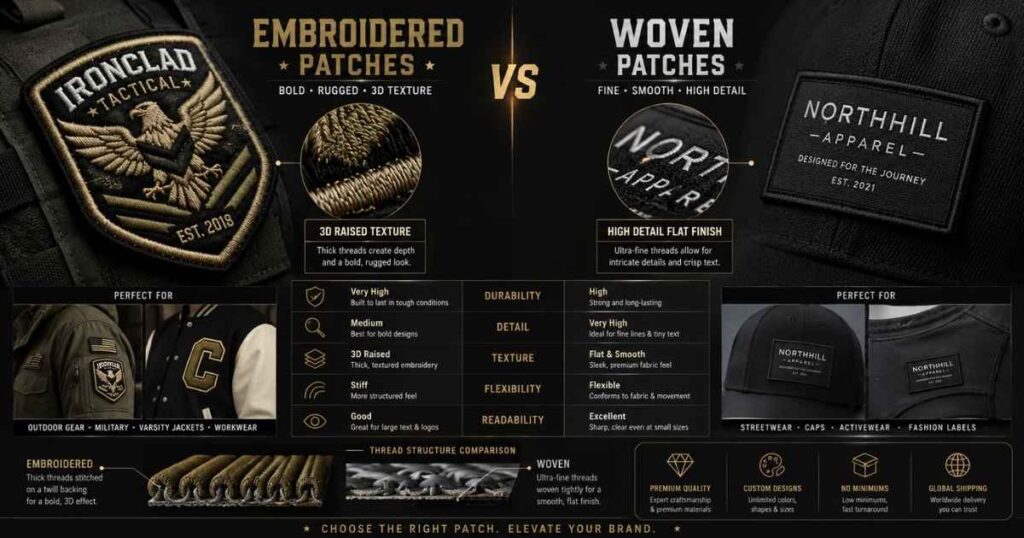
Embroidered patches are produced by stitching thick embroidery threads onto a twill base using industrial embroidery patches machines. The thread is built up in layers on top of the backing fabric — not integrated into it.
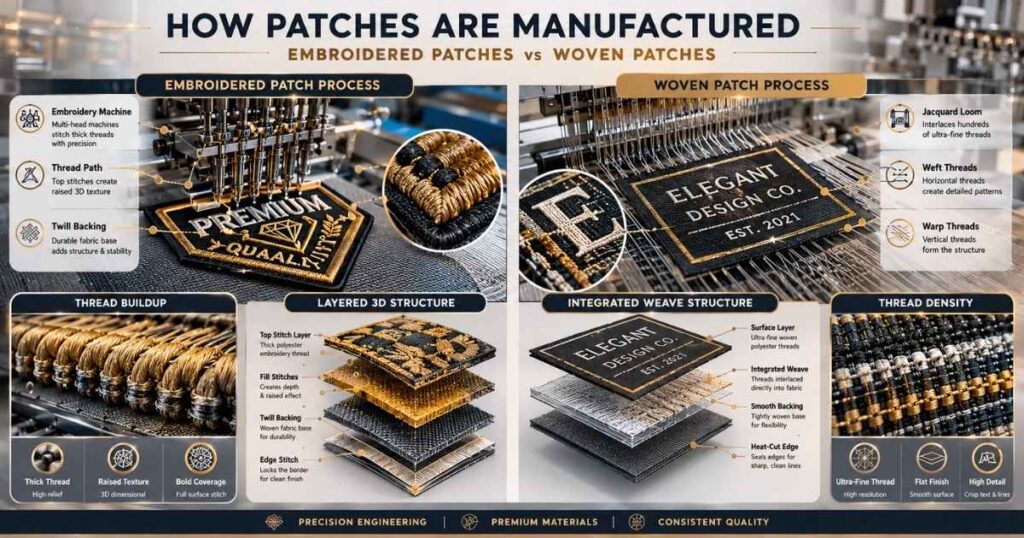
This process creates the signature raised surface embroidered patches are known for. The result is a bold, dimensional appearance with a 3D texture that catches light and commands attention from a distance.
However, thread thickness is both the strength and the limitation of embroidery. Thick thread means impactful visuals — but it also means fine lines, gradients, and small text become difficult or impossible to reproduce cleanly. Most suppliers offer 50%, 75%, or 100% thread coverage percentage options, each affecting cost and appearance.
If you’re planning a branded apparel project, our detailed How Much Does Custom Embroidery Cost? (2026 Pricing Guide) explains pricing factors, digitizing fees, order quantities, and what affects final embroidery costs.
How Woven Patches Are Made
Woven patches are created using ultra-fine threads on a loom — often a jacquard loom — where the design is built into the fabric structure itself rather than stitched on top. Think of it like how a clothing label is made.
Because the threads are much finer and woven together tightly, the result is a completely flat finish with no raised texture. The design clarity is exceptional — woven patches can reproduce text as small as 4pt and lines as thin as 0.5mm.
A damask patch is simply a premium variation of the woven technique — it uses a higher thread count and denser weave for even greater detail. When suppliers use the terms “soft woven,” “woven,” or “damask” interchangeably, they’re all describing flat-woven construction.
Side-by-Side Comparison Table
| Feature | Embroidered Patches | Woven Patches |
|---|---|---|
| Construction | Thread stitched on top of twill base | Thread woven into the fabric itself |
| Thread thickness | Thick embroidery thread | Ultra-fine woven thread |
| Surface texture | Raised, 3D textured feel | Flat, smooth finish |
| Design detail | Bold shapes; limited fine detail | High resolution; small text & thin lines |
| Min. text size | 8–10pt minimum | As small as 4pt |
| Weight & profile | Thicker and heavier | Thin, lightweight, low-profile |
| Flexibility | Less flexible; stiffer | Soft and flexible |
| Durability | Highly durable; abrasion resistant | Durable; better for frequent washing |
| Typical cost | Slightly higher; more thread used | Often more cost-effective at scale |
| Best for | Uniforms, outerwear, bold logos | Fashion labels, corporate branding, hats |
If you’re new to custom embroidery, understanding how artwork gets converted into stitch files is essential. Our beginner-friendly guide on What Is Embroidery Digitizing? A Beginner’s Complete Guide explains how digitizing impacts patch quality, detail clarity, and embroidery accuracy.
Texture and Appearance: Which Patch Looks Better?
“Better” depends entirely on the aesthetic you’re after. These two patch types are designed for different visual outcomes — and understanding that distinction saves you from a costly mismatch.
The Raised 3D Effect vs Flat Smooth Finish
Embroidered patches have a tactile, raised quality that makes logos feel handcrafted and substantial. The threads catch light differently as the viewing angle changes, giving the design depth and dimension. This is why they’re the go-to for biker vest patches, scout badges, and varsity jackets — the texture is part of the identity.
Woven patches look and feel more like a premium clothing label. The flat finish reads as modern, refined, and polished. For fashion labels and corporate uniforms that demand a clean, professional appearance, woven patches fit naturally without adding visual noise.
When Texture Is an Advantage — and When It’s Not
Texture works in your favor when bold visibility matters more than fine detail. A fire department patch needs to be seen from across a room. A military patch gains authority from its dimensional weight.
Texture works against you when your design includes thin lines, gradient shading, or small typography. Thick embroidery threads physically cannot render these elements accurately — the result looks blurry, cluttered, or unreadable.
In my testing, logos with taglines under 6pt were completely illegible on embroidered patches. The same artwork on woven patches was crisp and sharp at half the size.
Choosing between woven and embroidered patches becomes even more important for hats because curved surfaces affect texture and readability. That’s why our roundup of Best Custom Embroidered Hat Companies in the US highlights brands that specialize in premium embroidered cap designs and patch applications.
Design Detail and Small Text: Which Handles Complexity Better?
This is where the choice becomes non-negotiable. Design complexity is the single biggest factor in determining which patch type will actually deliver what your artwork promises.
Minimum Text Size for Embroidered Patches
Embroidery machines stitch thread paths. Every letter, curve, and line is built from thread that has physical width. This creates a practical floor: embroidered patches cannot reliably reproduce text smaller than 8–10pt.
When a client sends a logo with a four-word tagline in 5pt font and requests embroidery, the result is almost always a blurry blob of thread. This is the most common ordering mistake suppliers like Panda Patches and PatchCraftPro report seeing — and it’s 100% preventable.
The rule of thumb: if your design has small text, thin lines, or intricate gradients — anything below 4–5mm — embroidery will struggle. This is also why proper embroidery digitizing and digitizing artwork correctly before ordering is so critical.
Minimum Text Size for Woven Patches
Because woven patches integrate ultra-fine threads during production, they achieve a level of small text readability and design clarity that embroidery simply cannot match. Text as small as 4pt and lines as thin as 0.5mm remain sharp and legible.
This makes woven patches the clear choice for logos with complex wordmarks, corporate patches with URLs or addresses, and any design where color fidelity and gradient reproduction are critical.
Gradients, Thin Lines, and Intricate Logos — Which Patch Wins?
Woven patches win for complexity. Gradient reproduction, fine linework, and detailed artwork all render with far greater accuracy in woven construction. This is why fashion labels, tech brand patches, and detailed insignia almost always use woven or damask construction.
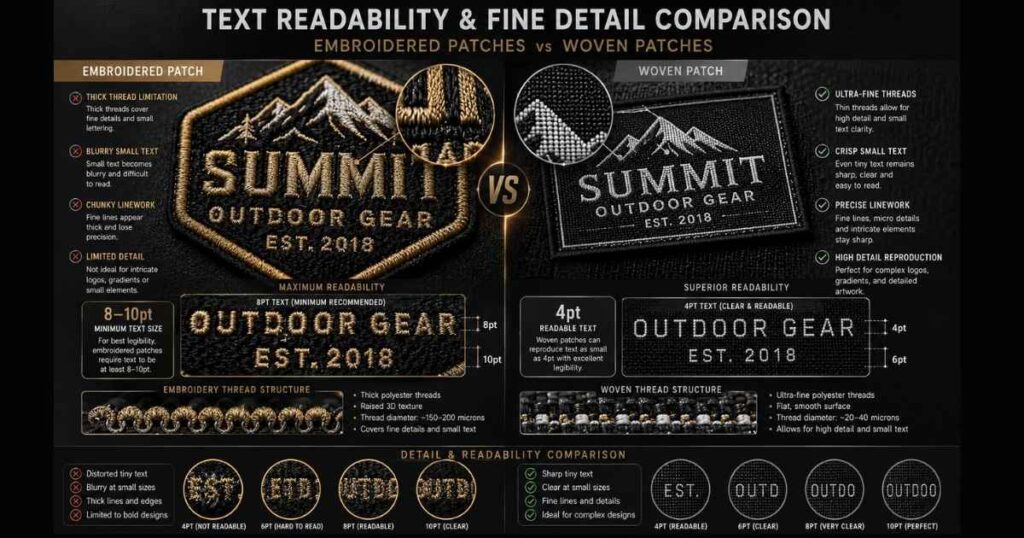
Embroidery wins for impact. A bold shield logo with thick letterforms on a police patch needs dimensional presence, not microscopic detail. That’s exactly what embroidery delivers.
For businesses that need small batch orders or test runs, ordering flexibility matters just as much as quality. Our guide to Custom Embroidered Patches: Best Providers, No Minimum Orders covers suppliers offering low-quantity custom patch options without sacrificing stitching quality.
Durability and Washability: Which Patch Lasts Longer?
Both patch types are built to last — but they perform differently depending on how they’re used and how they’re attached.
How Embroidered Patches Hold Up Under Heavy Wear
Embroidered patches are exceptionally durable under abrasion. The thick threads and twill base create a robust structure that withstands rough outdoor conditions, heavy friction, and the kind of wear that military patches, tactical gear patches, and workwear encounter daily.
The trade-off is that embroidery threads can fray or fade with aggressive washing cycles or exposure to harsh chemicals. Proper care — gentle machine wash, cold water, inside-out — significantly extends their lifespan.
How Woven Patches Perform Through Repeated Washing
Woven patches are built differently — the design is part of the fabric itself, not layered on top. This means they tend to hold their detail and color fidelity better through frequent washing, especially on delicate or lightweight garments.
They’re also less prone to thread snags since there are no exposed raised threads. For activewear, performance gear, and items washed frequently, woven patches typically outperform their embroidered counterparts in long-term appearance retention.
Backing Types and How They Affect Longevity
Both patch types are available with multiple attachment options. The patch backing you choose directly affects how the patch wears over time:
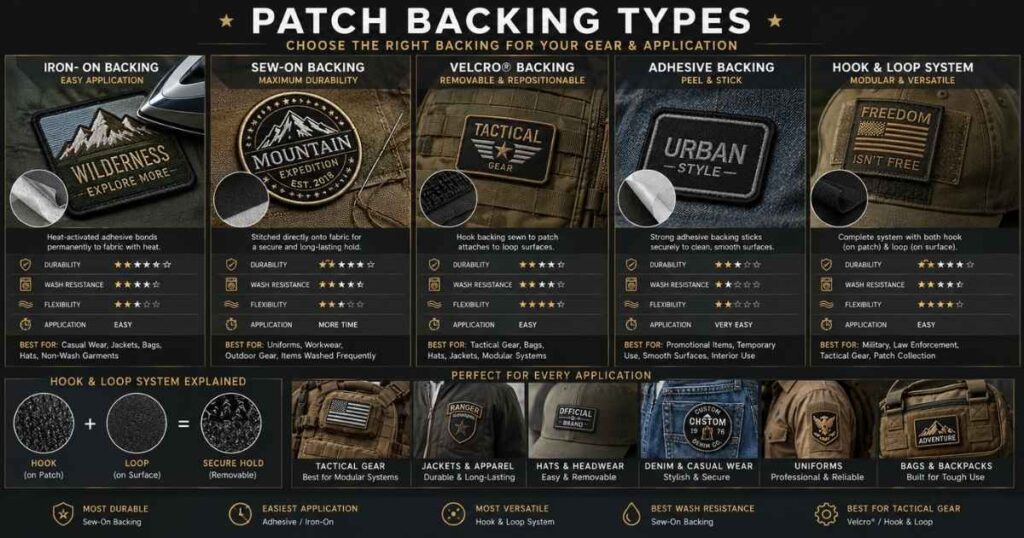
- Iron-on patches: Convenient for quick application, but the adhesive can weaken with repeated high-heat washing. Best for low-wear items.
- Sew-on patches: The most durable attachment method. Recommended for uniforms, outerwear, and anything laundered frequently.
- Velcro backing: Ideal for tactical gear and patches that need to be swapped or removed. Adds bulk but offers flexibility.
If longevity is the priority, sew-on is almost always the right choice regardless of patch type.
A blurry logo usually starts with poor artwork preparation, not bad embroidery. Before sending your design to production, read How to Prepare Your Logo File for Embroidery (Formats, Resolution & Tips) to avoid common file setup mistakes that reduce patch quality.
Cost Comparison: Are Woven or Embroidered Patches More Expensive?
Pricing is more nuanced than most buyers expect. The headline numbers are close — but the value calculation depends on what you’re actually getting.
Pricing Factors That Affect Both Patch Types
Several variables determine the final cost of any custom patches order, regardless of construction method:
- Size — larger patches require more material and production time
- Thread color count — more colors increase setup and changeover costs
- Thread coverage percentage — 100% coverage costs more than 50%
- Patch backing type — velcro and specialty backings add to the base price
- Quantity — per-unit cost drops significantly at higher order volumes
Bulk Order Pricing Differences
Embroidered patches generally carry a slightly higher unit cost. Each patch requires individual stitching passes, which means more thread volume and longer machine time. You’re paying for the physical depth and premium tactile feel.
Woven patches tend to be more cost-effective at scale. The loom-weaving process is faster and more efficient in high-volume production, which is why suppliers like GS-JJ and Dutch Label Shop position woven patches as the better value for detailed, large-run orders.
That said, the difference is often small enough that it shouldn’t be the primary decision driver. Choosing the wrong patch type to save a few cents per unit — and receiving blurry, unusable patches — is a far more expensive mistake.
Brand Perception vs Invoice Cost
Here’s the calculation most buyers miss: the right patch type doesn’t just represent your brand — it actively shapes how people perceive its value.
A woven patch on a premium performance shirt signals precision, modernity, and attention to detail. An embroidered patch on a $200 tactical jacket adds perceived craftsmanship and weight. The inverse creates a disconnect that undermines the entire garment.
Don’t just look at the invoice. Look at how the patch complements the final product.
If you’re using patches as part of a larger branding strategy, choosing the right patch style is only one piece of the puzzle. Our complete guide on Custom Patches for Small Business: The Complete Branding Guide explains how businesses use custom patches for brand identity, uniforms, merch, and customer retention.
Best Use Cases for Each Patch Type
Knowing when to use each patch type is the most practical knowledge you can walk away with. Below is a clear breakdown based on application.
When to Choose Embroidered Patches
Embroidered patches are the right choice when bold visual presence, traditional aesthetics, and heavy-duty durability are the priority. They’ve been the standard for decades — and for good reason.
Best applications include:
- Military patches and police patches — visibility and authority from a distance
- Fire department patches — withstands harsh, high-friction environments
- Varsity jackets and biker vest patches — the 3D texture is part of the tradition
- Scout badges — classic dimensional look that defines the format
- Corporate uniforms with simple, bold logos — max impact, no fine detail needed
When to Choose Woven Patches
Woven patches are the right choice when design clarity, small text readability, and a refined modern look matter more than raised texture.
Best applications include:
- Hat patches (structured and unstructured) — low profile adheres well to curved surfaces
- Fashion labels and clothing labels — smooth finish matches premium fabric aesthetics
- Corporate branding with detailed logos — crisp wordmarks, URLs, and taglines
- Activewear and performance gear — lightweight, flexible, no added bulk
- Any design with text under 8pt, gradients, or thin linework
Can You Use Both on the Same Garment?
Absolutely — and this is a strategy more high-end brands should adopt. Using an embroidered patch for the main chest logo (bold, dimensional, impactful) paired with a woven label inside the neck (crisp branding details, size information) gives you the best of both worlds.
THE/STUDIO and other premium suppliers regularly facilitate hybrid orders for clients who want embroidered impact on the outside and woven precision on the inside. It’s a sophisticated approach that elevates the overall perceived quality of the garment.
Still unsure which patch style fits your project best? Our detailed Custom patch types comparison guide compares embroidered, woven, PVC, chenille, leather, and sublimated patches to help you choose the ideal option for your design and garment type.
Use Case Quick Reference Table
| Use Case | Best Patch Type | Why |
|---|---|---|
| Military / police patches | Embroidered | Bold visibility, heavy-duty durability |
| Fire department patches | Embroidered | Withstands harsh outdoor conditions |
| Varsity jackets / biker vest patches | Embroidered | Classic raised look; traditional feel |
| Corporate uniforms (logo w/ small text) | Woven | Crisp lettering at any size |
| Hat patches (structured / unstructured) | Woven | Low profile; adheres to curved surfaces |
| Fashion labels / clothing labels | Woven | Smooth finish matches premium fabrics |
| Scout badges | Embroidered | Iconic 3D texture; matches tradition |
| Activewear / performance gear | Woven | Lightweight; no bulk on thin fabric |
People Also Ask: Your Questions Answered
Is woven the same as embroidered?
Are woven patches better than embroidered?
Why does my embroidered patch have blurry text?
What is a damask woven patch?
Which patch type is best for hats?
Do embroidered patches fade over time?
Quick Decision Guide: Embroidered vs Woven Patches in Under 60 Seconds
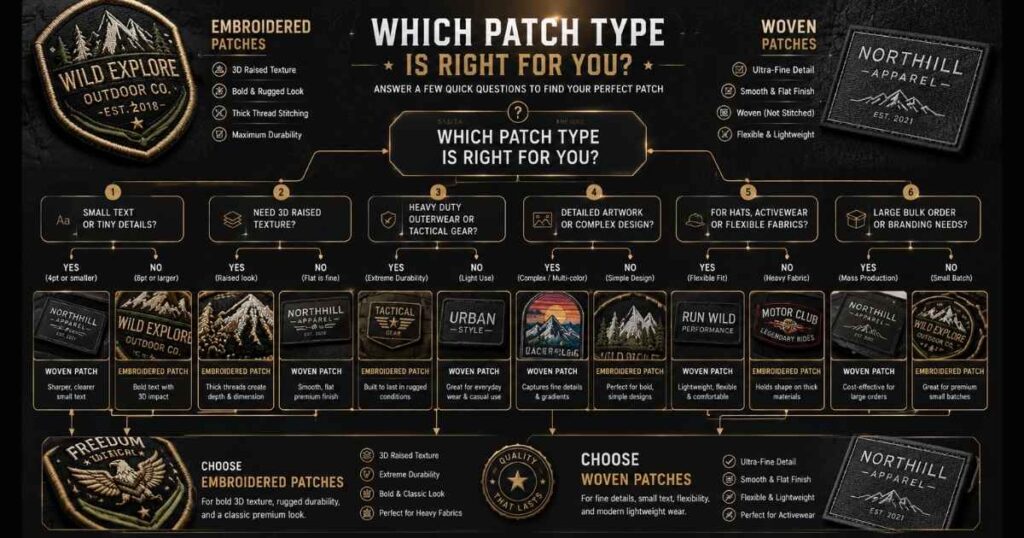
Run through these questions before you order:
1. Does your design include text smaller than 8pt, thin lines, or gradients?
- Yes → Choose woven patches
- No → Embroidered is an option
2. Where will the patch live — outerwear or lightweight fabric?
- Outerwear, tactical gear, denim → Embroidered
- Performance wear, fashion garments, hats → Woven
3. Is the 3D raised texture part of your brand identity?
- Yes (classic, traditional, bold) → Embroidered
- No (modern, clean, refined) → Woven
4. What’s your order size?
- Large bulk order with intricate design → Woven (better value)
- Small run with a simple bold logo → Embroidered
If you answered “woven” more than twice, go woven. If “embroidered” dominated, you know your answer.
Even the best patch type can fail if the artwork isn’t optimized correctly. That’s why our How to design a logo patch (artwork guide) walks you through sizing, line thickness, typography, and color choices that translate well into embroidery and woven production.
Final Verdict: Which Patch Is Right for Your Project?
The embroidered vs woven patches debate doesn’t have a winner — it has a right answer for each situation. And now you have everything you need to find yours.
Choose embroidered patches when you need bold, dimensional impact that survives heavy wear. Military patches, police patches, fire department patches, varsity jackets, and biker vest patches all belong in this category. Embroidery is the format that built the custom patch industry, and for bold, simple designs, nothing matches its presence.
Choose woven patches when your design demands precision — small text, complex artwork, fine lines, or a modern flat finish. Corporate branding, fashion labels, hat patches, and activewear all benefit from the superior design clarity and lightweight feel that loom-weaving provides.
And when in doubt? Request a free mockup from your supplier before committing. Reputable manufacturers — whether you’re working with THE/STUDIO, Dutch Label Shop, Panda Patches, or PatchCraftPro — will review your artwork and tell you which format works best before a single patch goes into production.
The right patch isn’t just decoration. It’s a statement about how seriously you take your brand. Make sure it says the right thing.
If you only need a few patches for testing, events, or product samples, bulk ordering may not make sense. Our guide on Custom patches no minimum order — when it makes sense explains when low-MOQ patch production is the smarter business decision.
💡 Pro Tip: If you’re unsure which type suits your artwork, always get a free digital mockup before ordering. The most common — and most expensive — patch mistake is choosing embroidery for a logo with small text. A 2-minute review saves weeks of turnaround time and a wasted budget.