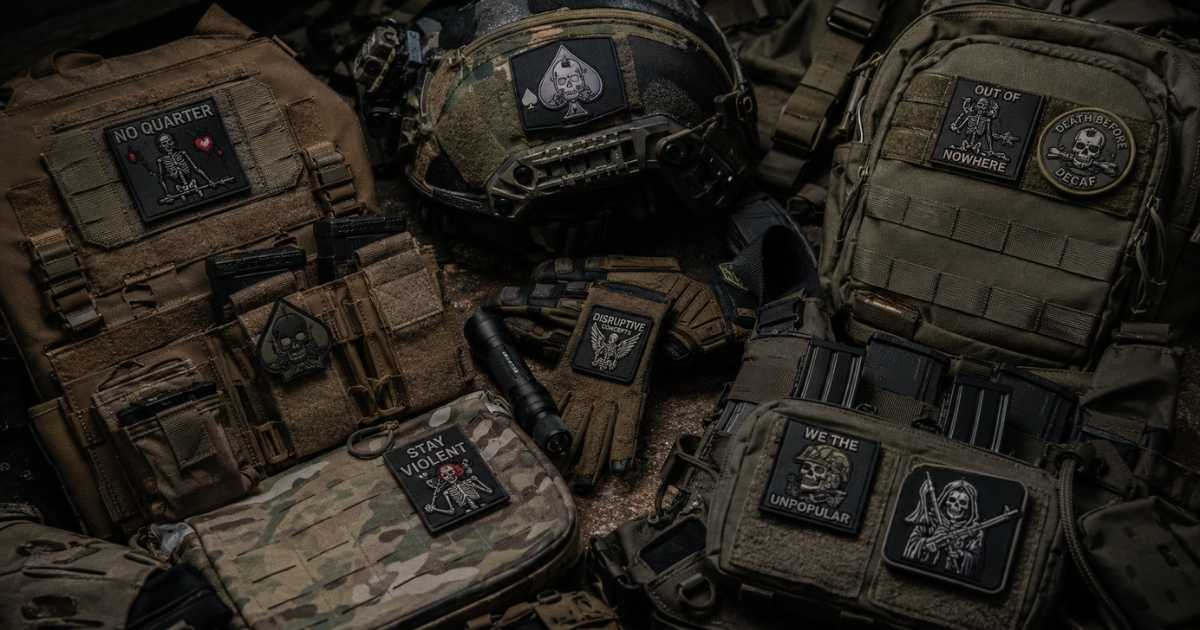
PVC patches for tactical gear are flexible, waterproof rubber insignia that attach via Velcro to plate carriers, helmets, and backpacks — delivering durability and bold 3D visuals that embroidered patches simply can’t match in the field.
Whether you’re a military operator running a plate carrier through a wet patrol, a law enforcement professional who needs reliable unit identification, an airsoft player building out a serious loadout, or an outdoor enthusiast who wants gear that expresses identity — this guide covers everything you need.
We’ll walk through what makes PVC patches the go-to choice for tactical applications, how they stack up against embroidered alternatives, the different types available, and exactly how to attach, place, and care for them. There’s also a full section on ordering custom patches if you want something built specifically for your unit or team.
Let’s get into it.
What Are PVC Patches for Tactical Gear?
PVC patches are molded insignia made from polyvinyl chloride — a soft, rubber-like plastic that holds its shape, color, and structure under conditions that would destroy fabric-based alternatives.
The manufacturing process involves injecting colored PVC into a precision metal mold (typically CNC-engraved), then heat-pressing it into the finished design. The result is a rigid yet flexible patch with crisp edges, bold color blocking, and optional raised 3D relief that gives it a tactile, high-detail finish.
They’re sometimes called rubber patches for gear or soft PVC patches, and those names are accurate — the material behaves more like firm rubber than hard plastic. It flexes without cracking and bounces back after being compressed under gear, through brush, or against body armor.
From a tactical durability perspective, it’s worth understanding the differences between materials before choosing your patch style. Our guide on Embroidered vs woven patches compares texture, detail quality, and long-term wear compared to PVC options commonly used on tactical gear.
How Are 2D and 3D PVC Patches Different?
- 2D PVC patches are flat with a single-plane design — clean, lightweight, and simple. Best for text-heavy designs, flags, or minimalist unit insignia.
- 3D tactical patches use layered depths in the mold to create raised elements — logos, skulls, animals, or emblems that literally stand out from the surface. The iconic Punisher skull and Spartan helmet designs you see everywhere are nearly always 3D molded.
The 3D format is more visually striking but adds marginal weight. For most tactical use cases, 3D is the standard.
Soft PVC vs Hard PVC: Which Works Better in the Field?
Soft PVC — the standard for patches — remains pliable in cold temperatures and won’t crack under compression. Hard PVC is stiffer and used for keychains or rigid accessories.
For tactical gear, always choose soft PVC. It conforms to curved surfaces like helmet covers and shoulder panels without lifting at the edges, and it won’t snap under pressure from gear stacking.
PVC Patches vs Embroidered Patches: The Definitive Comparison
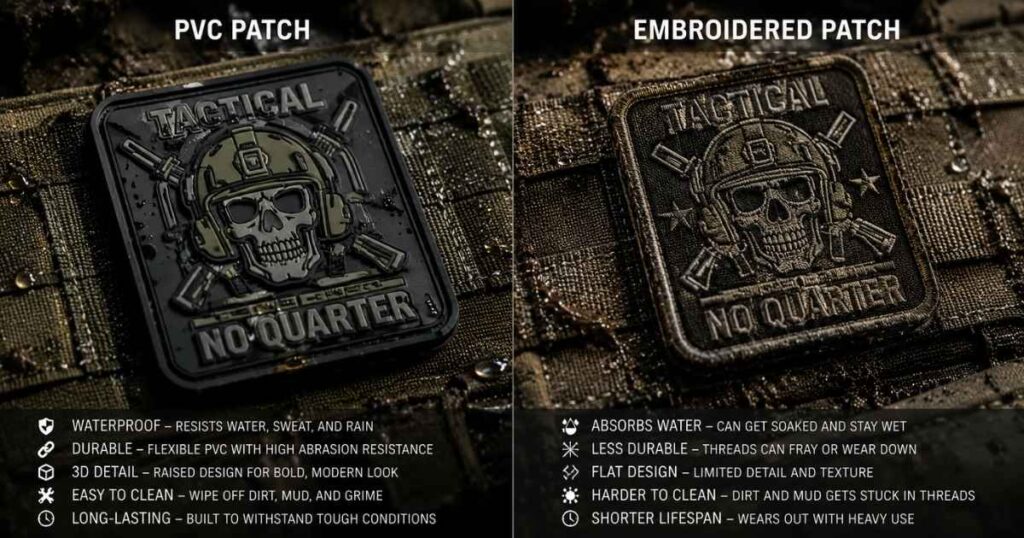
This is the question that comes up most. Here’s the honest answer: both have a place in a tactical kit — just not in the same places.
| Feature | PVC / Rubber Patches | Embroidered Patches |
|---|---|---|
| Waterproofing | Fully waterproof | Absorbs moisture |
| UV / Fade Resistance | Excellent | Moderate — threads fade |
| 3D Detail | Crisp, molded | Limited fine detail |
| Traditional Aesthetic | Modern / tactical | Classic heritage feel |
| Cost (small run) | Higher (mold cost) | More affordable |
| Abrasion Resistance | Won’t snag or fray | Threads fray over time |
| Cleaning | Wipe clean instantly | Requires spot-cleaning |
| Best Use | Field ops, plate carriers | BDUs, dress uniforms |
Durability in Harsh Conditions
When gear gets wet, muddy, and abused — PVC wins decisively. Polyvinyl chloride patches resist water, UV exposure, extreme temperatures, and friction without fading, fraying, or cracking.
In testing, PVC patches that have gone through hundreds of Velcro removal cycles, mud immersion, and sun exposure retain their color and shape far longer than their embroidered counterparts. Special Forces units have long favored PVC for exactly this reason — a patch that snags on brush or becomes waterlogged in a creek crossing is a liability, not an identity marker.
Embroidered patches, however, maintain a classic authority. For a service dress uniform or a BDU worn to a formal inspection, stitched insignia carries tradition and weight that molded rubber doesn’t replicate.
The Smart Play: Use Both
Use PVC for field gear. Use embroidered for dress and training environments.
Many tactical units run PVC morale patches on their plate carrier panels and keep embroidered rank and unit patches for their BDUs. Retailers like Tactical Gear Junkie and Tactical Outfitters stock both formats precisely because serious operators don’t choose one over the other — they choose the right tool for the context.
If you’re planning to create a fully personalized morale patch or unit insignia, the article How to design a logo patch (artwork guide) walks through sizing, color contrast, vector artwork, and design tips that work especially well for military, airsoft, and outdoor setups.
Types of PVC Patches for Tactical Applications
Not all tactical patches serve the same purpose. Here’s a breakdown of the main categories and when each makes sense.
Morale Patches
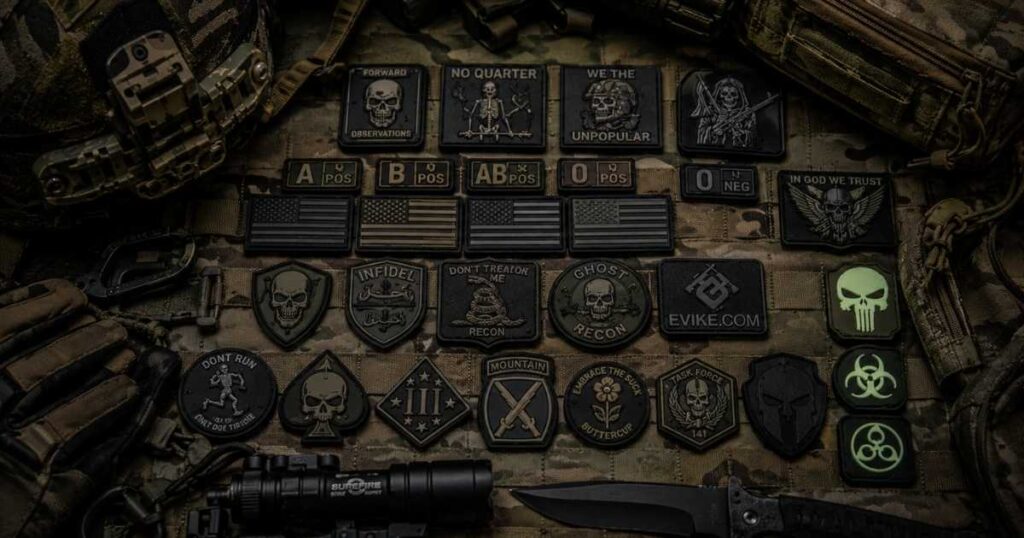
Tactical morale patches are the personality layer of a loadout. They range from humorous (the “Looking for Who Asked” meme patch that Tactical Gear Junkie popularized) to symbolic — wolves, eagles, crossed rifles, and the ever-present Spartan skull.
They build unit camaraderie, express identity, and add a human element to otherwise utilitarian gear. From airsoft players to active operators, morale patches are one of the most-searched categories in the entire tactical gear market.
Sizes typically run 2″–3.5″ and attach via hook-and-loop to any available panel.
Flag and Country Patches
Flag patches are among the most commonly worn identifier on tactical gear worldwide. In U.S. military convention, the American flag is worn with the union (stars) facing forward on the right shoulder — representing the flag “flying forward” as a soldier advances.
For field gear, PVC flag patches are preferred over embroidered because they stay legible when wet and won’t accumulate mud in the thread gaps.
IR and Glow-in-the-Dark Patches
This is a category most competitors completely ignore — and it matters.
Infrared (IR) patches are designed to be invisible to the naked eye but highly visible through night vision equipment (NVGs). They’re used for friendly identification in low-light operations.
However, IR patches carry a significant operational trade-off: they reveal your position to anyone with night vision capability — including adversaries. Use IR patches only when friendly-force identification outweighs concealment risk. They should be removed or covered when operating in environments where enemy NVD capability is likely.
Glow-in-the-dark PVC patches absorb ambient light and emit a low-level glow without electronics or IR markers. They’re popular for gear identification in low-light scenarios where full IR capability isn’t needed — tent poles, bag handles, or helmet covers in base camp settings.
Many tactical brands and gear creators start with small production runs before scaling. The guide Custom patches no minimum order — when it makes sense explains when low-MOQ PVC patches are the smartest option for testing designs, events, or limited-edition drops.
Blood Type and Medical ID Patches
These are functional, not decorative. A PVC blood type patch worn on a plate carrier or backpack strap can provide life-critical information to medical personnel if the wearer is incapacitated.
PVC is specifically the right material here — it’s legible even when wet or muddy, doesn’t absorb contaminants, and remains readable after significant field use. Embroidered blood type patches can become illegible when soaked or dirty.
Subdued Colorways
Subdued morale patches are designed to reduce visual signature in the field. Rather than full-color designs, they use a limited palette:
- OD green (Olive Drab) — the classic subdued military color
- Coyote tan — common in desert and arid environments
- Black-on-black — minimal contrast for low-visibility applications
- Multicam-compatible earth tones — designed to blend with modern camouflage patterns
If you’re running a plate carrier in any operational environment, subdued is almost always the right call over a full-color patch. If you want a broader understanding of different patch materials, backing options, and use cases, check out Custom patch types comparison guide. It breaks down PVC, embroidered, woven, chenille, and leather patches so readers can choose the best fit for tactical gear and outdoor equipment.
How to Attach PVC Patches to Tactical Gear
Attachment method matters more than most people realize. The wrong backing on the wrong surface means lost patches in the field.
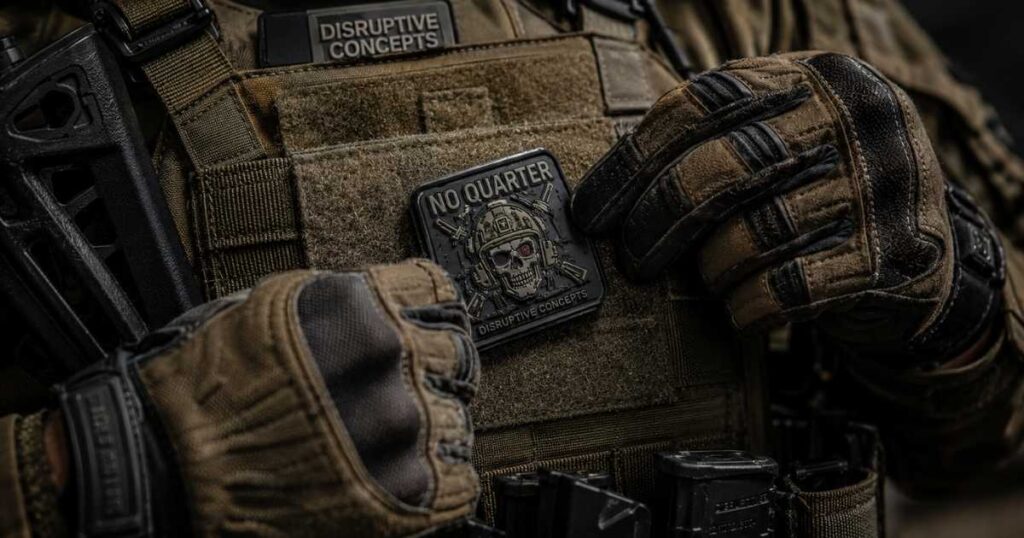
Hook and Loop (Velcro) Backing — The Standard
The vast majority of tactical PVC patches use hook-and-loop backing — the hook side (rough, rigid loops) on the patch, and the loop side (soft, fuzzy fabric) on the gear panel.
Not all Velcro is equal. Cheap hook-and-loop loses grip after 50–100 cycles. Mil-spec hook-loop is rated for thousands of cycles, maintains adhesion through mud and water, and keeps your patch firmly seated during dynamic movement.
When buying or ordering patches, always confirm mil-spec hook-and-loop is specified. Retailers like Chase Tactical and HR Tactical Innovations use industrial-grade backing as standard. Generic backing from budget suppliers may let your patch fall off mid-mission.
Custom Velcro patches — patches ordered with your own design and mil-spec backing — are the most popular format for unit and team identification.
Sew-On Attachment
For permanent placement that will never come loose, sew-on is the answer. Use nylon or polyester thread (not cotton — it degrades faster), run a backstitch around the full perimeter of the patch, and avoid stitching through the plate carrier’s structural material.
Sew-on is ideal for patches that won’t change — flag patches on a dedicated plate carrier, for example. The trade-off is obvious: once it’s sewn, reconfiguring your loadout requires cutting thread.
Sizing and Margin Rules
Before ordering or placing any patch, measure your Velcro loop panel and leave at least 0.25″ of margin on all sides.
A patch that’s too large won’t grip securely — the edges lift and peel during movement. A patch that’s too small may rotate or shift. Standard plate carrier admin panels run approximately 6″ × 3″, which comfortably fits two to three medium patches or one large one.
Where to Place PVC Patches on Your Gear
Placement is both tactical and aesthetic. Here’s how experienced operators approach it.
Plate Carriers
The front admin panel is prime real estate — visible, accessible, and typically the largest Velcro surface on the kit. Use it for unit identification, callsign patches, or your most important identifier.
- Front panel: unit ID, flag, callsign
- Left chest: blood type, medical info
- Shoulder panels: morale patches, secondary ID
- Back panel: flag (if required), IR patch for friendly ID from behind
Tactical Backpacks
Most quality tactical backpacks — including those using the MOLLE system — feature a loop panel on the front face. Arrange patches symmetrically or anchor with a primary patch (your most important identifier) in the center.
Less is more. Overcrowding the panel with too many patches reduces grip strength on all of them and creates a cluttered look that works against tactical professionalism.
Helmets and Headgear
Helmet covers often feature small Velcro loop panels — typically sized for a 2″ × 2″ or 2″ × 3″ patch. IR patches are commonly placed here for aerial/NVG identification. Keep helmet patches small and low-profile.
How to Order Custom PVC Tactical Patches
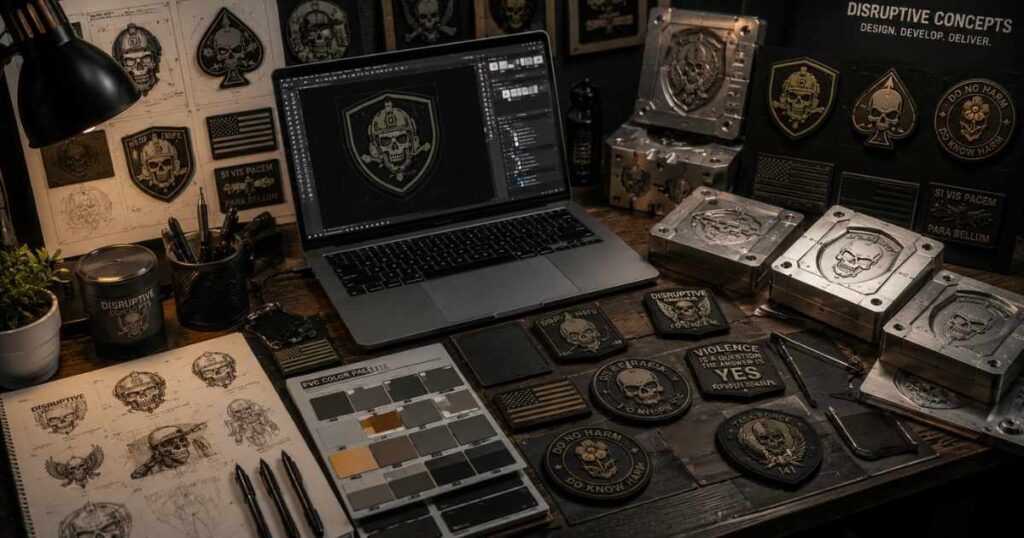
Whether you’re building unit patches, a team loadout, or custom morale patches for an event, the process is straightforward once you know what to specify.
Design Considerations
In my experience reviewing dozens of patch proofs, the most common mistake is trying to fit too much detail into a small patch. Here’s what works:
- Keep text short and legible — anything under 8pt equivalent will blur in the mold
- Bold, high-contrast designs translate better than fine gradients or photorealistic art
- Limit to 4–6 colors for clean, crisp molding — too many colors creates muddy transitions
- Simple silhouettes (animals, skulls, crests, symbols) work better than complex scenes
For complex logos with small text, consider a two-piece design: a larger PVC background patch with a separate smaller text element above or below it.
Sizing Reference
| Size | Best For |
|---|---|
| 1″–2″ | Hats, headgear, small gear panels |
| 2″–3″ | Standard morale patches, flag patches |
| 3″–4″ | Unit insignia, primary identifier patches |
| 4″+ | Back panel patches, large display pieces |
USA-Made vs Overseas Production
This is a gap no competitor addresses honestly, so let’s be direct.
USA-made PVC patches typically offer faster turnaround, easier communication for revisions, and domestic quality assurance — but cost 20–40% more per unit at equivalent quantities.
Overseas production (primarily from manufacturers in Pakistan, China, and Vietnam) often delivers comparable material quality at lower per-unit cost, especially for runs above 100 pieces. Vendors like Custom Paintball (HQ in USA, production in Pakistan) operate this hybrid model successfully.
The key variable is not geography — it’s the vendor’s quality control process. A reputable overseas manufacturer with rigorous QC will outperform a careless domestic one. Always request a physical sample before committing to a large run.
What to Expect on Timelines
- Standard production: 10–15 business days after proof approval
- Rush production: 5–7 business days (premium cost)
- Sample/prototype: 3–5 business days, often available before full order
Minimum order quantities (MOQs) vary by vendor. Most start at 10–25 pieces for custom designs. Unit orders for team kits typically run 50–100 pieces for meaningful cost savings.
Caring for Your PVC Tactical Patches
One of the biggest practical advantages of rubber patches for gear is how little maintenance they need.
Cleaning After Field Use
Wipe the patch down with a damp cloth — that’s genuinely all it takes for most field grime. For dried mud or heavy contamination, a soft brush and mild soap will restore the surface without affecting color or structure.
Remove patches before washing your gear bag or plate carrier. While PVC itself is waterproof, washing machines can stress the Velcro backing and reduce long-term adhesion.
Restoring Velcro Grip
If your hook and loop patches start slipping, the issue is almost always a clogged loop panel, not a failed patch. Loop panels accumulate lint, thread, and debris over time, which fills the loops and reduces grip.
Fix it with a lint roller or a strip of tape pressed firmly onto the loop surface — it pulls out debris and restores grip quickly. For stubborn fiber buildup, tweezers work well.
Store removed patches flat. A dedicated patch binder with sewn-in loop fabric is a neat organizational solution many collectors use.
For readers interested in creating patches beyond tactical applications, How to Make Custom Patches for Clothing (Complete 2026 Guide) covers the complete process from concept to production, including materials, attachment methods, and customization ideas that also apply to tactical apparel and backpacks.
Frequently Asked Questions
Are PVC patches better than embroidered for tactical use?
What size PVC patch fits a plate carrier's Velcro panel?
Can you wash PVC patches in a washing machine?
How long do custom PVC patches take to produce?
What is the difference between a morale patch and a unit patch?
Summary: Building the Right Patch Setup for Your Kit
PVC patches for tactical gear aren’t just accessories — they’re functional, identity-carrying components of a well-thought-out loadout.
Here’s the short version of everything covered:
- Choose PVC for plate carriers, field gear, helmets, and any surface exposed to weather, water, or heavy use
- Use subdued colorways (OD green, coyote tan, black-on-black) when operational visibility matters
- Use mil-spec hook-and-loop backing — generic Velcro fails faster than you think
- Place primary identifiers on the front panel, medical info on the chest, and IR patches where they’ll be visible to friendly NVG from above and behind
- Be deliberate with IR patches — they’re a visibility tool that works both ways
- Order custom patches with simple, high-contrast designs and confirm MOQs and sample availability before committing to a full run
- Maintain patches by cleaning the loop panel, not just the patch itself
Whether you’re sourcing off-the-shelf designs from Tactical Outfitters or going fully custom with a unit crest through HR Tactical Innovations, the fundamentals are the same: durable material, mil-spec backing, and intentional placement.
Your gear tells a story. Make sure the patches on it are built to survive the telling.