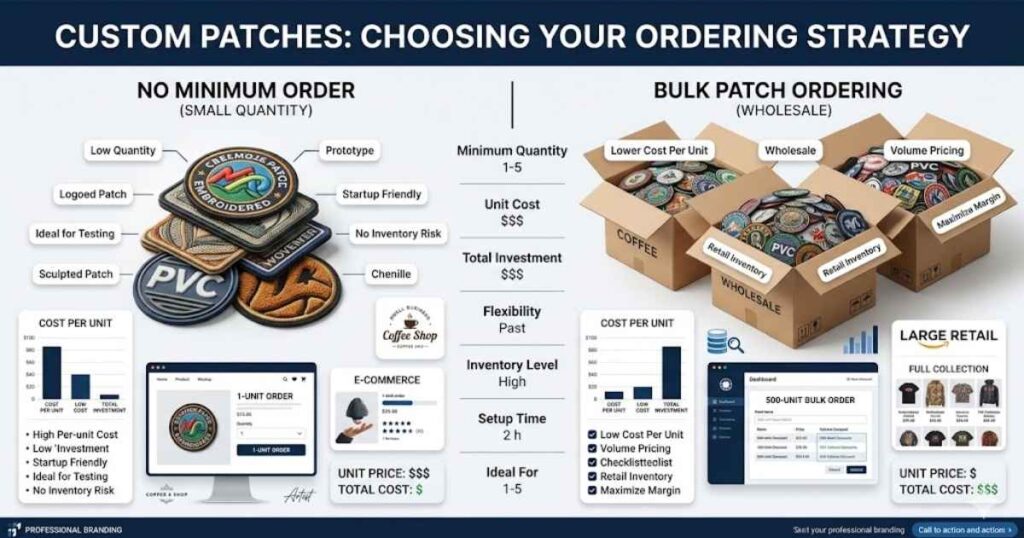
Custom patches with no minimum order sound like a dream — order exactly what you need, when you need it, with zero waste. But is no-MOQ ordering always the smartest move?
The short answer: it depends entirely on your use case. For some buyers, skipping the bulk commitment is a game-changer. For others, the higher cost per patch makes it a financially poor decision. This guide breaks it all down so you can make the right call before you place your order.
Before ordering small quantities, it’s important to understand which patch material best suits your branding needs and budget. Our Custom Patch Types Comparison Guide compares embroidered, woven, PVC, chenille, and leather patches for businesses experimenting with low-volume production.
What Does “No Minimum Order” Actually Mean for Custom Patches?
A minimum order quantity (MOQ) is the smallest number of units a manufacturer will produce in a single run. For years, traditional patch makers required buyers to commit to 50, 100, or even 500 pieces at a time.
That wasn’t arbitrary. Every custom patch order involves fixed upfront work — design digitizing, machine setup, color calibration, and quality control. When those costs are spread across 500 units, the price per patch drops dramatically. When they’re spread across 5 units, someone has to absorb them.
How Traditional Patch Ordering Used to Work
Before on-demand manufacturing went mainstream, getting a single custom patch was nearly impossible through legitimate commercial channels. You either committed to a large batch or went without. Small sports teams, indie creators, and individuals were effectively locked out.
That created real pain points — overordering, wasted inventory, and cash tied up in boxes of patches you’d never use.
How No-Minimum Ordering Changed the Game
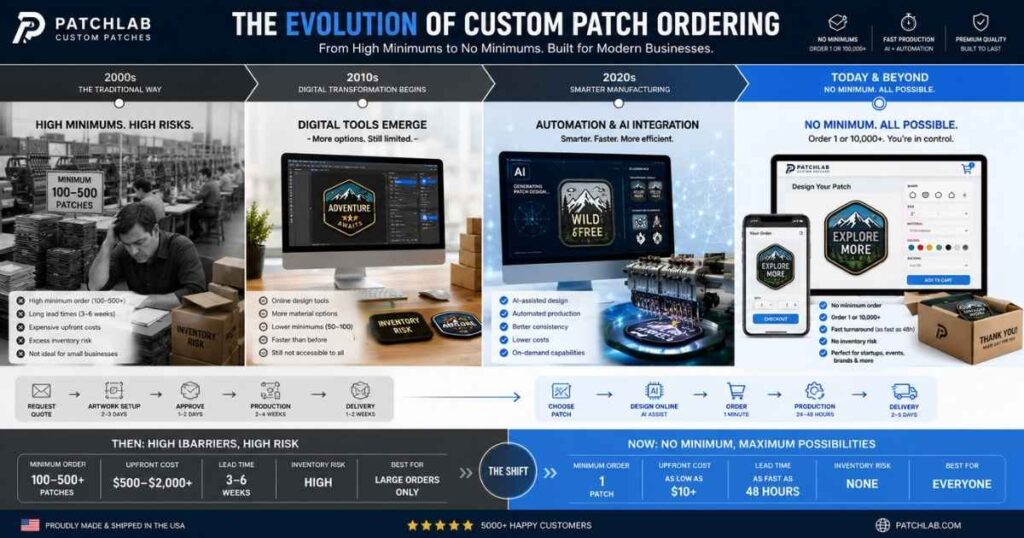
The rise of digital production tools, AI-assisted design, and on-demand fulfillment networks changed everything. Platforms like Printful, THE/STUDIO, GS-JJ / Patches.co, and Nexus Patches now absorb the fixed production costs into slightly higher per-unit pricing — and pass the flexibility directly to the buyer.
The result: you can now order custom patches online for a single piece, a handful, or thousands — all from the same supplier.
When Custom Patches No Minimum Order Actually Makes Sense
Not every buyer needs a bulk run. Here are the scenarios where no-MOQ ordering is genuinely the right choice.
You’re Testing a Design Before Committing to Bulk
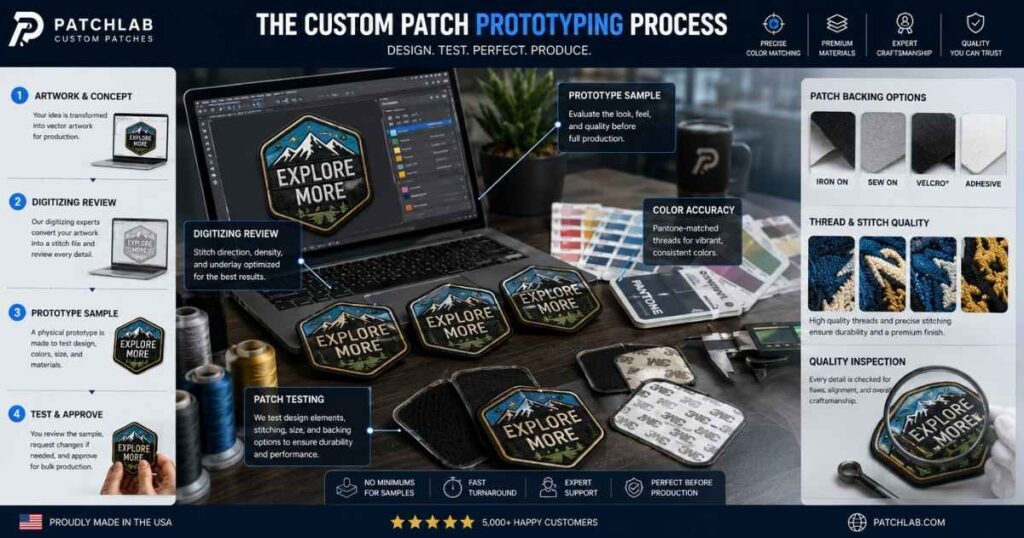
This is, hands down, the smartest use of no-minimum ordering. In my experience testing patch suppliers, even a well-digitized design can look different in real thread versus a screen mockup.
Ordering 1–5 patches as a prototype lets you:
- Verify embroidery accuracy and stitch coverage before scaling
- Check color fidelity against your brand standards (especially important if you’re using Pantone color matching)
- Evaluate patch durability, backing type, and feel on the actual garment
- Catch sizing issues before they multiply across a full run
Platforms like Panda Patches and 4inCustomPatch explicitly support prototype ordering for this reason. Catching a design flaw on a 3-patch test order saves far more than the premium you pay per unit.
You’re a Small Business or Startup With Tight Cash Flow
When you’re bootstrapping, every dollar of inventory is a dollar of risk. No-minimum patch ordering eliminates that risk entirely.
You can:
- Launch a product line with zero upfront inventory
- Integrate with a print-on-demand platform and sell patches before you’ve produced a single one
- Test multiple designs simultaneously without overcommitting to any one concept
This model is especially powerful for Etsy sellers, streetwear brands, and custom apparel shops running on lean margins.
You Need Patches for a One-Time Event or Personal Use
Some orders are inherently small — and that’s perfectly fine.
Common single-run use cases include:
- Wedding patches for bridesmaid gifts or groomsmen party favors
- Memorial patches honoring a person or milestone (typically 5–20 pieces)
- Convention and event patches for attendees or staff
- Team patches for a local club, small sports squad, or volunteer group
- Biker patches for a ride-along or club anniversary
Ordering 100 patches when you only need 12 creates waste, storage problems, and budget strain. No-minimum vendors solve this completely.
You’re a Patch Collector or Custom Hobbyist
Patch collectors are a unique audience. They want one-of-a-kind, specific designs — not multiples of the same piece.
Whether you’re building a jacket display wall, designing morale patches, or creating something entirely personal, no-MOQ ordering gives collectors the creative freedom they need without forcing them into bulk quantities they’ll never use.
You’re Gifting Custom Patches to a Small Group
Corporate gifting, employee recognition, volunteer appreciation, and team rewards often involve groups of 5–30 people. Bulk pricing is overkill. No-minimum ordering is purpose-built for this exact scenario — you get premium-quality, personalized patches without paying for inventory you’ll never distribute.
When No-Minimum Custom Patches Don’t Make Financial Sense
Honesty matters here. No-minimum ordering isn’t always the right call — and understanding the tradeoffs will save you money.
The Per-Patch Price Difference Is Dramatic
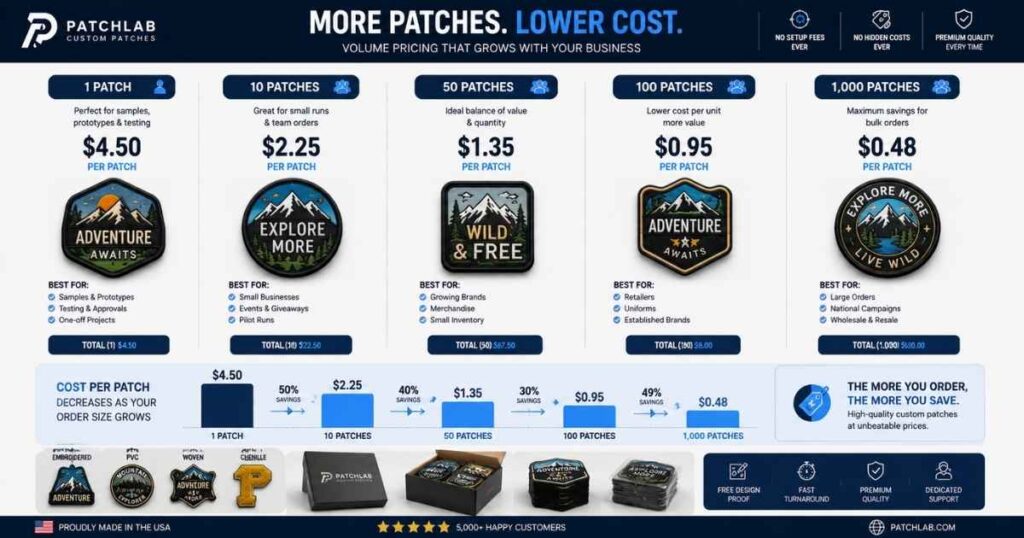
This is where most buyers underestimate the cost gap. Here’s a realistic price comparison for a standard 3-inch embroidered patch:
| Quantity | Estimated Price Per Patch |
|---|---|
| 1 patch | $8.00 – $15.00 |
| 10 patches | $4.00 – $9.00 |
| 50 patches | $2.50 – $4.00 |
| 100 patches | $1.50 – $2.88 |
| 1,000 patches | $0.33 – $1.20 |
Price data aggregated from Panda Patches, Custom Patch Factory, and The Patchio (2026).
At 1,000 units, you can pay as little as $0.33 per patch. At a single unit, you may pay 30–40x that. The math is stark.
You’re Outfitting a Large Team, Organization, or Retail Store
If you need uniform patches for a full staff, brand patches for retail inventory, or team patches for an entire league, no-minimum pricing will quickly erode your margins.
At that scale, a dedicated bulk manufacturer — with factory-direct pricing and volume discounts — will almost always serve you better. The premium you pay for “ordering freedom” at 300+ units becomes difficult to justify.
Low-minimum patch orders are especially useful for testing employee uniform designs before committing to large bulk purchases. In Custom Patches for Employee Uniforms, we explain how businesses maintain branding consistency while scaling uniform production.
You Have a Specialty or High-Complexity Design
Complex artwork — intricate woven patches with fine detail, 3D puff embroidery, metallic thread, or multi-layer PVC patches with sculpted depth — carries higher per-unit production costs regardless of quantity.
At small quantities, those specialty costs hit even harder. If your design is sophisticated and your quantity is large, working directly with a manufacturer like Ninja Patches or a factory-direct supplier gives you both quality control and significantly better economics.
Types of Custom Patches Available With No Minimum Order
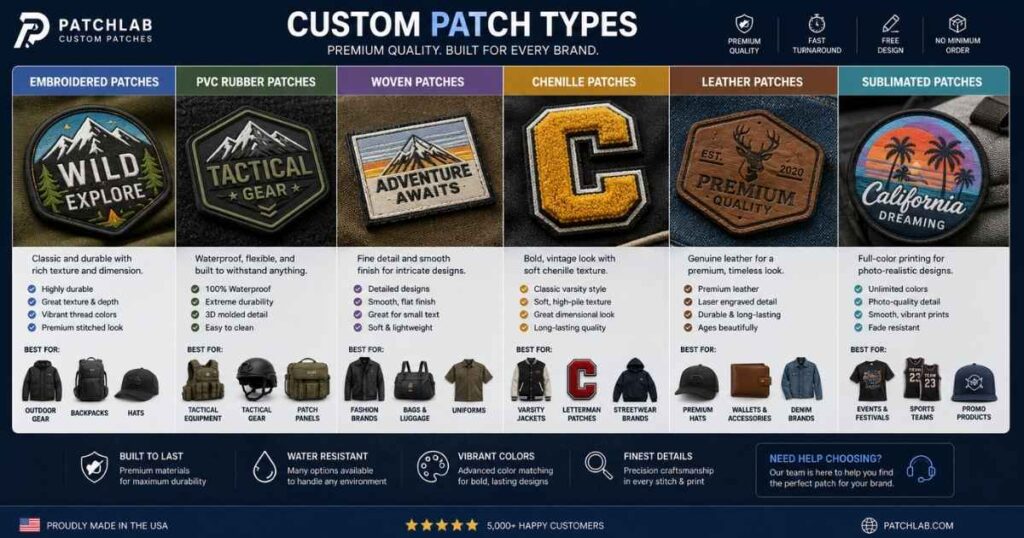
Most no-MOQ suppliers offer the full range of patch types. Here’s a quick reference to match patch type to use case:
| Patch Type | Best For | Notes |
|---|---|---|
| Embroidered | Logos, team crests, brand identity | Classic look; most versatile |
| PVC / Rubber | Outdoor gear, tactical, weather exposure | Waterproof, fade-resistant, 2D/3D options |
| Woven | Fine text, detailed artwork | Thinner thread = sharper detail |
| Chenille | Varsity, streetwear, vintage looks | Soft, plush texture; bold aesthetic |
| Leather | Premium hats, denim jackets | Upscale feel; works with stitching or adhesive |
| Sublimated / Printed | Full-color, photo-realistic designs | No stitch limit; vivid color reproduction |
Even small patch orders require properly optimized artwork to achieve clean stitching and professional results. How to Design a Logo Patch (Artwork Guide) covers vector files, embroidery simplification, and digitizing tips for first-time patch buyers.
Embroidered Patches — The Classic Choice
Embroidered patches remain the most popular patch type for a reason. They’re stitched onto durable twill fabric using high-quality threads, with stitch coverage options typically ranging from 50% to 100%. A merrowed border gives a traditional, raised edge finish, while a hot-cut border creates a cleaner, die-cut silhouette ideal for irregular shapes.
They hold up well across dozens of wash cycles and work on everything from patches for hats to full back patches for jackets.
PVC Patches — Best for Durability
PVC patches are molded from soft, flexible rubber. They’re waterproof, heat-resistant, and built to survive real outdoor conditions — which is why military units, law enforcement, and outdoor brands reach for them first.
Suppliers like Nexus Patches and Ninja Patches offer 2D and 3D PVC options with no minimum, making them accessible for one-off gear customization.
Chenille Patches — Best for Texture and Impact
If you want a patch that physically stands out on a garment, chenille patches deliver. The plush, looped yarn construction creates bold visual depth — popular in varsity culture, streetwear, and vintage-inspired fashion. They’re machine washable and retain their texture well over time.
How to Choose the Right No-Minimum Patch Supplier
Not all no-MOQ suppliers are equal. Here’s what to evaluate before you commit.
Key Questions to Ask Before You Order
- Do they offer a free digital proof? Industry standard is within 12 hours of order submission.
- Are there hidden digitizing or setup fees? Some suppliers advertise no minimums but charge $20–$50 for artwork processing.
- What is the actual turnaround time for small orders? Some vendors prioritize bulk runs; small orders may sit in queue.
- How many revisions are included? You should be able to refine the proof until you’re satisfied.
- What is their quality guarantee or remake policy? Reputable suppliers offer a remake or refund window — typically 30–45 days.
What to Look for in Proof and Sampling Policies
A proper digital proof previews exactly what your patch will look like — thread colors, dimensions, border style, and backing type — before a single stitch is made. Suppliers like GS-JJ / Patches.co and 4inCustomPatch include unlimited revisions with every proof.
For high-stakes projects — uniform programs, large branded merch lines, or wholesale inventory — request a physical sample before approving full production. The small extra cost is worth the peace of mind.
Domestic vs. Overseas Suppliers — Does It Matter for Small Orders?
For small runs, US-based manufacturers tend to offer faster turnaround times and more responsive communication. Overseas suppliers — particularly those with production in China — typically offer lower per-unit pricing but longer lead times (7–15 business days for production, plus shipping).
If speed matters more than cost, look for domestic options or suppliers with US-based fulfillment warehouses. If per-patch price is the priority and you have lead time flexibility, overseas factory-direct suppliers often win.
Also worth checking: whether the supplier holds OEKO-TEX Standard 100 certification, which confirms that materials are free from harmful chemicals — important if patches will be worn on children’s clothing or directly against skin.
Understanding Patch Pricing — No Minimum vs. Bulk
What Factors Affect the Price of a Single Custom Patch?
The cost per patch is determined by several variables:
- Size — larger patches use more thread and material; a 6.5-inch patch can cost 3–4x more than a 2-inch patch
- Stitch coverage — 100% fill uses significantly more thread than 50% coverage
- Color count — most suppliers allow up to 9 colors free; specialty or metallic threads add cost
- Backing type — iron-on and sew-on are typically included; Velcro backing adds a flat fee
- Border style — merrowed vs. hot-cut affects production time and cost
- Design complexity — intricate artwork requires more digitizing time and thread passes
Patch digitizing — the process of converting your artwork into a stitch file — is often charged as a setup fee by traditional manufacturers. Many no-minimum suppliers now include it free.
When the Math Favors Ordering More (Even If You Don’t Need All of Them)
Here’s a practical tip most buyers overlook: at very small quantities, ordering 10 instead of 1 often costs nearly the same per unit — or even less in total.
For example, if one patch costs $12 but ten patches cost $45, ordering ten gives you nine spare patches for $33 more. Those spares are useful for replacements, gifts, giveaways, or resale.
Always run the numbers across 1, 5, 10, and 25 units before defaulting to the smallest quantity. The break-even point is often lower than you’d expect.
Many ecommerce startups and creator brands begin with limited-edition patch drops before expanding into larger merchandise collections. Learn how small-batch patches support online businesses in Custom Patches for Branded Merchandise and Merch Stores.
Top Use Cases by Audience — Quick Reference
| Audience | Why No-Minimum Works |
|---|---|
| Etsy & POD sellers | Test designs risk-free before stocking |
| Small sports teams | Small rosters don’t justify bulk runs |
| Military & law enforcement | Unit morale patches in limited quantities |
| Event planners | One-time occasion, no leftover inventory |
| Streetwear / fashion brands | Capsule drops and seasonal designs |
| Non-profits & charities | Volunteer recognition, awareness campaigns |
| Patch collectors | One-of-a-kind designs, not mass multiples |
| Corporate gifting | Employee recognition for specific group sizes |
Frequently Asked Questions
Can I really order just one custom patch?
How long does it take to get custom patches with no minimum order?
Are no-minimum custom patches lower quality than bulk orders?
What's the cheapest type of custom patch with no minimum?
Do no-minimum suppliers offer free design help?
What file formats do patch suppliers accept?
Can I iron on a single custom patch?
Conclusion — Is No-Minimum Custom Patch Ordering Right for You?
Custom patches with no minimum order are genuinely the right choice in the right situation. If you’re testing a design, filling a small personal or event order, operating as a lean startup, or simply need a handful of team patches or event patches without excess inventory — no-MOQ vendors like Printful, THE/STUDIO, Ninja Patches, and Nexus Patches give you everything you need.
But if your quantity is climbing toward 50 units or beyond, the per-patch cost difference becomes significant enough to revisit bulk pricing. The sweet spot: start small to validate, then scale with confidence.
Use the pricing table in this guide, ask the right questions about proofs and turnaround times, and choose a supplier who aligns with your timeline, budget, and design complexity. Custom patches no minimum order are a tool — and like any tool, they work best when used in the right situation.
Last updated: May 2026