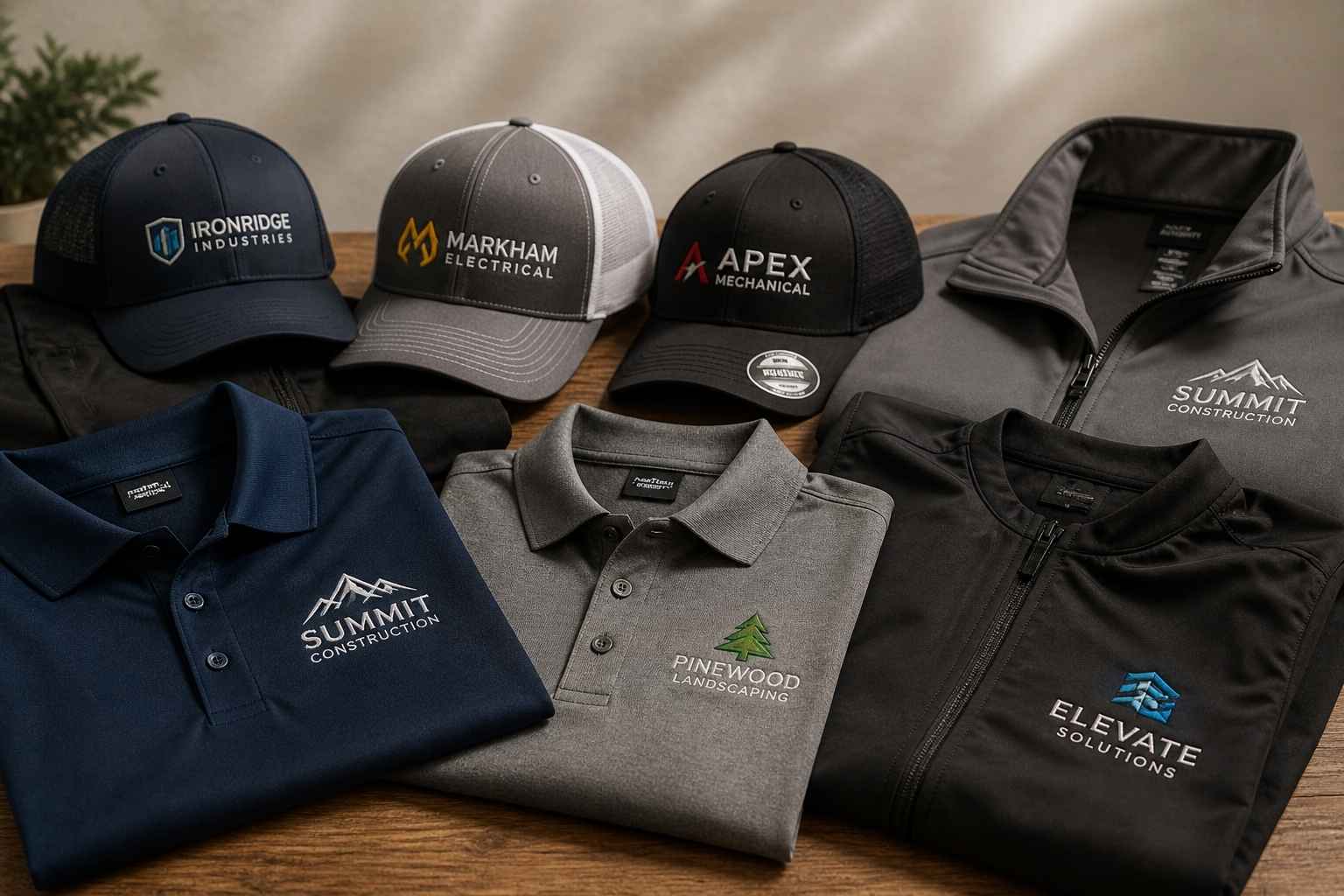
Custom Patches for employee uniforms are branded or personalized emblems — most commonly embroidered, woven, or PVC — that attach to workwear to identify staff, display company logos, and project a consistent, professional image. They’re one of the most cost-effective branding tools available to businesses of any size, with per-unit costs typically ranging from $0.84 to $8.00 depending on patch type, complexity, and order volume.
If you’ve ever walked into a hotel, a hardware store, or a mechanic’s shop and immediately known exactly who to approach — that’s a well-designed patch doing its job quietly and effectively.
This guide covers everything: patch types, backing options, placement, costs, design steps, and the content gaps most businesses overlook when ordering for the first time.
Why Businesses Use Custom Patches on Employee Uniforms
There’s a reason the military, law enforcement, healthcare, and hospitality industries have relied on uniform patches for decades. They communicate a lot — instantly, without a word.
For businesses, the case is straightforward.
Staff Identification at a Glance
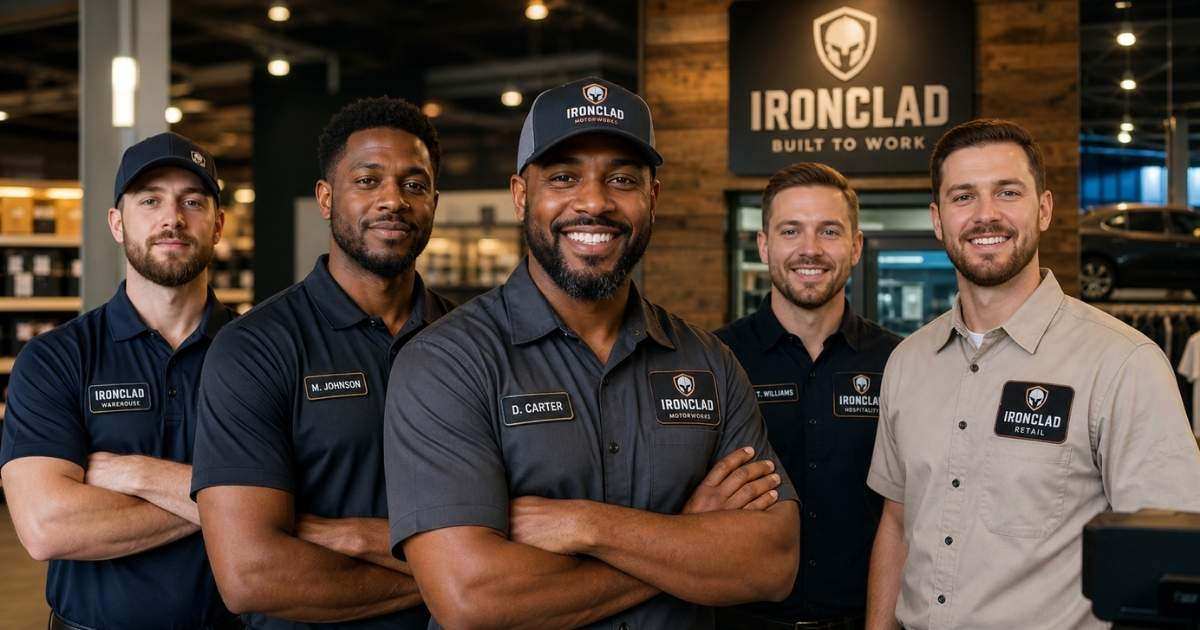
In busy environments — retail floors, hospital wards, hotel lobbies, construction sites — customers and visitors need to identify staff quickly. A name tag patch on the left chest tells someone exactly who they’re dealing with and what role that person fills, before a single word is exchanged.
Patches showing department names, job titles, or certification logos take this further. An ASE certification logo on a mechanic’s uniform, for instance, communicates competence and builds trust with customers who may not know what to look for otherwise.
Brand Visibility That Walks Out the Door
A company logo patch on a staff uniform is mobile advertising. Every job site visit, service call, or public commute puts your brand in front of people your marketing budget would never otherwise reach. Unlike a billboard or a digital ad, a well-placed company logo emblem on a uniform is seen at close range, by real people, in real contexts.
Vendors like Patches4Less and World Emblem have built entire business models around this reality — helping companies turn their workwear into a consistent, high-visibility branding asset.
A clean and embroidery-friendly logo can significantly improve the final appearance of uniform patches. In How to Design a Logo Patch (Artwork Guide), you’ll learn how proper artwork setup helps maintain sharp details and color accuracy on uniforms.
Building Team Identity and Employee Pride
Uniforms signal belonging. Patches reinforce it. When a team member receives a patch — whether it marks their role, their department, or a service milestone — it makes membership feel earned and real.
Uniform patches help people feel connected to a shared team identity while creating a well-organized, professional environment that reflects order and hierarchy. That’s not a soft benefit. In industries with high turnover, anything that builds loyalty and a sense of belonging has measurable operational value.
A Cost-Effective Alternative to Full Uniform Replacement
Here’s something most businesses don’t consider until they’ve already been burned by it: when a uniform gets damaged or worn out, direct embroidery and screen printing go with it. The garment and the branding are one. When you patch, the branding is separate.
One small business that switched to embroidered patches from WizardPins reported cutting their uniform budget to one-third of what it had been. Because patches transfer between garments, a torn shirt doesn’t mean a wasted logo — it just means a new shirt.
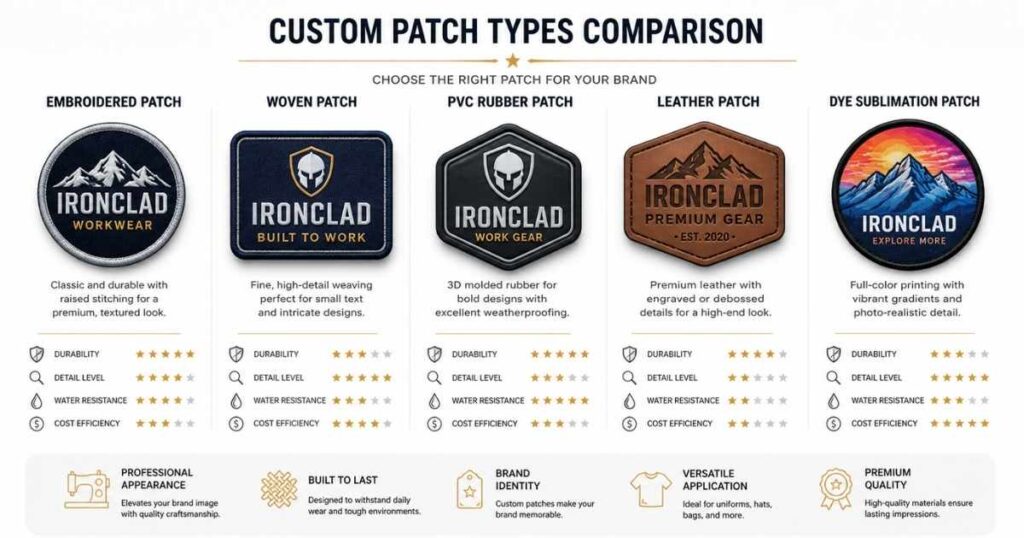
Types of Custom Patches for Work Uniforms
Not all patches are built the same. The right type depends on your design complexity, the environment your staff works in, and how often uniforms go through commercial laundry. Here’s a straightforward breakdown.
Embroidered Patches
The most traditional, most widely recognized option. Embroidered patches are stitched with colored thread onto a base fabric, finished with a merrow border (the raised, looped edge you’ll recognize from most uniform patches), and built to last.
They’re long-lasting, available in virtually any thread color, and carry a classic, professional look. The limitation: they’re not ideal for very fine detail or photographic imagery — the embroidery thread count has physical limits.
Best for: Company name patches, name tag patches, department logos, occupational patches in healthcare and trades.
Woven Patches
Woven patches are made on a loom rather than stitched on top of a base fabric, which allows for far more intricate designs and precise typography. If your logo has thin lines, small text, or a detailed icon, woven patches can reproduce it accurately where embroidery would lose resolution.
Brands like THE/STUDIO and NinjaPatches offer woven options that can match exact brand color codes — important for businesses where brand consistency in uniforms is non-negotiable.
Best for: Detailed logos, branded apparel for corporate environments, name tags with fine typography.
PVC Patches
PVC patches are molded from soft rubber-like plastic, making them waterproof, dimensionally bold, and extremely durable. They hold up in environments where fabric patches would degrade — outdoor worksites, maritime industries, emergency services.
They also photograph well and have a modern, tactile feel that gives branded apparel a premium edge.
Best for: Outdoor, tactical, and high-wear environments. Security and construction uniforms.
Printed / Dye Sublimation Patches
When a design includes gradients, photography, or colors that simply can’t be replicated in thread, dye sublimation patches are the answer. The artwork is printed onto a canvas material and laser-cut to shape, with a stitched border for durability.
StickerYou, for example, allows full-color uploads — photographs, complex illustrations, anything — and produces them as patches with no design restrictions. The trade-off is that they don’t carry the same textured, classic feel as embroidered options.
Best for: Event patches, promotional patches, detailed branded imagery, die-cut patches with custom silhouettes.
Leather and Faux Leather Patches
A premium option that’s grown in popularity for upscale hospitality brands, craft trades, and lifestyle-oriented workwear. Genuine leather patches are laser-etched with your design — rich, rugged, and refined. Faux leather offers similar aesthetics at lower cost.
Best for: Premium workwear, hospitality and hotel staff uniforms, craft brewery or restaurant teams going for a distinctive aesthetic.
Chenille Patches
Soft, textured, and visually distinctive. Chenille patches are more commonly associated with letterman jackets and academic programs, but they’re increasingly appearing on retail and lifestyle brand uniforms where a tactile, approachable look is part of the brand identity.
Best for: Retail, lifestyle brands, youth-facing organizations.
Quick Comparison Table
| Patch Type | Best For | Design Detail | Durability | Est. Cost (ea.) |
|---|---|---|---|---|
| Embroidered | Logos, names, occupational | Medium | Very High | $0.84–$3.00 |
| Woven | Fine detail, precise text | High | High | $1.00–$5.04 |
| PVC | Outdoor, tactical | High | Excellent | $1.22–$4.00 |
| Dye Sublimation | Photos, gradients | Highest | Medium | $1.97–$5.00 |
| Leather | Premium workwear | Medium | Very High | $1.03–$6.00 |
| Chenille | Retail, lifestyle | Low–Medium | Medium | Varies |
Backing Options: How Patches Actually Attach to Uniforms
This is the part most buyers gloss over — and then regret. The backing type determines how permanently a patch attaches, how it holds up in the wash, and whether it can be moved between garments.
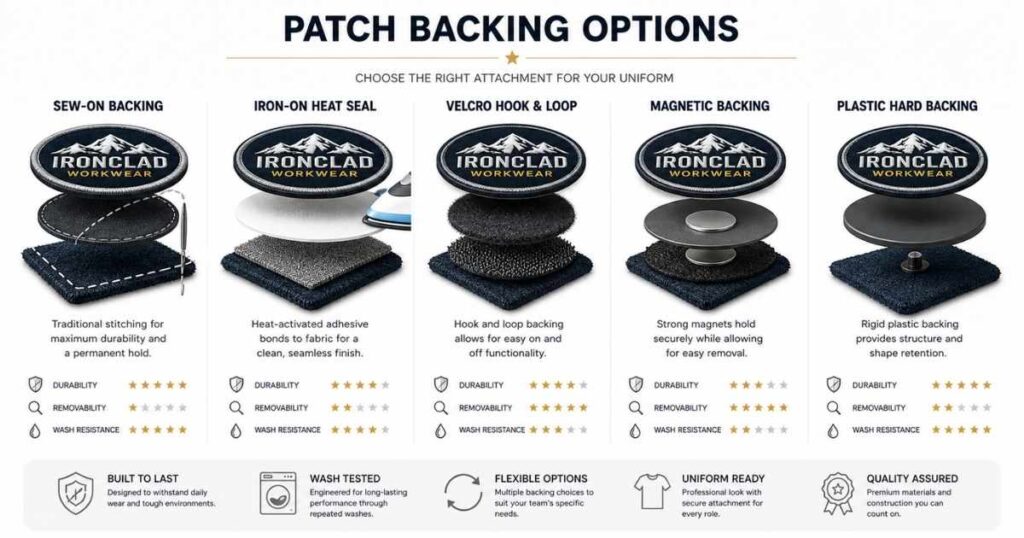
Sew-On Patches
The most permanent option. A sew-on patch with no adhesive backing is attached by stitching directly to the garment — by hand or by a professional tailor. This is the most durable attachment method and the right choice for uniforms that go through heavy commercial laundry cycles regularly.
Iron-On / Heat Seal Patches
Iron-on patches use a heat-activated adhesive backing that bonds to fabric when pressed. Industrial heat seal backing — used by suppliers like World Emblem — can withstand up to 52 commercial wash cycles, which surprises most buyers who assume iron-on means temporary.
For a home iron, set to the highest heat the fabric allows. For a heat press, 340–350°F for 20 seconds with medium-firm pressure is the standard. One important caveat: heat seal doesn’t bond reliably to nylon, silk, wool, or water-repellent fabrics. Always confirm your uniform material before selecting this backing.
Velcro / Hook-and-Loop
Velcro patches are ideal when patches need to be swapped out — different roles, temporary assignments, or uniforms shared across shifts. They’re widely used in security, emergency services, and military contexts precisely because they allow fast changes without damaging the garment.
For employee uniforms, Velcro makes sense when you want to reuse the same base patch with interchangeable name rockers — individual name strips that attach separately.
Magnetic Backing
A good option for formal uniforms or situations where you need quick, non-permanent attachment without any heat or stitching. Magnetic patches are popular for events and temporary staff identification. They don’t damage fabric and leave no residue.
Plastic / Hard Backing
Adds structural rigidity to the patch — useful for larger logo patches that would otherwise curl or lose shape over time. Typically used in combination with another backing type.
What to Put on an Employee Uniform Patch
Uniform patches don’t have to be limited to a name. Here are the most effective uses, from basic to strategic:
- Company name and logo — the most common use; turns every staff member into a walking brand ambassador
- Employee name — builds personal connection with customers; shown to increase trust in service environments
- Job title or department — especially useful in large teams where role clarity matters
- Certification or qualification logos — think ASE for automotive, or relevant trade certifications; communicates expertise without explanation
- Service milestone patches — 1-year, 5-year, 10-year anniversary patches; a low-cost, high-impact element of employee recognition programs
- Event or seasonal patches — limited-edition patches for campaigns, fundraisers, or company events, applied to existing uniforms without reprinting anything
The last two are where most businesses leave value on the table. Milestone patches cost pennies compared to formal recognition programs, and they’re worn publicly — which means they signal to customers that this is a team that stays.
Placement Guide: Where Patches Go on a Uniform
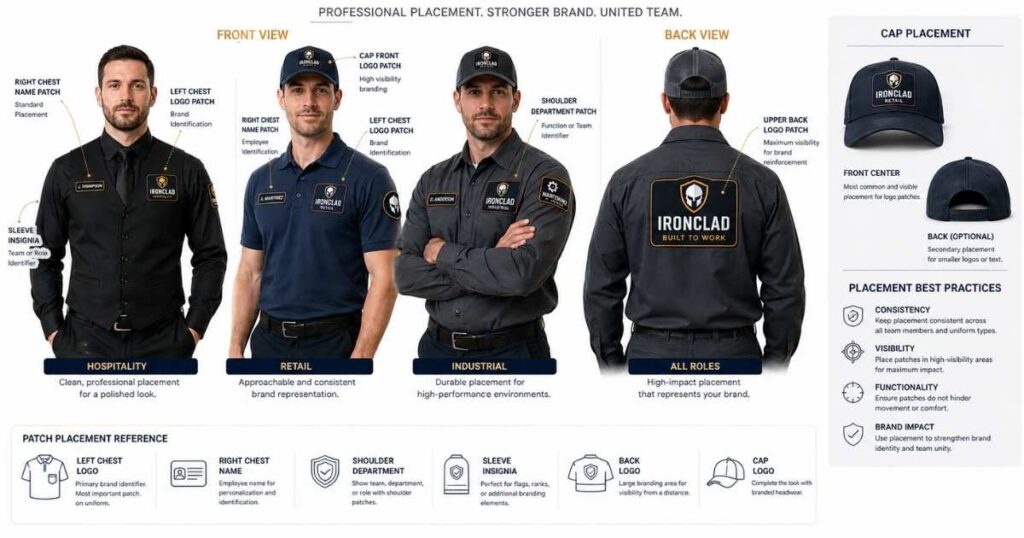
Placement matters more than most buyers realize. A patch in the wrong position looks like an afterthought. Here’s where each type of patch typically lives — and why.
| Position | Best Used For |
|---|---|
| Left chest | Primary company logo or name tag patch (the default “first look” zone) |
| Right chest | Employee first name or role patch |
| Left shoulder / sleeve | Department, division, or rank patches |
| Right shoulder / sleeve | Secondary organizational identifier |
| Back | Large-format logo, brand statement, or event patch |
| Hat / cap (front crown) | Logo patch — common in hospitality, construction, and food service |
| Collar / cuff | Discreet identification on formal or dress uniforms |
In my experience helping teams work through their first patch program, the combination that reads best in customer-facing environments is: company logo on the left chest, employee first name on the right. Customers naturally read left-to-right, which means they see the brand first, the person second — exactly the right order for trust-building.
For industries like security or healthcare where role clarity is critical, adding a department or title patch to the sleeve creates a quick visual hierarchy that works even at a distance.
How to Design Custom Patches: A Step-by-Step Process
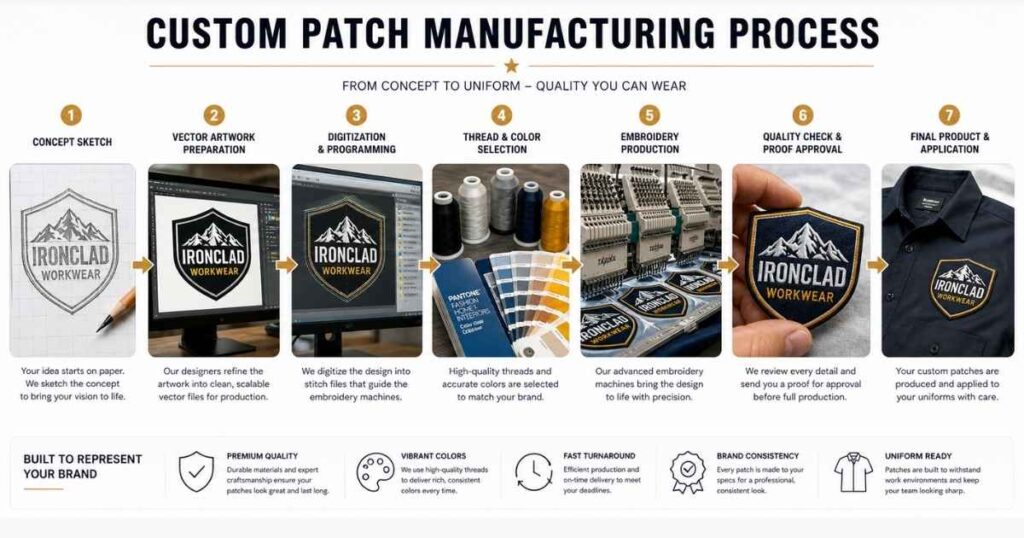
Getting this right the first time saves money and avoids the frustration of reprinting. Here’s the process, simplified:
- Define the purpose — Is this for identification, branding, certification display, or employee recognition? The answer shapes every decision that follows.
- Decide on size and shape — Chest patches typically run 3–4 inches wide. Sleeve patches are usually narrower. Die-cut patches can take any silhouette — a wrench for a mechanic, a cross for a medical team.
- Choose your patch type — Refer to the comparison table above. If your logo has thin lines or detailed text, lean toward woven or sublimation. For a classic, durable logo patch, embroidered is almost always the right call.
- Prepare your artwork — Vector files (AI, EPS, SVG) produce the cleanest results and are preferred by every major supplier. If you only have a raster logo, make sure it’s at least 300 DPI. During patch digitization, the supplier converts your artwork into a stitch-ready format — this is where fine detail can get simplified, so the cleaner your source file, the better the output.
- Choose colors deliberately — Match thread colors to your Pantone or brand color codes where possible. High-contrast patches — light design on dark background or vice versa — read better from a distance and in varied lighting.
- Select your backing type — Based on your fabric, wash frequency, and whether patches need to be removable.
- Request and review your proof — Never skip patch proof approval. Every reputable supplier (NinjaPatches, WizardPins, Patches4Less) provides a digital proof before production. Review it carefully for color accuracy, text readability, and border treatment.
- Plan your quantities thoughtfully — Order a small buffer above your current headcount. New hires happen, patches get damaged, and reordering in small quantities later usually costs more per unit.
How Much Do Custom Patches for Employee Uniforms Cost?
Custom uniform patches are also becoming popular for branded apparel and promotional merchandise. Discover how businesses extend their branding strategy beyond uniforms in Custom Patches for Branded Merchandise and Merch Stores.
Let’s be direct about pricing, because most supplier pages aren’t.
Per-Unit Cost by Patch Type
- Embroidered patches: from ~$0.84/ea. at volume
- PVC patches: from ~$1.22/ea.
- Leather patches: from ~$1.03/ea.
- Woven patches: from ~$5.04/ea.
- Dye sublimation: from ~$1.97/ea.
These are ballpark figures — actual pricing depends on size, complexity, quantity, and the specific supplier. The per-unit cost drops significantly with volume. Ordering 500 patches will typically cost 30–60% less per patch than ordering 25.
Setup and Digitization Fees
Many suppliers charge a one-time digitization fee to convert your logo into an embroidery-ready format. This typically runs $0–$50 and is often waived for large orders. Ask upfront.
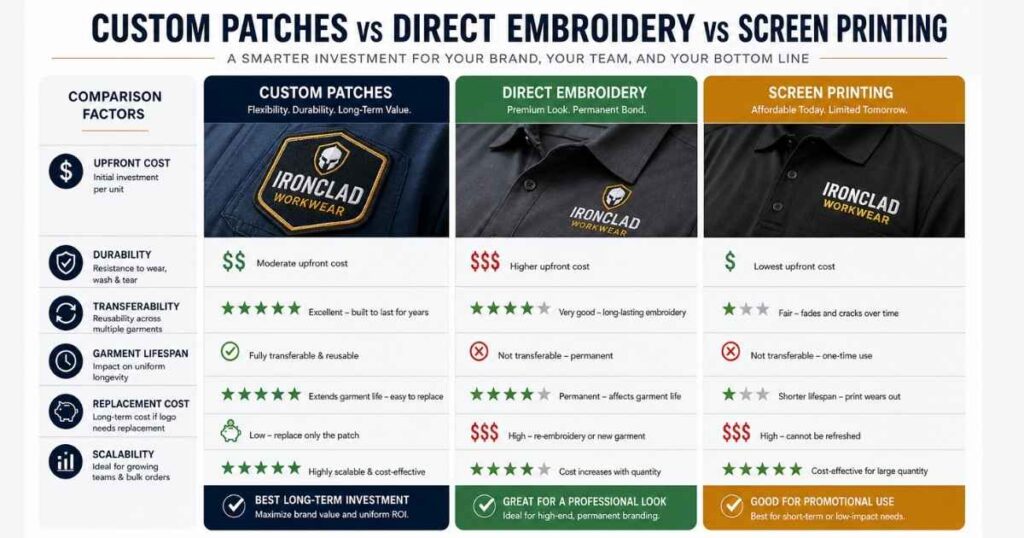
The Real Cost Comparison: Patches vs. Direct Embroidery vs. Screen Printing
| Method | Upfront Cost | Garment-Tied? | Transferable? | Per-Unit at Scale |
|---|---|---|---|---|
| Custom patches | Low–Medium | No | Yes | Low |
| Direct embroidery | Medium | Yes | No | Medium |
| Screen printing | Low | Yes | No | Low–Medium |
The key advantage of patches for workwear management is transferability. When a garment wears out, the patch doesn’t. That single factor makes patches the smarter long-term investment for businesses with ongoing uniform programs, even if the initial patch cost is slightly higher than screen printing.
What to Look for in a Custom Patch Supplier
Not all patch suppliers are equal. Here’s what separates reliable partners from risky ones.
No Hidden Setup Fees
Good suppliers are upfront about digitization costs, setup charges, and shipping. If pricing only becomes clear at checkout, that’s a red flag.
Proof Before Production — Always
Any reputable supplier provides a digital proof for approval before going to production. Vendors like NinjaPatches include free proofs on orders above a certain threshold. Others offer them as standard. Never proceed with a supplier who won’t show you what you’re getting before they make it.
Realistic Turnaround Communication
Standard production typically runs 2–3 weeks from proof approval. Rush options — some suppliers offer 5-day turnaround on select patch types — are available but usually carry a premium. Know your deadline and confirm it in writing.
Wash Durability Ratings
Ask specifically about washability. Industrial heat seal-backed patches are rated to survive 52 commercial wash cycles. For sew-on patches, the limiting factor is the garment, not the patch itself. Demand specifics rather than vague promises about “durability.”
Minimum Order Quantities
If you’re a small business or testing a new design, MOQ matters. Several suppliers — including StickerYou and some WizardPins products — operate with no minimum order, which is genuinely useful when you need 10 patches for a small team, not 100.
Many small businesses prefer testing uniform branding before placing large bulk orders. Custom Patches No Minimum Order — When It Makes Sense explains how low-quantity orders can help companies prototype staff uniforms cost-effectively.
Frequently Asked Questions
What's the best type of patch for employee uniforms?
How long do uniform patches last?
Can I wash uniforms with patches still on them?
What's the minimum order quantity?
Can custom patches replace name tags?
Are custom patches better than direct embroidery on uniforms?
Summary
Custom patches for employee uniforms are one of the most underestimated tools in a business’s branding and operations toolkit. They build brand consistency in uniforms, support employee identification, reduce long-term workwear management costs, and — when used thoughtfully — play a genuine role in employee recognition programs and team culture.
The key decisions are:
- Type: Embroidered for classic durability, woven for fine detail, PVC for outdoor resilience, sublimation for full-color complexity
- Backing: Sew-on for permanence, heat seal for convenience, Velcro for flexibility
- Placement: Left chest for brand, right chest for name, sleeve for role
- Design: Vector artwork, proper sizing, always approve a proof before bulk production
Whether you’re outfitting five staff members or five hundred, the process is the same. Start with purpose, choose the right patch type for your environment, design with contrast and clarity in mind, and work with a supplier who shows you what you’re getting before they make it.
Choosing the correct patch material is essential for employee uniforms because durability, wash resistance, and appearance vary between patch styles. Our Custom Patch Types Comparison Guide helps businesses compare embroidered, woven, PVC, leather, and chenille patches for professional workwear applications.
Ready to put your brand on your team? Request a free design proof from a reputable supplier — no commitment required, and most will digitize your logo at no charge for your first order.