

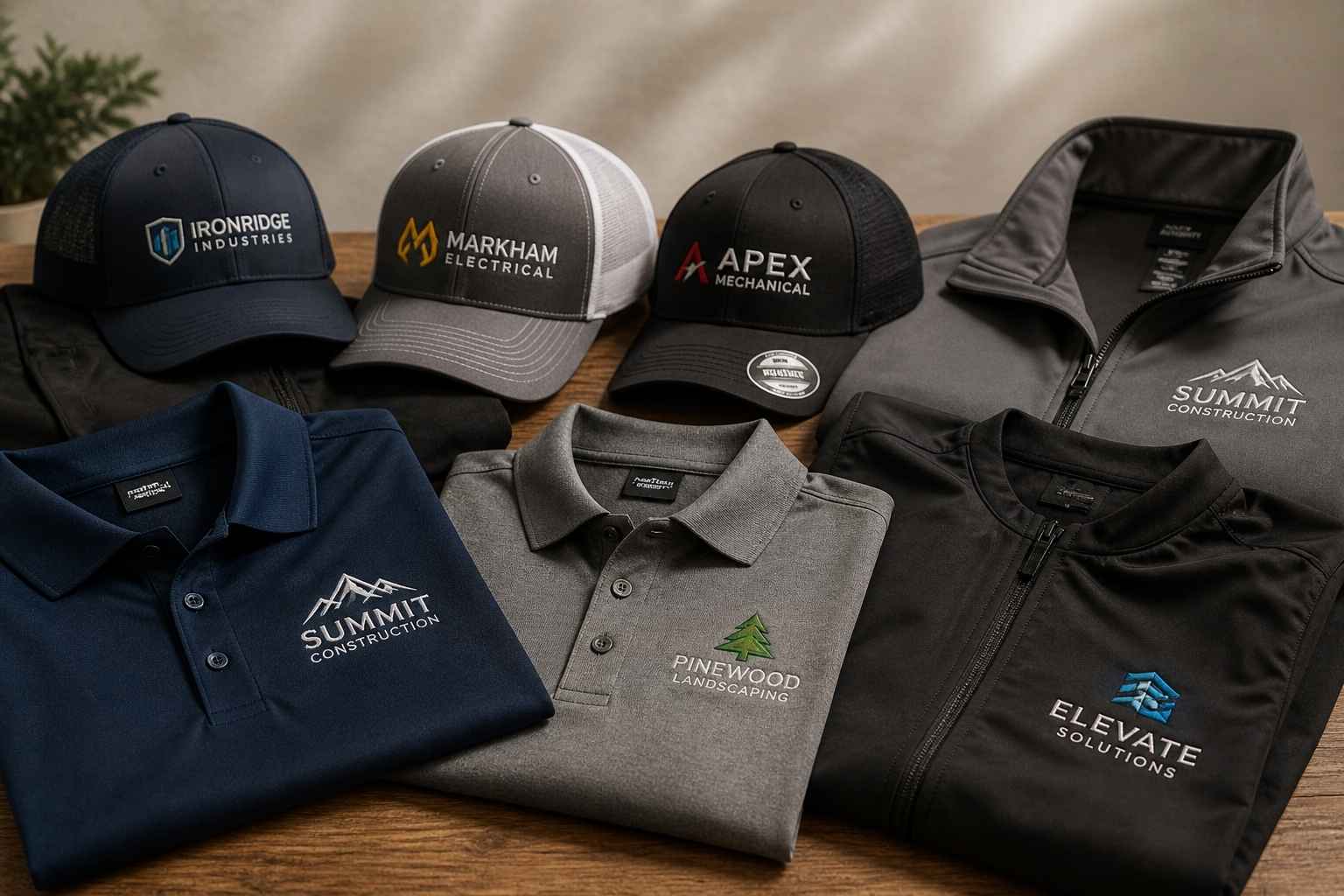
Your logo is the first thing people see. When it’s stitched onto a uniform, a hat, or a jacket, it either looks sharp and professional or it doesn’t. There’s very little middle ground with embroidery.
The challenge isn’t finding an embroidery company. Type “custom embroidery” into Google and you’ll get thousands of results. The real challenge is knowing which companies actually deliver on thread quality, on digitizing accuracy, on turnaround, and on price transparency.
This guide cuts through the noise. Whether you’re a small business ordering branded polos for the first time, a corporate team sourcing workwear embroidery at scale, a sports organization outfitting a roster, or a startup apparel brand building your first collection, you’ll find a clear, honest breakdown of the best embroidery companies in the USA right now.
We’ve evaluated companies on stitch quality, in-house digitizing capability, pricing models, minimum orders, product range, and customer experience. We’ve also included a pricing guide, a product-type matchmaker, and answers to the questions buyers ask most.
Let’s get into it. Top 10 Best Embroidery Companies in the USA
What Makes an Embroidery Company Stand Out in the USA?
Not all embroidery is created equal. The gap between a great provider and a mediocre one shows up in subtle but consequential ways — thread that bleeds color after two washes, a logo that puckers on a soft polo, or small lettering that turns into an unreadable blur. Here’s what separates the best from the rest.
Stitch Quality and Thread Selection
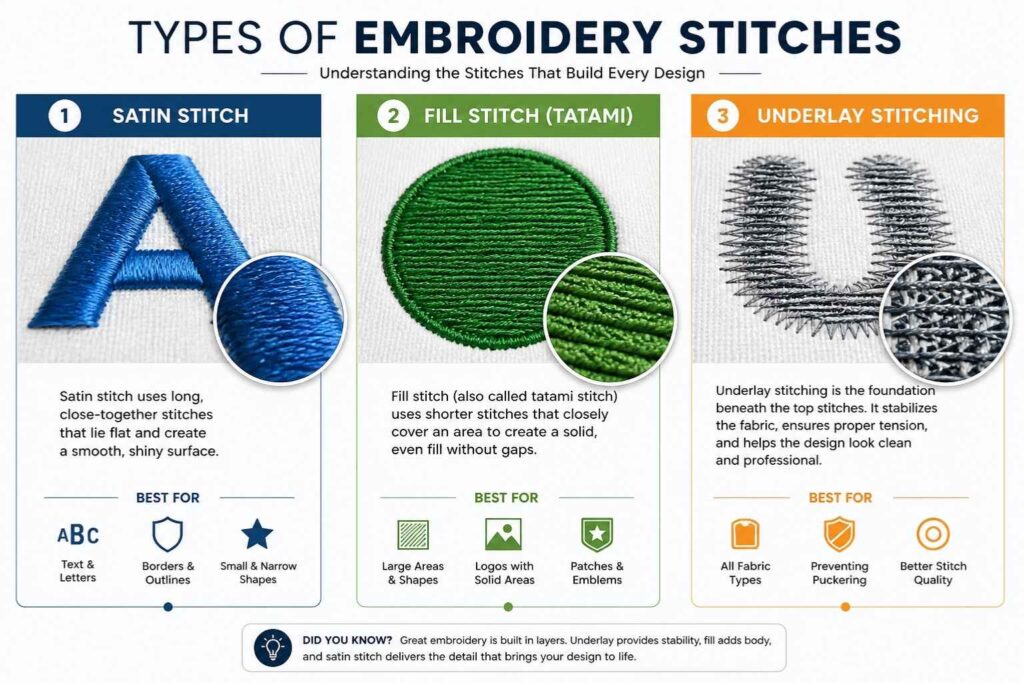
Quality embroidery starts with the fundamentals: the right stitch type for the design, the right thread for the fabric, and precise calibration of the machine.
- Satin stitch is ideal for text, borders, and narrow shapes — it produces a smooth, shiny surface with a professional finish.
- Fill stitch (also called tatami stitch) covers larger design areas evenly without creating a bulky surface.
- Underlay stitching is the invisible foundation stitched beneath the top layer — it stabilizes the fabric and determines how clean the final design looks. Top companies never skip it.
- 3D puff embroidery uses foam inserts beneath the design to create a raised, three-dimensional effect — popular for hat logos and bold brand marks.
- Metallic thread embroidery adds a premium look but requires careful machine calibration to prevent fraying and thread breaks. Only experienced operators handle it well.
Thread tension calibration is equally critical. Poorly calibrated machines produce uneven surfaces, visible bobbin thread on the face of the garment, or stitches that pull the fabric. Elite companies check and adjust tension settings per job.
In-House Digitizing Capability
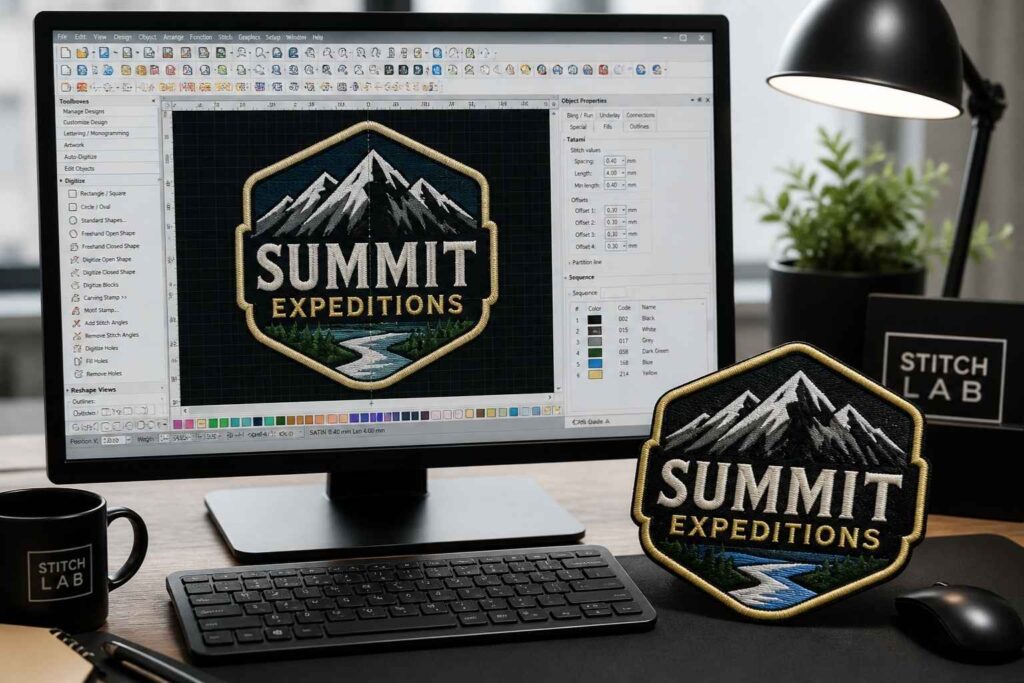
Before any needle touches fabric, your artwork must be converted into a machine-readable stitch file — a process called embroidery digitizing. The output file (typically in DST, PES, or JEF format, depending on the machine brand) contains precise stitch-by-stitch instructions: where each needle falls, the stitch direction, the density, and the color sequence.
Auto-digitizing software can do this quickly, but the results are often poor for logos with fine detail, small text, or complex layering. Manual digitizing — where a skilled operator maps each stitch path by hand — produces significantly better output. It’s slower and more expensive, but the difference on fabric is immediately visible.
When evaluating providers, ask whether digitizing is done in-house or outsourced, and whether it’s manual or automated. Companies with strong in-house digitizing teams tend to produce more consistent, higher-quality results.
If you already have a DST, PES, or JEF file from a previous provider, many companies will accept it directly and waive the digitizing fee.
Turnaround Time and Rush Order Options
Standard turnaround times across the industry range from 10 to 20 business days. Factors that extend timelines include design complexity, large order volumes, and the need for design revisions before approval.
Many companies offer rush embroidery service at an additional fee – typically 20–30% above the standard rate. Some providers can turn around same-day or 24-hour digitizing for urgent projects, though production lead times are harder to compress.
If timing is critical, clarify the full timeline before committing: digitizing, proof approval, production, and shipping are all separate phases, and each one adds time.
Minimum Order Requirements
Minimum order policies vary significantly:
- Some national online providers (like Thread Logic and Stitch America) have no minimum quantity — you can order a single embroidered item.
- Others require 6, 12, or 24 pieces minimum for embroidered apparel.
- Patch specialists like The American Patch also offer no minimum requirements, though bulk pricing makes larger orders considerably more economical.
- Digitizing-only services typically have a minimum charge of $10–$25 per design, regardless of whether you’re producing one piece or one thousand.
For small businesses and startups, no-minimum providers are a major advantage. For corporate or team buyers placing large volume orders, minimum requirements become irrelevant — and bulk pricing discounts become the key factor.
Before diving in, make sure your artwork is production-ready — read our complete guide on How to Prepare Your Logo File for Embroidery to avoid the file mistakes that cause delays, rejections, and costly rework.
Top 10 Best Embroidery Companies in the USA (2025–2026)
Below are the top 10 best embroidery companies in the USA for 2025–2026, selected across quality, turnaround, pricing transparency, and real-world reliability. Whether you’re searching for the best embroidery digitizing companies in the USA or a full-service production partner, this list covers every use case and budget.
Underground Printing — Best Overall for Custom Apparel
Underground Printing earns its spot at the top through a combination of production quality, product range, and customer support that few competitors match.
What sets it apart: Every order is reviewed and produced by real people — no fully automated pipelines. Their in-house design team offers free art assistance, which is a genuine differentiator for buyers who don’t have polished artwork ready to submit. The team can refine logos, adjust stitch paths, and flag potential issues before production begins.
Product range: Extensive — polos, hats, jackets, bags, hoodies, tees, and more. They accommodate both small orders and bulk embroidery orders with consistent results. Top-tier brand options (Nike, Adidas, and others) are available, though pricing reflects the label premium.
Ordering options: Online, in-store, by phone, or via email — more flexibility than most online-only providers.
Best for: Small businesses, corporate events, promotional products, and anyone who values hands-on service over purely transactional ordering.
Pricing note: Premium quality carries a premium price — budget buyers may find better value elsewhere.
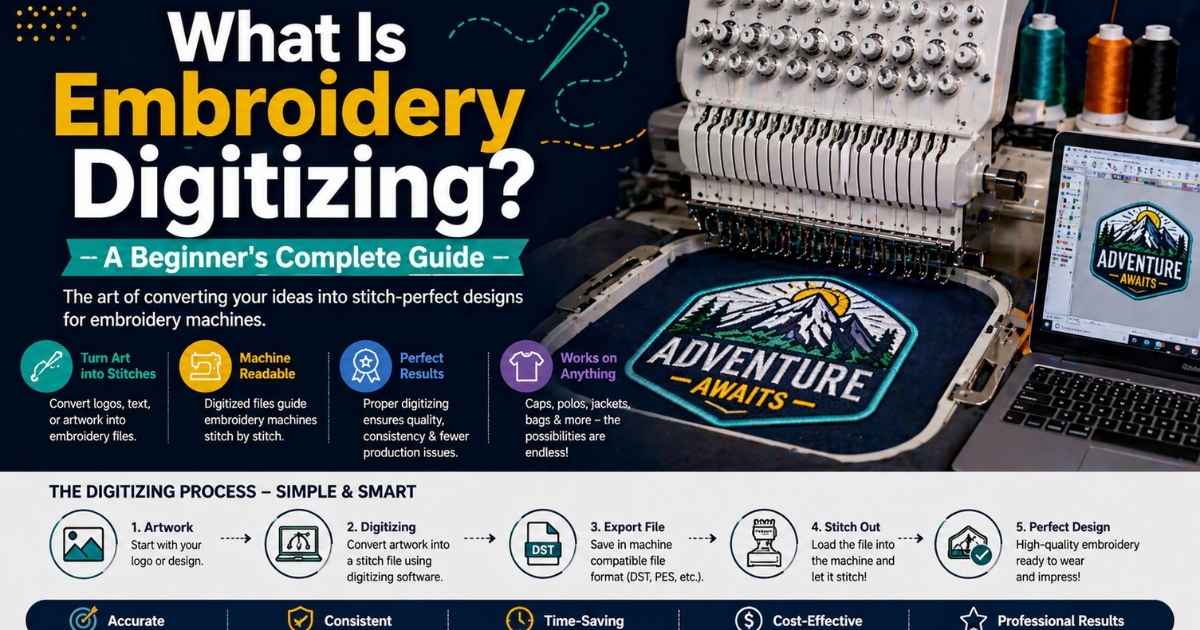
Take a moment to read What Is Embroidery Digitizing? A Beginner’s Complete Guide to get a clear foundation before diving deeper.
Broken Arrow Wear — Best Budget-Friendly Option
For buyers who need quality embroidery without a high price tag, Broken Arrow Wear delivers consistently strong results at competitive pricing.
What sets it apart: Their free online design tool is one of the better DIY tools in the industry — easy to use, with the ability to upload your own artwork or select from a template library. Pricing is transparent, and their per-unit cost on standard left chest logo embroidery competes well with most national providers.
Pricing snapshot: 12 quality polo shirts with standard left chest embroidery runs approximately $18.80 per piece, with free shipping on most orders. That’s one of the most competitive rates in this category.
Limitation: Customer support is limited to business hours — weekend and late-night orders must be placed via email and are handled the next business day.
Best for: Budget-conscious businesses, schools, sports teams, and anyone placing straightforward, mid-volume orders who doesn’t need hand-holding through the process.
Thread Logic — Best Embroidery-Only Specialist
Thread Logic does one thing: embroidery. They don’t offer screen printing, direct-to-garment (DTG) printing, or other customization methods. That singular focus translates into a level of embroidery expertise that generalist providers can’t match.
What sets it apart: Thread Logic is ideal for buyers who already have digitized artwork or a clear vision and just need a reliable production partner. Their catalog of apparel is solid, and their pricing is competitive — especially on bulk embroidery orders where per-unit costs drop meaningfully.
Limitation: No design assistance or templates. If you don’t have artwork ready or need creative input, this isn’t the right starting point. Shipping costs are also separate and can add up for smaller orders.
Best for: Experienced buyers, repeat corporate clients, and businesses sourcing workwear embroidery at volume who have their files dialed in and want consistent, high-quality output every time.
Stitch America — Best for Corporate Branding
Stitch America positions itself as a full-service, quality-first embroidery provider with a particular strength in corporate branding applications.
What sets it apart: Their process is highly managed — every order goes through a proof review before production begins, and they control the full workflow from digitizing to packaging in-house. This end-to-end control keeps quality consistent across large batches, which matters enormously for companies ordering corporate uniforms or branded merchandise for hundreds of employees.
Their product selection is extensive — shirts, hats, bags, outerwear, and accessories — and they offer graphic design services for clients who need logo development alongside production.
Best for: Mid-to-large businesses, franchises, nonprofits, and organizations that prioritize brand consistency and need a provider capable of managing complex, multi-item orders reliably.
Embroidery Your Way — Best for Customer-Supplied Items
Most embroidery companies work from their own product catalog. Embroidery Your Way does something rare: they welcome customer-supplied garments for embroidery.
What sets it apart: If you’ve already purchased garments — perhaps a preferred brand not carried by standard suppliers, a limited-edition item, or existing uniform stock — Embroidery Your Way will embroider them. This is a significant advantage for niche use cases that other providers simply can’t accommodate.
They also carry their own product range for buyers who prefer to order through them, and their digitizing capability handles standard and complex designs well.
Limitation: There’s a $25 art services fee if you need custom design work. Sales tax applies to customer-supplied garment orders.
Best for: Clients with specific garments in mind, fashion brands, boutique businesses, or anyone with existing inventory they want customized.
Corporate Casuals — Best for Bulk Polo Orders
As the name implies, Corporate Casuals specializes in corporate and business apparel — and their polo selection is among the strongest in the category.
What sets it apart: Free shipping on most orders is a meaningful perk for bulk buyers, and their embroidery quality on polo shirts in particular is excellent. Thread colors are well-matched, stitch density is consistent, and the finished product holds up well through commercial washing.
Pricing note: A $35 setup fee applies when uploading custom designs for the first time. For repeat orders using the same file, this cost disappears. Plan accordingly if you’re budgeting a one-time small order.
Best for: Businesses ordering branded polos and corporate casualwear at volume, particularly those placing repeat orders where the setup fee amortizes quickly.
CustomInk — Best for Group and Team Orders
CustomInk built its reputation on group ordering — school events, sports teams, corporate retreats, family reunions, and fundraisers. Their platform is specifically engineered for the collaborative process of getting a diverse group of people to agree on a design and place a single order.
What sets it apart: Their online design lab is one of the most polished in the industry. The platform supports group ordering workflows, including shared design links, size collection tools, and split-payment options. Customer service is well-rated, and they offer a quality guarantee.
Limitation: Like Embroidery Your Way, exact pricing requires legwork — the platform is designed around the design and quote process rather than transparent upfront pricing. Screen printing and promotional products are available alongside embroidery.
Best for: Event organizers, coaches, HR teams, club administrators, and anyone managing an order across a large, diverse group.
Queensboro Embroidery — Best Product Variety
Queensboro has one of the broadest product catalogs in the industry. If it can be embroidered, there’s a reasonable chance Queensboro carries it.
What sets it apart: Their catalog spans apparel (shirts, polos, outerwear, hats), bags, and accessories, and they offer both embroidery and screen printing across the range. Graphic design services are available for clients who need help creating or refining their logo. Thread color selection is wide, and their digitizing process is thorough.
Best for: Buyers who need a single supplier for a wide range of embroidered items — businesses running loyalty programs, schools managing multiple uniform types, or promotional products buyers who want variety without managing multiple vendors.
The American Patch — Best for Custom Embroidered Patches
For organizations that need embroidered patches — military units, police departments, sports teams, brands, scouts, or workwear manufacturers — The American Patch is a specialist worth knowing.
What sets it apart: No minimum order requirement is a genuine differentiator in the patch space. Their pricing is transparent and determined by five clear factors: size, embroidery coverage (50%, 75%, or 100%), backing/material type (Velcro, adhesive, iron-on, sew-on), border type, and quantity.
They work with both standard embroidered patches (thick thread over twill, giving that classic raised 3D feel) and woven patches (flat, smooth, better for complex designs and small text). Backing options are wide, and their quality is consistently cited in customer reviews.
Best for: Military, law enforcement, sports teams, fashion brands, uniform manufacturers, and anyone needing custom embroidered patches with no minimum friction.
Fimmy Apparel — Best for Startups and Full-Service Digitizing
Fimmy Apparel takes a vertical integration approach that’s particularly well-suited to startups and emerging apparel brands: they combine garment manufacturing with an in-house embroidery and digitizing division.
What sets it apart: For a new brand, this matters enormously. Rather than managing separate vendors for production and decoration, Fimmy handles both — meaning the digitizing decisions are made with direct knowledge of how the design will behave on specific fabrics and constructions. That integrated workflow eliminates a common failure point where a digitized file performs well in theory but poorly on the actual garment.
They also offer raster to vector conversion for founders working from hand-drawn logos or low-resolution assets, and their team provides consultation on design sizing, stitch type, and placement before committing to production.
Best for: Startups, DTC brands, fashion entrepreneurs, and small-batch producers who need a single expert partner to manage the full journey from concept to finished product.
How to Choose the Right Embroidery Company for Your Needs
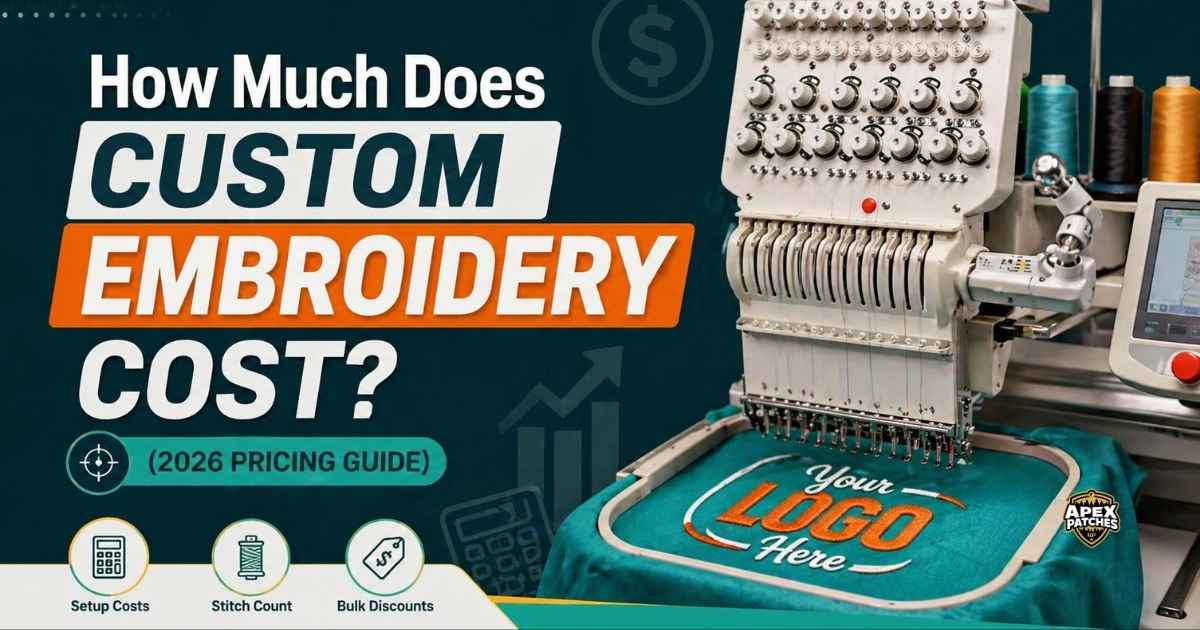
With so many options out there, picking the right embroidery company can feel overwhelming. Before you move ahead, it’s worth understanding how pricing actually works in embroidery. Check out How Much Does Custom Embroidery Cost? (2026 Pricing Guide) to get a clear idea of what impacts the cost.
Small Business vs. Bulk Corporate Orders
If you’re a small business ordering 6–24 pieces at a time, your priorities are different from a company ordering 500 uniforms per quarter.
For small businesses:
- Look for no-minimum or low-minimum providers.
- Prioritize companies with free or low-cost digitizing on first orders.
- Free art assistance (like Underground Printing offers) saves money if your logo needs prep work.
- Total cost including shipping matters more than per-unit price at small quantities.
For bulk corporate buyers:
- Per-unit price at volume is the key metric — small differences multiply quickly across large orders.
- Consistent repeat quality matters more than one-off samples. Ask about quality control processes.
- Turnaround reliability across multiple batches is critical for companies running ongoing uniform programs.
- Account management and invoice/billing processes matter at scale.
Local Shop vs. National Online Provider
Both have legitimate advantages.
Local embroidery shops:
- Faster turnaround for rush needs — no shipping time.
- In-person proofing and design consultations.
- Better for custom or complex jobs that benefit from direct communication.
- Often willing to accommodate unusual requests or customer-supplied items.
National online providers:
- Typically more competitive pricing due to volume and automation.
- Broader product catalogs.
- Easier repeat ordering and online account management.
- Better for standardized, repeatable orders where you don’t need hand-holding.
The right answer depends on your order complexity, timeline, and how much value you place on direct human interaction versus convenience.
Questions to Ask Before Placing an Order
Before committing to any provider, get clear answers to these:
- Is digitizing included in the price, or is it a separate fee? Is it a one-time fee or per-order?
- Will I receive a proof before production starts? How many revisions are included?
- What is the actual turnaround time — from order to ship date?
- Do you accept customer-supplied garments?
- What file formats do you accept, and can I reuse my file for future orders?
- What is your policy if I’m not satisfied with the finished product?
- What are your shipping costs and carrier options?
Getting written confirmation on these points before ordering eliminates the most common sources of post-order frustration. explore our roundup of the Best Custom Embroidered Hat Companies in the US to compare quality, pricing, and turnaround times before you place your order.
Embroidery Pricing Guide — What to Expect in 2025–2026
Custom embroidery pricing is layered. Most buyers focus on per-piece cost and miss the fees that stack on top of it. Here’s the full picture.
Per-Stitch vs. Flat-Rate Pricing Models
The US embroidery market has shifted noticeably toward flat-rate digitizing pricing — a cleaner model that’s easier to budget.
Per-stitch pricing: Charges a rate per 1,000 stitches, typically starting at $3.99–$5.00 per thousand, with a minimum charge of $15–$25. A standard left chest logo runs roughly 5,000–8,000 stitches, putting digitizing at $20–$40. Larger designs like jacket back digitizing can reach 30,000–50,000+ stitches, with corresponding costs.
Flat-rate pricing: Companies like Broken Arrow and others charge a fixed fee per design regardless of stitch count — typically $10–$25 for most standard logos. This simplifies budgeting significantly and is generally better value for complex designs.
For production (the actual embroidery on garment):
- Standard left chest logo (6–12 pieces): approximately $8–$12 per piece above the garment cost.
- At 50+ pieces, per-unit embroidery costs typically drop to $4–$7.
- At 100+ pieces, many providers offer further volume discounts.
Digitizing Fees and Setup Charges
Digitizing is typically a one-time fee — once your file is created and approved, future orders using the same design don’t require re-digitizing. This means the first order carries the highest total cost, and repeat orders become progressively more economical.
Setup fees (sometimes called “tape charges” or “run fees”) are separate from digitizing and typically range from $25–$35 per design. Some providers waive them for repeat orders; others charge them every time.
Additional cost factors:
- Rush digitizing: 24-hour turnaround usually adds 20–30% to the digitizing fee.
- Multiple placements (e.g., left chest + sleeve + back): each placement typically incurs its own digitizing and setup cost.
- 3D puff embroidery and metallic thread work carry premium pricing due to complexity and material cost.
How to Reduce Costs Without Sacrificing Quality
- Simplify your design before digitizing. Removing a fine border, reducing a gradient layer, or increasing minimum text size can drop stitch count by 20–30% without visibly degrading the logo at normal viewing distances.
- Provide clean vector files (AI or EPS). Clear artwork reduces digitizing time and revision cycles. If you’re providing a raster file (PNG or JPG), ensure it’s at minimum 300 DPI with clean edges.
- Consolidate placements. Each placement is a separate cost. If your design looks great in a single left chest position, a second placement on the sleeve may not justify the added expense.
- Order in consistent batches. Spreading orders across multiple small runs is more expensive than batching them. If you know you’ll need more units within 60 days, combine the order.
- Use your approved DST/PES/JEF file. Retaining your digitized file and providing it to new providers avoids paying digitizing fees repeatedly.
People Also Ask — Quick Answers
What Is the Best Embroidery Company for Small Businesses?
How Much Does Custom Embroidery Cost in the USA?
- Garment cost: $10–$18 per shirt (varies by brand and style)
- Digitizing: $10–$35 (one-time fee)
- Setup/tape charge: $25–$35 per design
- Embroidery per piece: $3–$8
- Shipping: $0–$30 depending on provider
What Is the Minimum Order for Custom Embroidery?
- No minimum: Thread Logic, Stitch America, The American Patch, and several digitizing specialists.
- 6-piece minimum: Some boutique and local providers
- 12-piece minimum: Common for screen printing add-ons and some bulk apparel providers.
- For patches specifically: The American Patch has no minimum, though bulk pricing incentivizes larger orders.
How Long Does Custom Embroidery Take to Deliver?
- Standard turnaround: 10–20 business days from order to delivery.
- Rush orders: Many providers can compress production to 5–7 business days at an added cost.
- Digitizing only: 24–48 hours is standard; same-day is available at premium pricing.
Can I Send My Own Clothing to Be Embroidered?
What File Format Do Embroidery Companies Require?
Embroidery by Product Type — Which Company Is Best?
Best for Hats & Caps
Cap embroidery is technically demanding. The curved surface creates alignment challenges that flat garments don’t have — stitch angles must account for the curve, and density must be managed carefully to prevent the fabric from distorting or the logo from shifting.
Best picks:
- Underground Printing for full-service cap orders with design assistance.
- Broken Arrow Wear for budget cap embroidery with solid quality.
- Stitch America for corporate hat programs requiring consistent batch quality.
Ensure your provider uses proper cap digitizing (not flat-garment digitizing applied to a cap) — the difference in final quality is visible.
Best for Polos & Workwear Uniforms
Left chest logo embroidery on polo shirts is the most common embroidery application in the corporate world, and most major providers handle it well. The differentiators are garment brand selection, per-unit pricing at volume, and consistency across repeat orders.
Best picks:
- Corporate Casuals for polo-specific bulk orders with free shipping.
- Thread Logic for large volume repeat orders with a dialed-in file.
- CustomInk for team and group orders where the platform’s group ordering features add value.
- SanMar as a wholesale supplier for distributors and decorators needing blank apparel alongside embroidery — a key player in the supply chain worth knowing.
Best for Jackets & Outerwear (Jacket Back Digitizing)
Jacket back embroidery involves large design areas on heavier, structured fabrics. Stitch density must be managed carefully — too dense and the fabric buckles; too light and the design looks thin. Underlay stitching is critical on outerwear, and the digitizing file must be specifically built for the fabric weight and construction.
Best picks:
- Underground Printing for high-quality execution on premium outerwear brands.
- Stitch America for consistent quality on corporate jacket programs.
- Fimmy Apparel for startups that need jacket back digitizing integrated with manufacturing.
When briefing your provider on jacket back work, specify the exact garment style, fabric composition, and whether the back has seams or panels that the design must work around.
Best for Bags, Patches & Accessories
Bags, totes, and accessories have their own embroidery challenges — variable fabric weights, handles and hardware that create clearance issues, and structured shapes that require specific hooping.
Best picks:
- The American Patch for all patch work, no minimum, wide backing options.
- Queensboro Embroidery for a broad range of embroidered bags and accessories.
- Embroidery Your Way if you’ve already sourced the bag and need it decorated.
Embroidered tote bags in particular have seen strong demand growth — if you’re building a branded merchandise line, this is an increasingly popular premium item worth including.
USA-Made vs. Offshore Embroidery — Pros and Cons
Quality Control Benefits of Domestic Production
When embroidery is produced domestically, the full workflow — digitizing, sample review, production, quality inspection, and shipping — happens under one operational system and legal framework. That means:
- Consistent machine calibration standards.
- Clear accountability when something goes wrong.
- The ability to request physical samples before committing to full production runs.
- No customs delays or import quality surprises.
For corporate clients where a single batch of off-spec uniforms can disrupt an entire launch event, the quality control certainty of domestic production is often worth a price premium.
Turnaround and Communication Advantages
Offshore digitizing and embroidery services often advertise attractive pricing, but turnaround windows are longer and communication can be harder to manage across time zones. Revision cycles that take one business day with a domestic provider can stretch to three or four with an international one, particularly if you’re dealing with a language barrier or asynchronous working hours.
For rush embroidery service, domestic is almost always the only viable option — offshore providers simply can’t compress shipping timelines.
When Offshore Services Make Sense
Offshore embroidery makes sense in specific scenarios:
- High-volume, standardized orders where the design is finalized, the file is approved, and you’re simply scaling production. Price advantages are real at large volumes.
- Patch manufacturing at high quantities — offshore patch factories often produce at significantly lower per-unit cost for simple, repeatable designs with long lead times.
- Digitizing only — several offshore digitizing services produce excellent quality stitch files at $10–$15 flat rates, often with 24-hour turnaround. Using an offshore digitizing partner while keeping physical production domestic is a practical middle ground many experienced buyers use.
Sustainability and Ethical Sourcing in USA Embroidery
Eco-Friendly Threads and Organic Fabric Options
Environmental standards in the apparel industry have risen considerably, and embroidery is not exempt from that pressure. Several forward-looking providers now offer:
- Recycled polyester threads made from post-consumer plastic waste, with comparable performance to virgin polyester.
- Organic cotton blanks certified under GOTS (Global Organic Textile Standard) — the preferred base for eco-conscious branded merchandise.
- PVC-free backing materials for embroidered patches, replacing standard plastic backings with more sustainable alternatives.
If sustainability matters to your brand — particularly for B2B buyers pitching to ESG-conscious clients or nonprofits with ethical sourcing commitments — ask providers directly about their thread sourcing and blank garment supply chain. Not every company publicizes this prominently, but many will accommodate specific requests.
Fair Labor Association (FLA) Accredited Suppliers
SanMar, one of the largest wholesale blank apparel suppliers in the USA and a key upstream partner for many embroidery companies, is an accredited participating company of the Fair Labor Association and a member of the Sustainable Apparel Coalition. Their products are worn by Fortune 500 companies, schools, local governments, and community organizations.
When your embroidery provider sources blank garments from FLA-accredited suppliers, it extends ethical sourcing assurance through your supply chain — not just to the decoration step, but to the garment itself.
For organizations with procurement policies that require ethical sourcing documentation, asking your embroidery provider which blank apparel brands they work with — and confirming those brands carry FLA or similar accreditation — is the right due diligence step.
Summary: Finding Your Best Fit
The best embroidery company in the USA isn’t a single answer. It depends entirely on what you’re making, how much of it, and what matters most to you.
Here’s the quick-reference breakdown:
| Use Case | Best Pick |
|---|---|
| Best overall | Underground Printing |
| Best budget option | Broken Arrow Wear |
| Best embroidery specialist | Thread Logic |
| Best for corporate branding | Stitch America |
| Best for customer-supplied items | Embroidery Your Way |
| Best for bulk polos | Corporate Casuals |
| Best for group/team orders | CustomInk |
| Best product variety | Queensboro Embroidery |
| Best for patches | The American Patch |
| Best for startups | Fimmy Apparel |
Whatever provider you choose, go in prepared: have clean artwork ready (vector preferred), know your quantities, confirm digitizing and setup fees upfront, and always review a digital proof before approving production. Those four steps alone will eliminate the vast majority of problems buyers encounter.
Custom embroidery, done right, turns a plain garment into a branded asset that lasts. The companies on this list know how to do it right.
Pingback: Embroidered vs Woven Patches: Guide to Choosing the Right One - Apex Patches