

You’ve picked your garment, finalized your logo, and now you’re staring at a supplier quote wondering: is this price actually fair?
Custom embroidery cost trips up buyers — not because it’s unreasonably expensive, but because the pricing is layered. Stitch counts, digitizing fees, hooping fees, thread color surcharges… each one quietly inflates the total if you don’t know what to look for.
This guide breaks down every pricing factor clearly and completely — from embroidery pricing models and digitizing fees to item-by-item cost benchmarks and the hidden charges most buyers miss entirely.
Whether you’re sourcing custom embroidered shirts for a corporate team, ordering embroidered uniforms for a sports club, or buying embroidered hats wholesale for a brand launch — you’ll leave this page knowing exactly what to pay.
How Much Does Custom Embroidery Cost? (Quick Answer)
Custom embroidery cost typically ranges from $5 to $30 per piece for most standard applications, depending on stitch count, design complexity, garment type, and order quantity.
Here’s a fast reference by order volume:
| Order Size | Embroidery Cost Per Piece |
|---|---|
| 1–5 pieces | $15 – $30 |
| 6–24 pieces | $10 – $20 |
| 25–49 pieces | $8 – $15 |
| 50–99 pieces | $6 – $12 |
| 100+ pieces | $5 – $10 |
Decoration cost only. Assumes a standard left-chest logo up to 5,000 stitches. Blank garment cost is additional.
These are starting benchmarks. Your real quote will be shaped by the six pricing factors covered next. If you want to explore top service providers after understanding the pricing, be sure to check out Best Embroidery Companies in the USA (2025–2026).
6 Factors That Determine Your Embroidery Pricing
Embroidery pricing is not arbitrary — it’s a direct function of time, materials, and complexity. Understanding these six variables gives you full control over your budget.
1. Stitch Count — The Primary Cost Driver
Stitch count is the total number of needle penetrations needed to complete your design. More stitches mean more machine time, which means higher cost.
- Simple text or monogram: ~3,000–5,000 stitches
- Standard logo with fills: ~8,000–12,000 stitches
- Complex multi-color design: ~15,000–25,000 stitches
- Full jacket back design: 25,000–50,000+ stitches
Most shops charge $0.50–$2.00 per 1,000 stitches, or include a base stitch allowance (typically 5,000–10,000) in a flat per-piece rate.
Two logos that look identical in size can have dramatically different stitch counts if one uses heavy filled areas and the other relies on clean outlines. Always ask for a stitch count estimate before approving a quote.
2. Design Complexity and Thread Colors
Thread colors add cost because each color change requires the machine to stop, rethread, and restart.
Most base embroidery pricing includes up to 3–6 thread colors. Beyond that, expect a surcharge of $1–$5 per additional color, per piece.
Design tip: Gradients are nearly impossible to replicate in embroidery — they require dense layered stitching that drives stitch counts sky-high. Simplify them into flat colors to save significantly.
3. Garment Type and Fabric
The item being embroidered affects both technique and cost.
- Polo shirts and t-shirts — standard, straightforward, and most affordable
- Hats and caps — curved surfaces require specialized hooping, adding complexity and time
- Jackets and outerwear (Nike, Patagonia, Columbia) — thick or structured fabrics demand heavier needles, denser stitching, and careful stabilization
- Performance and technical fabrics — stretch materials need specific stabilizers to prevent puckering, increasing labor
The American Apparel & Footwear Association (AAFA) publishes construction guidelines that inform how different fabric types respond to needle work — a useful reference when sourcing specialty garments.
4. Embroidery Placement and Number of Locations
Each embroidery location is quoted and billed separately.
A left-chest logo plus a sleeve name equals two separate decoration charges. Left-chest placement is the most common and most affordable. Adding a second location — right sleeve, back yoke, collar — roughly doubles the per-garment decoration cost.
For corporate embroidery on dress shirts or embroidered uniforms for hospitality staff, keeping placement to a single left-chest logo is the most cost-effective approach.
5. Order Quantity and Volume Discounts
Volume discount tiers are the single biggest lever buyers have on price.
Fixed costs — digitizing, machine setup, and production prep — are spread across every unit in the order. A 100-piece run costs dramatically less per unit than a 10-piece run of the same design.
Pro tip: If you’re planning phased uniform rollouts, consider placing a single larger order upfront. The per-piece savings from a bulk embroidery order almost always outweigh the cost of holding inventory.
6. Turnaround Time and Rush Fees
Rush orders carry a standard 20–30% premium across most suppliers.
Standard production runs 3–7 business days. Same-day or 48-hour delivery costs significantly more and may limit your garment selection. Rush fees are among the most avoidable costs in the entire process — plan ahead and you simply won’t pay them.
Embroidery Pricing Models: Stitch Count vs Flat Rate Embroidery
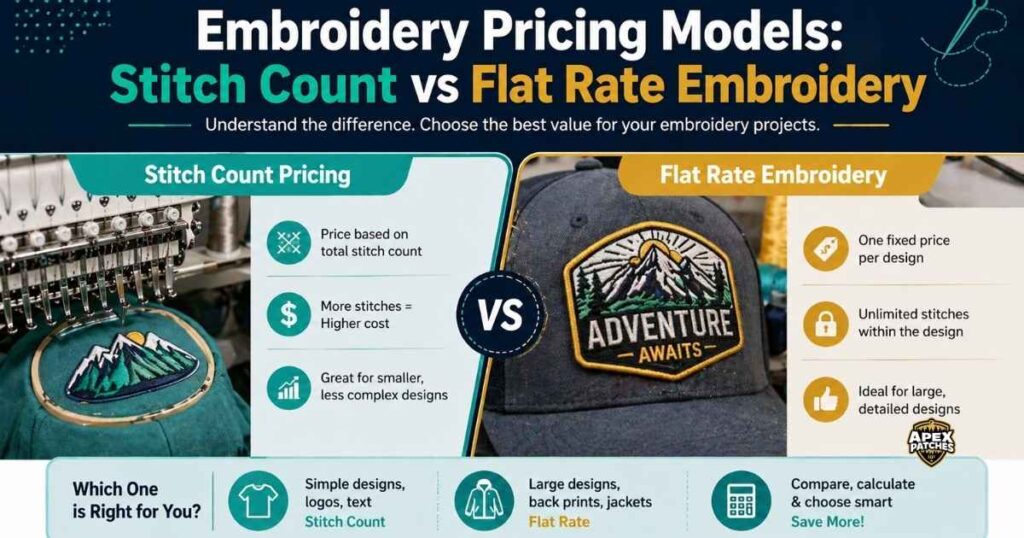
Two pricing models dominate the industry. Understanding both helps you compare quotes accurately and choose the model that works best for your order type.
Stitch Count Pricing
The most widely used model. Your cost is calculated based on how many stitches your design requires, typically quoted as a rate per 1,000 stitches.
Example: A 9,500-stitch logo at $1.00 per 1,000 stitches = $9.50 decoration cost per piece.
This model is transparent and fair for complex designs. The challenge: you need to know your stitch count to compare suppliers accurately — and quotes can vary widely without that number.
Tools like Imprint Next offer online design platforms that automatically calculate stitch count based on your artwork, making this model far easier to work with than it used to be.
Flat Rate Embroidery
A fixed decoration cost per piece, regardless of stitch count (up to a defined maximum). Flat rate embroidery is simpler, more predictable, and easier for buyers to budget.
The trade-off: suppliers set the flat rate to be profitable across all design types, so simple logos can end up slightly overpriced compared to stitch count pricing.
Some shops embed logo embroidery cost directly into the garment price. This looks like a single clean number but makes cross-supplier comparison nearly impossible. Always ask: “What is the decoration cost separately from the blank garment cost?”
Which Pricing Model Should You Choose?
- Stitch count pricing — best for complex, one-of-a-kind, or highly detailed designs
- Flat rate embroidery — best for standard logos on repeat bulk orders
- Hybrid model — flat rate up to a stitch cap, with overage charges beyond it. Increasingly common and often the most balanced option
What Is a Digitizing Fee for Embroidery?
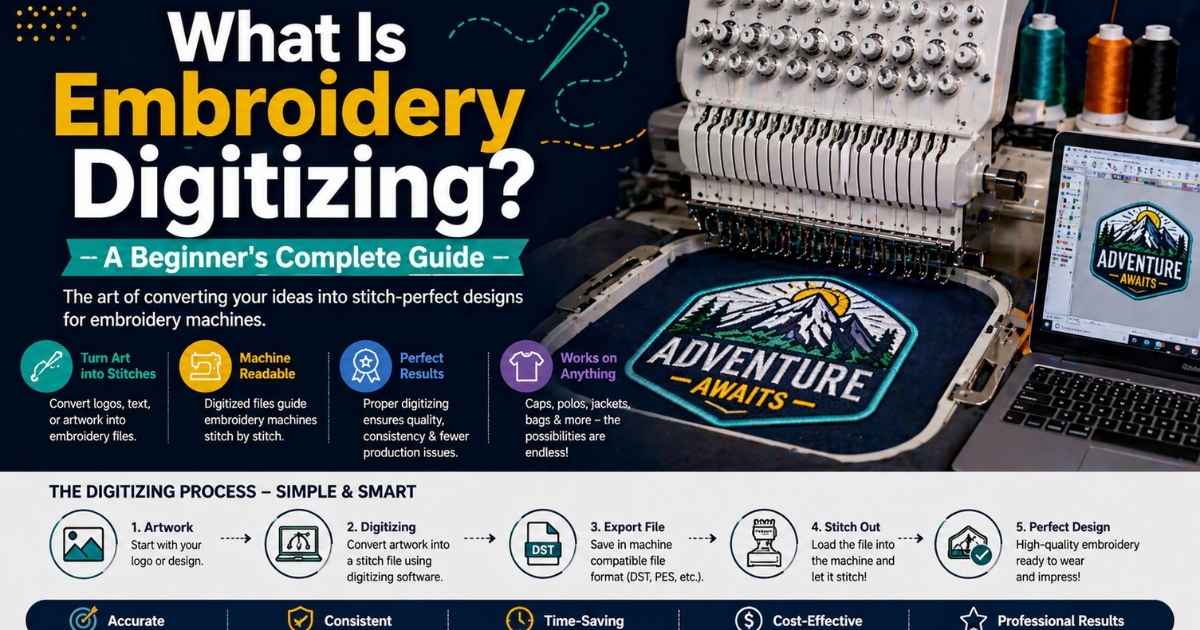
A digitizing fee is a one-time charge to convert your logo or artwork into a machine-readable stitch file — the instruction set that tells the embroidery machine exactly how to sew your design.
Common stitch file formats include DST, PES, JEF, and EXP, depending on the machine manufacturer. Professional embroidery digitizing service providers work with all major formats.
High-end machines from Brother, Tajima, and Bernina all require properly formatted DST files to run. Even with modern digitizing software, the process requires skilled human input — stitch direction, density, underlay, and sequence must all be manually mapped for quality results.
Typical Digitizing Costs in 2026
| Design Complexity | Digitizing Fee |
|---|---|
| Text / simple monogram | $20 – $40 |
| Standard logo | $40 – $75 |
| Complex multi-element design | $75 – $150+ |
The critical point: digitizing is a one-time cost. Once your DST file exists, you use it on every future order — from any supplier — at zero additional cost.
When “Free Digitizing” Isn’t Actually Free
Many suppliers advertise free digitizing as a selling point. In almost every case, that cost is absorbed into a higher per-unit price or enforced minimum order quantity.
That’s not inherently dishonest — but if you plan to reorder regularly across multiple suppliers, owning a paid, properly digitized file will save you money over time. A cheaply digitized file also tends to produce inconsistent stitch quality, which compounds across large orders.
Custom Embroidery Cost by Item Type
The item you’re embroidering on has a significant impact on your final price. Here are realistic cost benchmarks for the most common applications.
How Much Does It Cost to Embroider a Hat?
Custom embroidered hats cost between $10 and $25 per unit, including the blank, at typical order volumes.
Hats are the single most popular embroidered product — and the curved surface requires specialized hooping equipment that adds a small premium over flat garments.
- Decoration cost: $4–$8 per hat
- Blank hat (e.g. Richardson 112 trucker, structured snapback): $5–$15 wholesale
- Finished cost: $10–$25 each at standard quantities; lower embroidered hats wholesale
3D puff embroidery — where foam underneath the thread creates a raised, three-dimensional effect — is highly popular on structured caps. It adds 15–25% to the decoration cost but significantly elevates the perceived quality of the finished product.
For unstructured or flexible hats like beanies, standard flat embroidery is recommended — 3D puff doesn’t hold its shape well on soft crowns.
Custom Embroidered Shirts: Cost in Bulk
Custom embroidered shirts cost $15–$30 per unit all-in for standard bulk orders — and that price drops meaningfully at higher quantities.
This is the most common application for embroidered workwear, staff uniforms, and corporate embroidery programs.
- Decoration cost: $5–$10 per shirt
- Blank polo (Port Authority, Gildan): $8–$20 wholesale
- Finished custom logo apparel: $15–$30 total; under $18 at 100+ pieces
For orders of 50–100+ custom embroidered shirts, the per-piece cost including garment typically drops into the $15–$22 range — a significant saving versus small-run pricing.
Jackets and Outerwear: $20–$45+ per Piece
Higher-end brands like Nike, Patagonia, and Columbia are popular choices for premium corporate gifting and executive uniforms. Expect to pay more for both the blank and the decoration.
Thick or structured outerwear materials require heavy-duty needles, specialized stabilizers, and lower machine speeds — all of which add to the embroidery per piece cost.
Embroidery is strongly preferred over printing for jackets. Ink-based methods like DTF and screen printing don’t adhere reliably to structured outerwear — embroidery is the professional standard.
Bags, Towels, and Accessories
- Tote bags and backpacks: $8–$18 per item decorated
- Towels and robes: $5–$15, depending on terry pile density
- Beanies: $8–$15 per unit
- Aprons: $7–$12 per piece
Accessories often carry different minimums than apparel — confirm before ordering.
Custom Patches Cost
Custom embroidered patches cost $1–$5 each in standard bulk quantities (50+), making them one of the most cost-efficient branding options available.
They’re produced separately and either sewn on or iron-applied. For organizations that rotate uniforms or need portability across garment styles, patches are an excellent alternative to direct embroidery.
Screen Printing vs Embroidery: Which Costs Less?
Is embroidery more expensive than screen printing? Yes — per piece, embroidery typically costs more. But cost per piece is only part of the story.
| Factor | Embroidery | Screen Printing |
|---|---|---|
| Best application | Logos, uniforms, hats, structured garments | Large graphic tees, event shirts |
| Durability | 50–100+ wash cycles | 30–50 washes before cracking or fading |
| Cost per piece | $5–$30 | $3–$10 |
| Setup cost | $20–$75 (one-time digitizing) | $25–$50 per color screen |
| Thread/ink colors | Up to ~12 practical | Up to 4–6 practical |
| 3D texture | Yes (standard and 3D puff) | No |
| Works on hats | Yes | No (not reliably) |
| Works on jackets | Yes | Poor adhesion |
When Embroidery Is the Right Choice
- Embroidered uniforms for daily use — durability dramatically reduces replacement cost over time
- Corporate embroidery on structured garments — polo shirts, dress shirts, outerwear
- Embroidered hats — no other method holds up on curved surfaces
- Premium brand perception — embroidery signals quality in a way printing cannot replicate
When Screen Printing Makes More Financial Sense
- Large, colorful, full-front graphic designs — embroidery can’t replicate photorealistic imagery
- High-volume event t-shirt runs — printing is faster and cheaper at scale for simple garments
- Budget-constrained one-off projects where long-term durability isn’t a requirement
For most business applications — particularly embroidered workwear and branded uniforms worn repeatedly — embroidery delivers a better cost-per-wear ROI than printing, even at a higher upfront price.
Why Is Embroidery So Expensive? (The Real Answer)
Embroidery costs more than other decoration methods because it is fundamentally a slower, more precise, and more materials-intensive process.
Here’s what you’re actually paying for:
- Machine time — commercial embroidery machines like the Avancé 1501C run at high speed but still require minutes per item. A 12,000-stitch logo on a jacket takes 6–10 minutes of uninterrupted machine time per piece.
- Skilled setup — each order requires hooping, tension calibration, and design verification before production begins
- Thread and materials — commercial polyester and rayon thread, stabilizer backing, and topping (for 3D puff) are consumed per item
- Digitizing labor — the one-time cost of converting your artwork into a production-ready DST file is a skilled service, not automation
- Hooping labor — physically securing each garment in the hoop frame (the hooping fee) takes time on every single piece
The result is a decoration method that outlasts the garment itself. When you calculate cost over the life of a uniform — not just the purchase price — embroidery is often less expensive than alternatives.
How to Reduce Your Custom Embroidery Costs Without Sacrificing Quality
Smart buyers lower their embroidery bill before they ever contact a supplier. These four strategies work every time.
Optimize Your Logo Design for Fewer Stitches
- Replace heavy fill areas with outlined or open designs
- Remove or enlarge fine text below 4–5mm (it requires dense stitching to be legible)
- Limit thread colors to 3 or fewer where brand standards allow
- Eliminate gradients entirely — they force layered fill stitching that multiplies stitch count
A well-optimized logo can reduce stitch count by 20–40%, directly lowering your embroidery per piece cost on every single order you ever place.
Use Volume Discounts Strategically
Commit to larger quantities to unlock volume discount tiers. Moving from a 12-piece order to a 50-piece order commonly cuts per-unit decoration cost by 30–50%.
If your team is growing, place a larger initial order and store the surplus. The savings almost always exceed storage costs.
Own and Reuse Your Digitized Stitch File
Pay for professional digitizing once and keep the DST file. Provide it to every supplier on every future order — this eliminates repeat embroidery setup fees and guarantees stitch consistency across reorders.
Using a professional embroidery digitizing service (rather than accepting a “free” in-house digitize from each supplier) gives you a portable, high-quality file that belongs to your brand permanently.
Limit Embroidery Locations Per Garment
One well-placed left-chest logo almost always looks better than multiple locations — and costs significantly less. Resist the urge to add sleeve logos or back designs unless they genuinely serve the brand.
Hidden Embroidery Fees to Watch Out For
Most invoice surprises in embroidery orders come from fees that weren’t clearly disclosed upfront. Here’s the complete list.
Common Hidden Fees in Embroidery Quotes
- Digitizing fee / embroidery setup fee — sometimes buried, sometimes called a “one-time artwork fee” ($20–$75)
- Hooping fee — a per-item labor charge for securing garments in the hoop frame ($0.50–$2.00 per piece)
- Thread color surcharge — applied beyond the included color count, typically 3–6 colors ($1–$5 per additional color)
- Thread match fee — charged when your brand requires a specific Pantone-matched custom thread
- Rush production fee — 20–30% premium for expedited turnaround
- Small order surcharge — extra cost for orders below the shop’s minimum run (often 6–24 pieces)
- Stitch overage charge — applied when your design exceeds the included stitch count (e.g. $0.35 per 1,000 stitches over 10,000)
- Shipping and handling — sometimes absorbed, sometimes a significant line item on large garment orders
Questions to Ask Every Supplier Before Ordering
- What is the decoration cost separate from the garment cost?
- Is digitizing included, or billed as a separate setup fee?
- What stitch count is included in the base price — and what’s the overage rate?
- Are there color surcharges, and at what threshold?
- Do you charge a hooping fee per item?
- What is your minimum order, and is there a surcharge below it?
- What does rush turnaround cost, and what’s your standard lead time?
Getting written answers to all seven before ordering will eliminate virtually every invoice surprise.
How to Find Reliable Custom Embroidery Near Me vs. Online
Searching for “embroidery near me” gives you speed and the ability to inspect samples in person. Online suppliers give you lower pricing, larger selection, and the ability to compare quotes easily.
Local Embroidery Shops
Best for:
- Rush orders where turnaround time matters more than price
- Complex or sensitive jobs where in-person approvals reduce error risk
- Ongoing relationships that produce consistent quality over time
Online Embroidery Suppliers
Best for:
- Bulk embroidery orders where per-unit cost is the priority
- Standardized logo applications where you can rely on digital proofs
- Brands using an embroidery price calculator to get instant estimates before committing
Many online platforms now offer automated quoting. Tools like Imprint Next power online storefronts for embroidery businesses, allowing real-time price calculations based on stitch count, quantity, and item type — a significant improvement over the traditional quote-request process.
Frequently Asked Questions
How much does it cost to embroider a hat?
What is a digitizing fee for embroidery?
Is embroidery more expensive than screen printing?
How much does embroidery cost per 1,000 stitches?
How much do custom embroidered shirts cost in bulk?
What is the minimum order for custom embroidery?
Why is embroidery so expensive compared to printing?
Summary: What You Should Pay for Custom Embroidery in 2026
Custom embroidery cost in 2026 ranges from $5 to $30 per piece for most standard applications — and that number is highly controllable once you understand the pricing levers.
Here’s the full picture in one place:
- Stitch count drives price more than anything else — optimize your design before you digitize
- Digitizing fee ($20–$75) is one-time — own your DST file and use it forever
- Volume discounts are your biggest savings tool — 50+ pieces unlocks 30–50% lower per-unit cost
- Flat rate embroidery offers simplicity; stitch count pricing offers fairness on complex designs
- 3D puff embroidery adds premium visual impact on hats at a 15–25% cost premium
- Hidden fees (hooping fee, setup fee, color surcharges) are common — always request a full fee breakdown
- Screen printing vs embroidery: printing wins on price, embroidery wins on durability and professionalism
- Embroidered workwear and corporate embroidery programs deliver better ROI than printing over the life of a uniform
Whether you’re ordering custom embroidered shirts for a five-person startup, running a bulk embroidery program for a national retail brand, or searching for a reliable supplier offering embroidery near me — use this guide as your pricing reference and you’ll never overpay again.
Pingback: Embroidered vs Woven Patches: Guide to Choosing the Right One - Apex Patches
Pingback: Why Personalized Gifts Cost More: A Clear Pricing Guide